We were at the end of our visit of the veterinary faculty of Perugia, a town with a long Roman and Etruscan heritage.
Three months of preparations, five days of inspections, interviews, and team meetings plus a final presentation in the main building of this prestiges veterinary school lay behind us, to find out if the course in Perugia was good enough to keep the university’s accreditation as a certified education establishment that met European standards.
Eventually, there was some time to spare for me and my fellow visitors, before we had to head back to Rome, to catch our flights back to our own faculties or places of work.
“Just follow me” said Professora Silvana Diverio, who had looked after us during our stay. “Our agricultural faculty is just a short walk up the hill and I think that you will like it”.
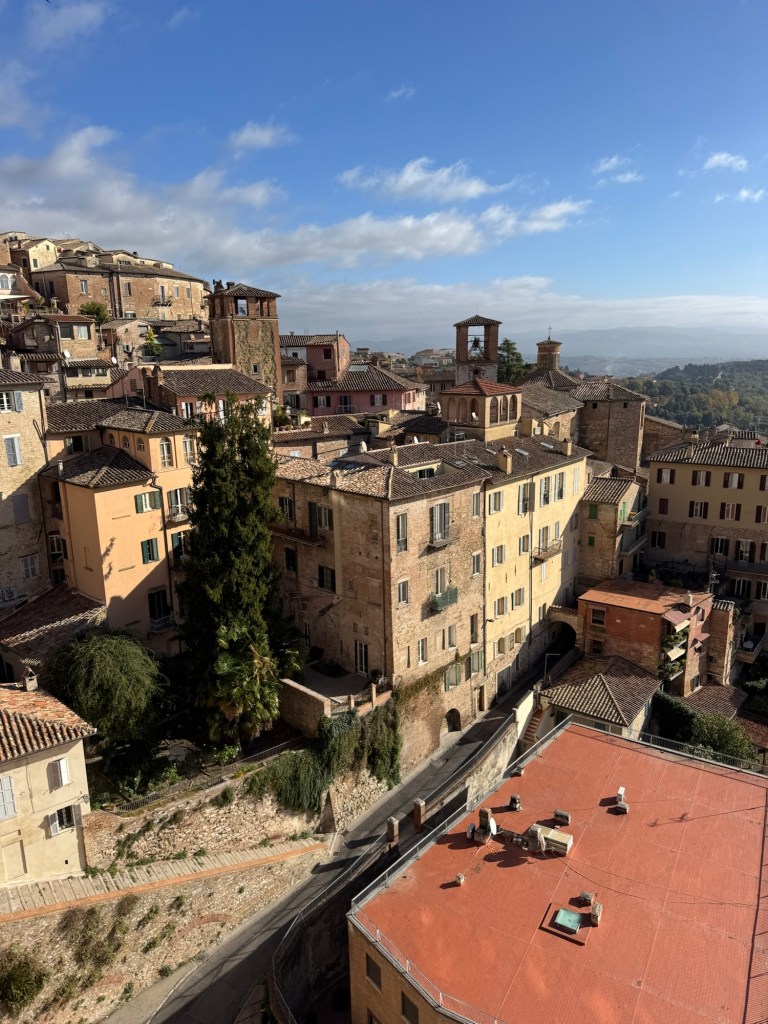
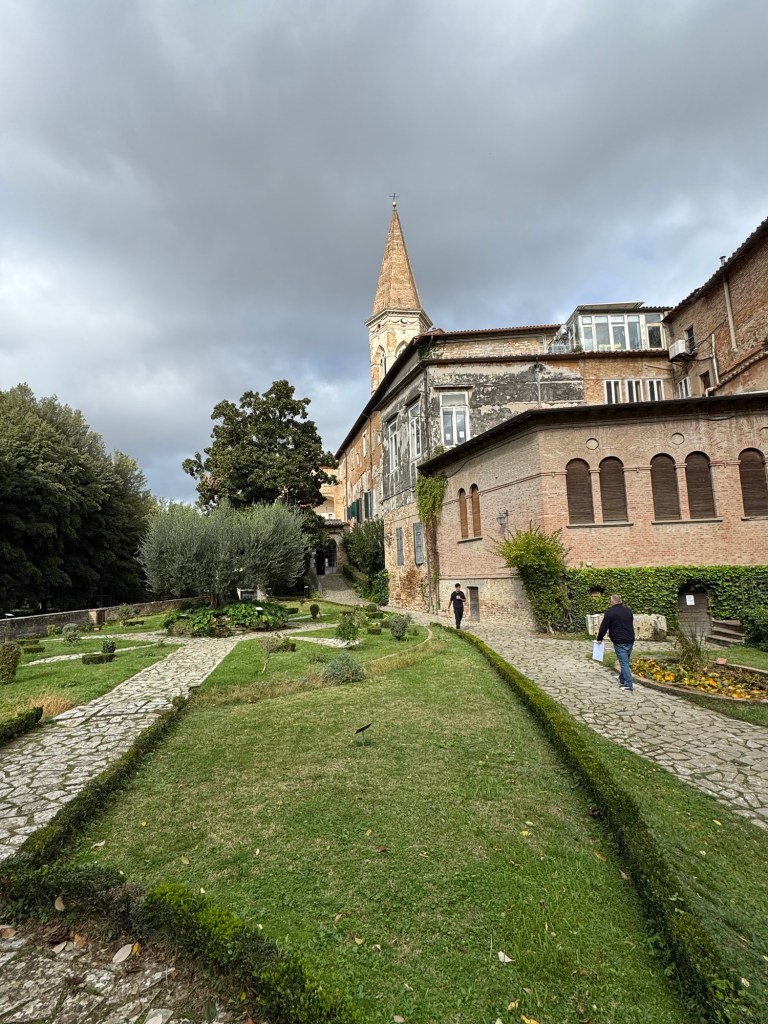
So, with nothing better to do, we followed our host and within a few minutes we found ourselves on the other side of Porta San Costanza and in the middle of Giardini del Frontone, a large public park, which to these days has been a meeting place for poets and novelists.
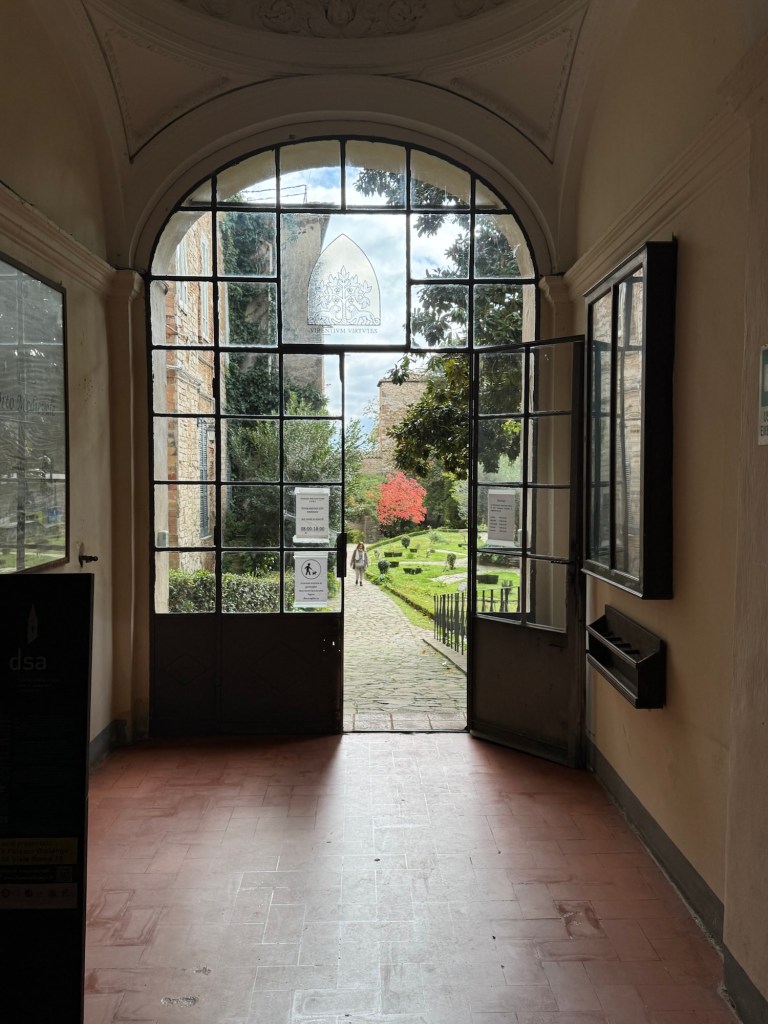
On the other side of Borgo XX Giugno, the agricultural faculty was housed inside the walls of a former Benedictine monastery. Approaching these buildings that looked back on a history of well over a thousand years, each of our steps were keenly followed by the watchful eyes of a resident alchemist who, in a small unheated room on the top of the tower next to the Arco di Braccio, was said to have pursued here his futile ambition to creat gold out of less valuable materials.
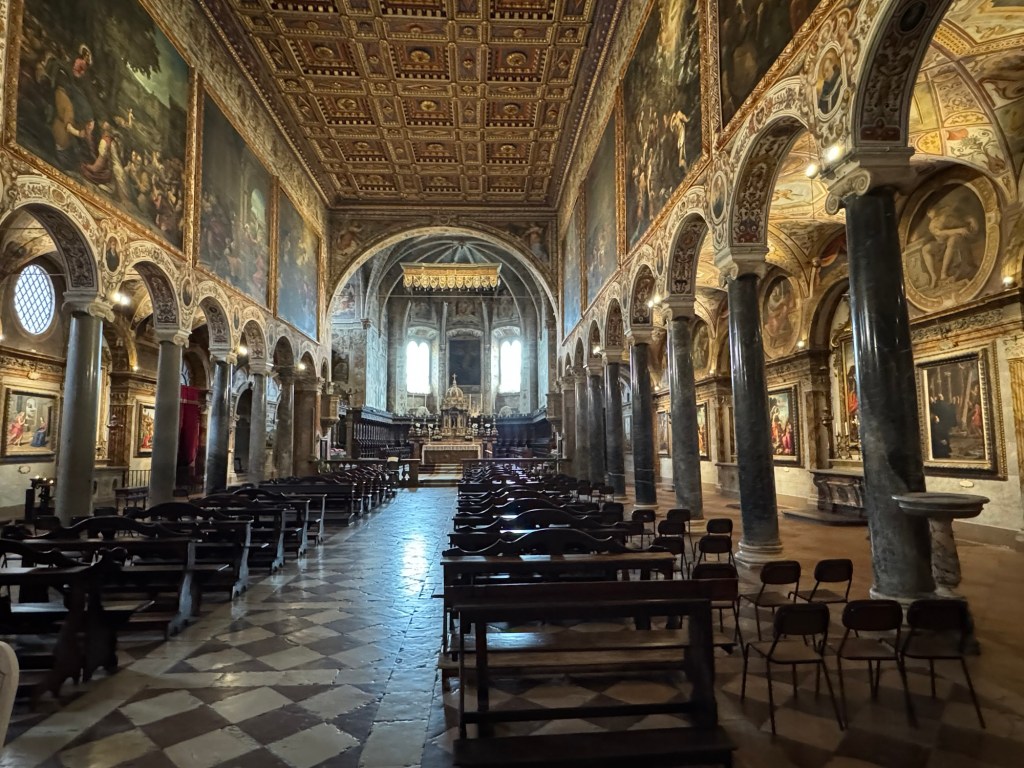
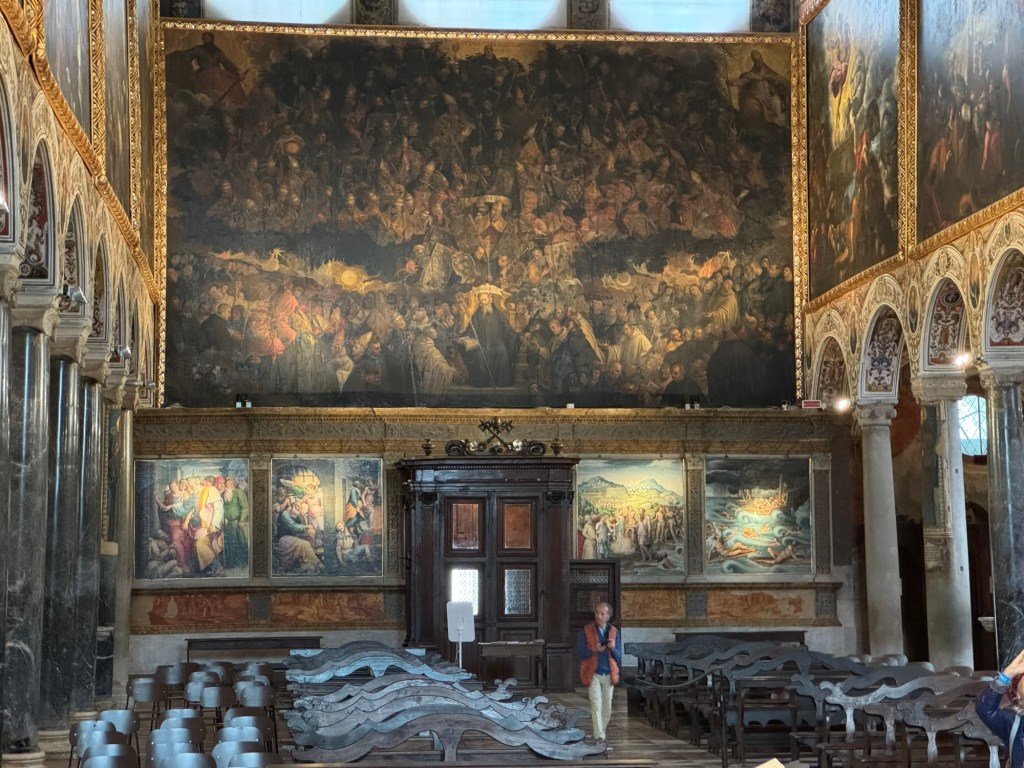
We then entered the Abbey of San Pietro, the striking center piece of the whole monastery and for me – while so unexpected – an absolute revelation.
Richly decorated with depictions of biblical scenes on every part of its walls and ceiling, its sides covered with large paintings, the first impression was overwhelming. And yet, this house of God started to grow on me, not because of its opulence, but because of all the subtile, at times playful, but mostly frightening details.
One of these, on the right side of the nave near the altar, was a smaller painting, showing the destruction of the temple of Dagon by the blinded Samson.
Its vivid colours, the bodies of Philistines hurling through the air (how did they get there ?…) and the panic in the face of a young man fleeing the scene, looked so surreal that it would have gone unnoticed in a Dali retrospective. Considering that the temple of this fishtailed god had been located in Gaza, the theme of this painting could not have been more contemporary.
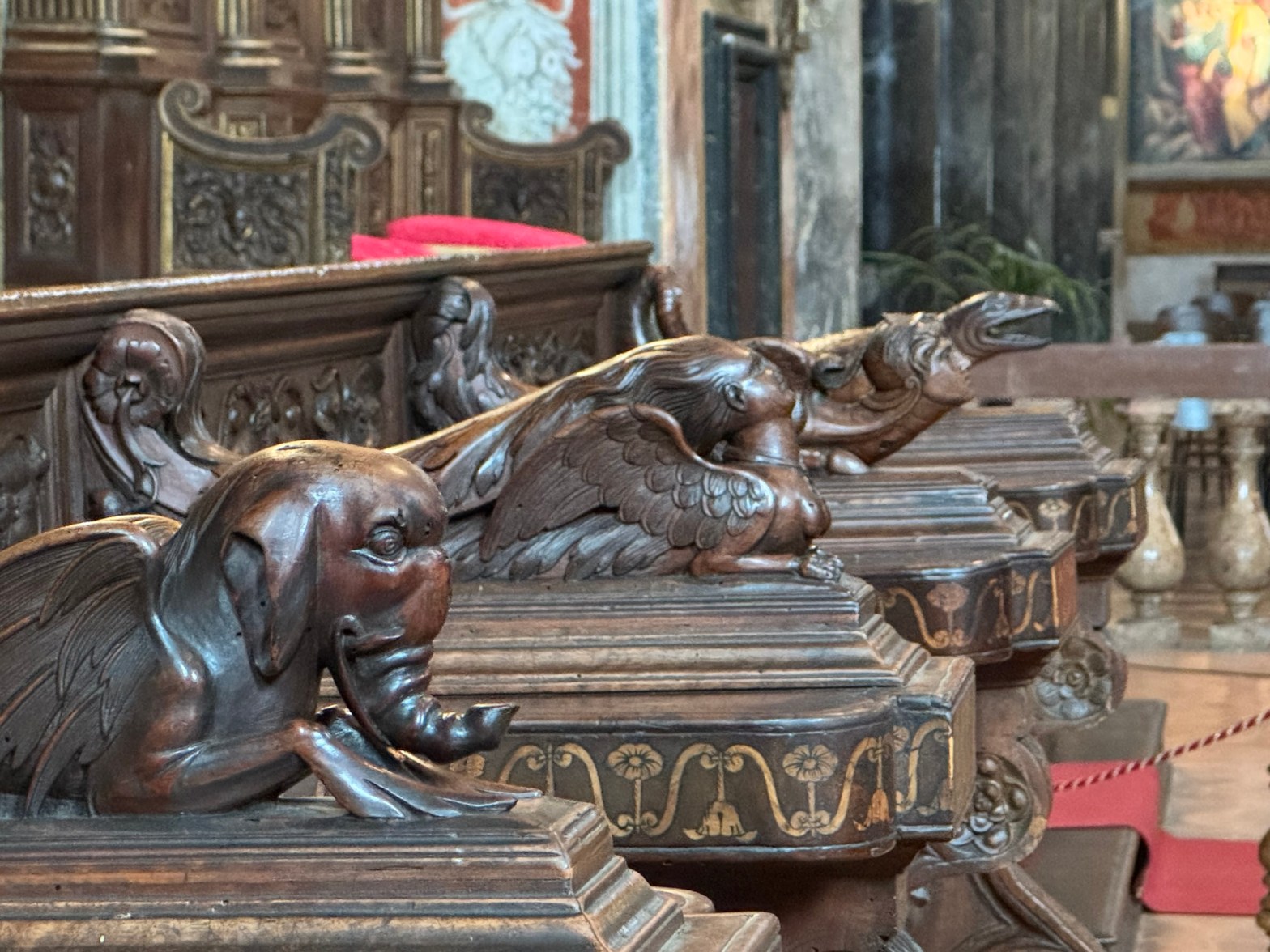
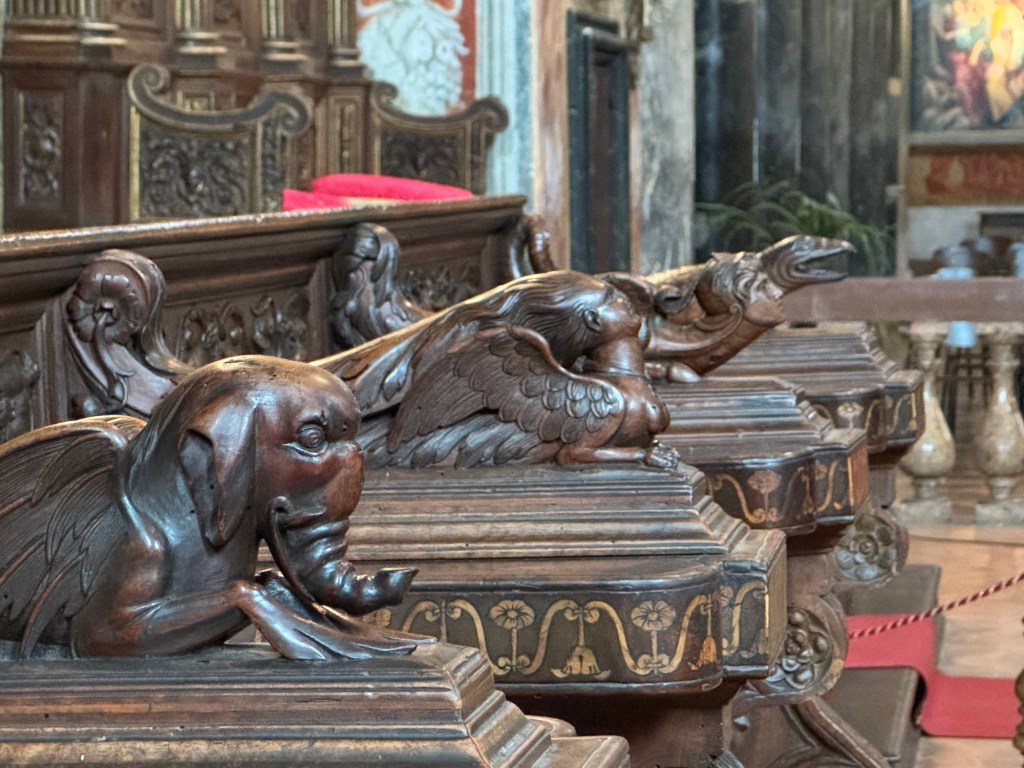
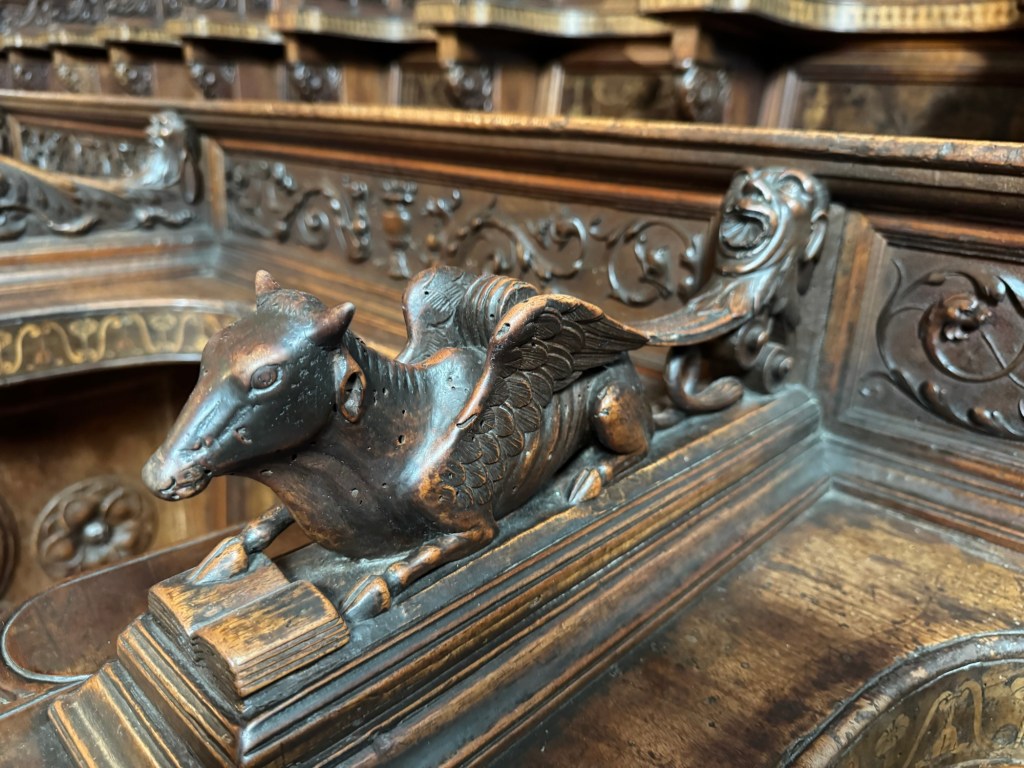
Crossing the nave and standing in front of the wooden choir seats, I then found myself among an assembly of the weirdest creatures one could imagine, as if conjured straight out of a psilocybin-fuelled Hieronymus Bosch painting.
A winged cow reading a book, an elephant with both wings and fins, a sphinx, harpies, sirens and echidnas, as well as a number of evil looking snakes and lizards.
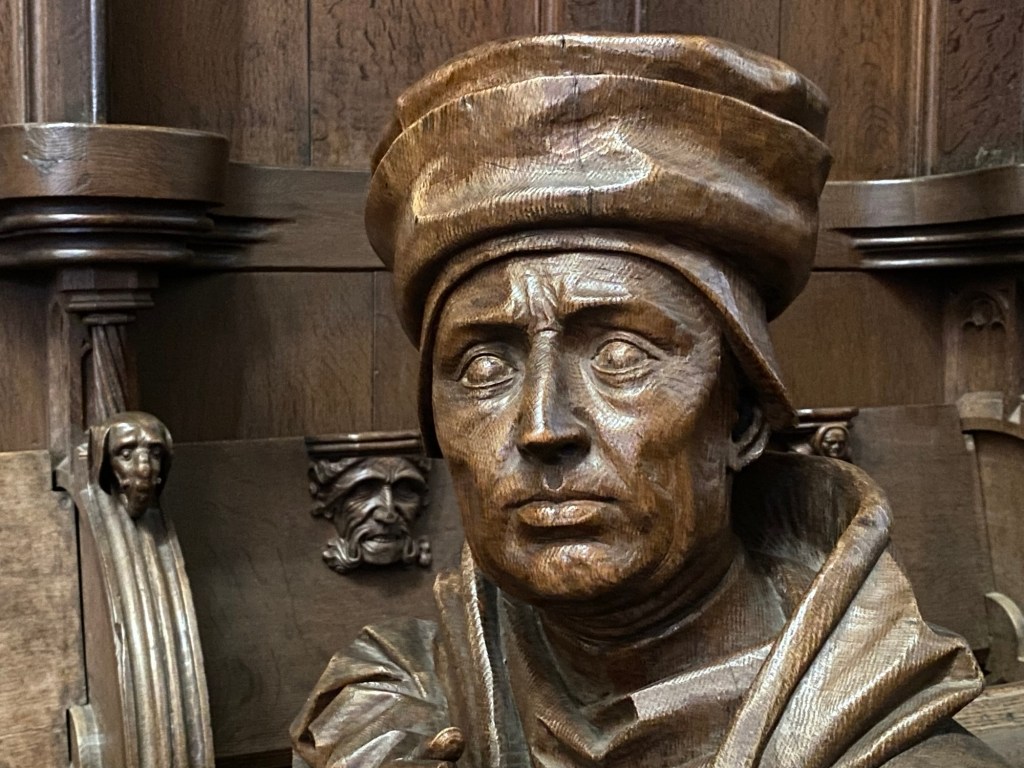
Each of these creatures were more than 500 years old and one could just imagine, how generations of bored parishioners must have admired, touched, and distracted themselves with these delicately carved sculptures during endless church services.
Apparently, these figures as well as the intarsia of the choir were some of the finest of their kind in Italy and they were on par with the equally exquisite carvings of the wooden choir in the cathedral of Ulm, which I had visited a couple of years earlier. There the heads of saints and of famous classical thinkers had been the inspiration for Jörg Syrlin the Elder, a medieval sculptor, and they had served there the same decorative and entertaining purpose.
I sat down among the biblical beasts and closed my eyes. I took in the silence and the peace of this enormous room, I smelled the ancient wood, while my fingers were running over the figure of a bearded man holding a plate with a flame.
Getting up again, I felt lightheaded and walking slowly back towards the entrance of the abbey, was it just me, or was I walking straight into the face of a giant skull?….
Ana wasn’t on time – she was five minutes early ….
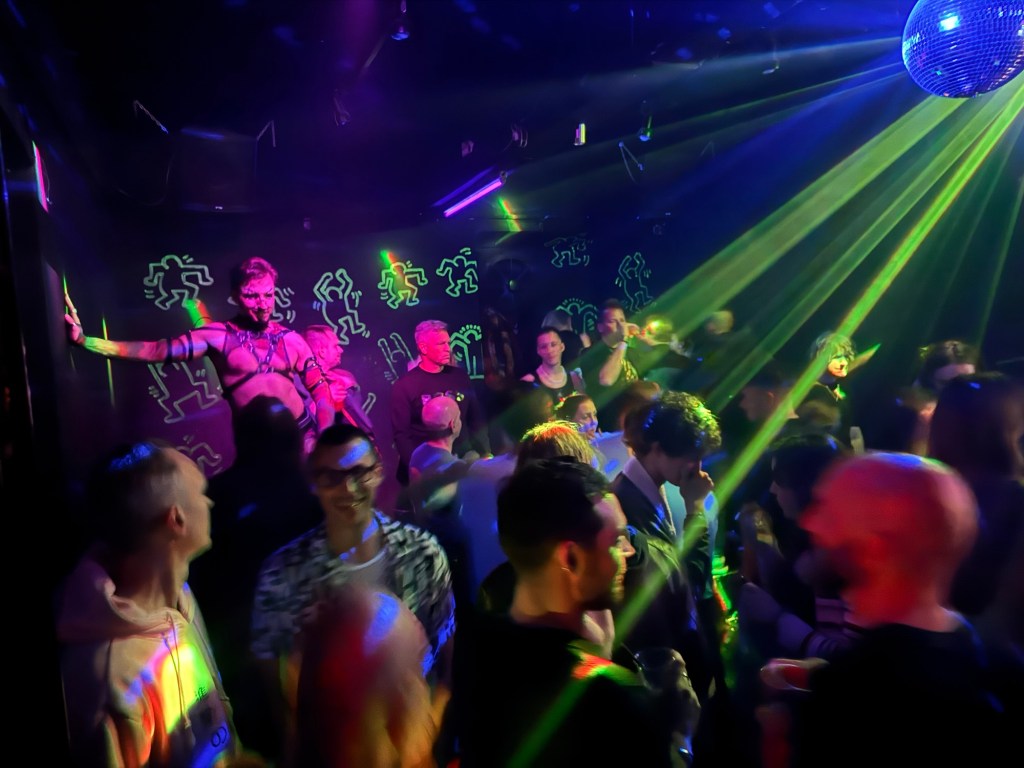
This usually is fine by me, but not after a party with one of Belgrade’s finest rock music bands and a subsequent tour with the die-hards through Ljubljana’s limited, but still surprisingly wild nightclubs, resulting in hardly more than a couple of hours comatose sleep.
With a constant ringing from the traumatised tympanic membranes in both ears, I dragged myself down the stairs and in front of the hotel where her car was already waiting.
I knew that it hadn’t been wise to schedule our trip on the last day of the conference I was attending, but this one was special and I had been looking forward to it for as long time.
Ana Nemec, no ordinary colleague, but one of Europe’s finest veterinary dentists, was in addition to this also an ambassador of the great outdoors of her native Slovenia. If her posts did not feature the oral cavities of smaller or larger domestic carnivores, Ana was taking her large number of devoted followers to the most scenic and pristine and unspoiled locations of her Alpine home, either on her mountain bike or while hiking, usually in the company of her black Labrador.
With other words – I couldn’t have asked for a better mountain guide, and I wouldn’t let a hang over get in the way of joining her for a day.
Thankfully Ana was driving, so that I could just lay back and enjoy the scenery, while we were heading West towards the border of neighbouring Italy.
“We are driving to a slightly unusual location” said my guide “It’s a mercury mine. I have never been there, but I think that you will like it….”
“Lovely” I said and raised an eyebrow while Ana was watching the traffic ahead of us.
‘Had I misheard or had I done something wrong ?’ I thought. ‘Is she serious ?’
Mercury – one of the most lethal environmental toxins. The stuff of nightmares – stories about chronic renal failure, mad hatters, birth defects…immediately crossed my still dazed mind.
‘Where is she taking me ?…..’ I thought, and my expectation of seeing a pristine alpine autumn landscape was replaced by a sense of foreboding that we would spend the day hiking through an industrial wasteland. Had Ana, the nature lover, gone to the dark side and developed a secret passion for post apocalyptic factory ruins?
And just then it was that I noticed that her Labrador was missing too…..
After half an hour we exited the motorway and the roads became noticeably smaller as the landscape around us became more mountainous. We drove through villages that had the characteristic mix of Austrian, Italian and Yugoslav features, that is to typical for this part of Europe and that told the story of periods of variable occupations.
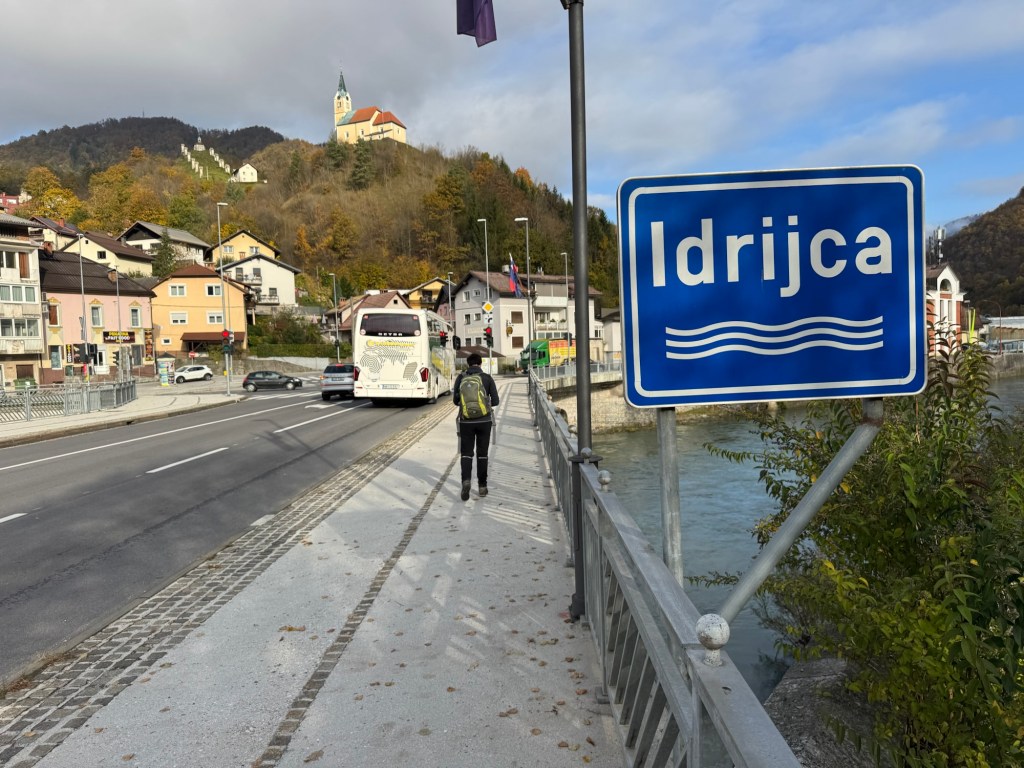
Eventually, we arrived in a narrow valley, in a small town that was dominated by a white church and a calvary of fourteen stations on a steep hill. The surrounding mountain sides were a beautiful patchwork of green fields and dense forest covered in yellow, amber, red and brown leaves. From time to time the cloud cover broke and rays of the still warm October sun enhanced the display of colours and patterns.
“Here we are !” said Ana while parking the car near a bridge.
“This is Idrija, where we will start our hike!”
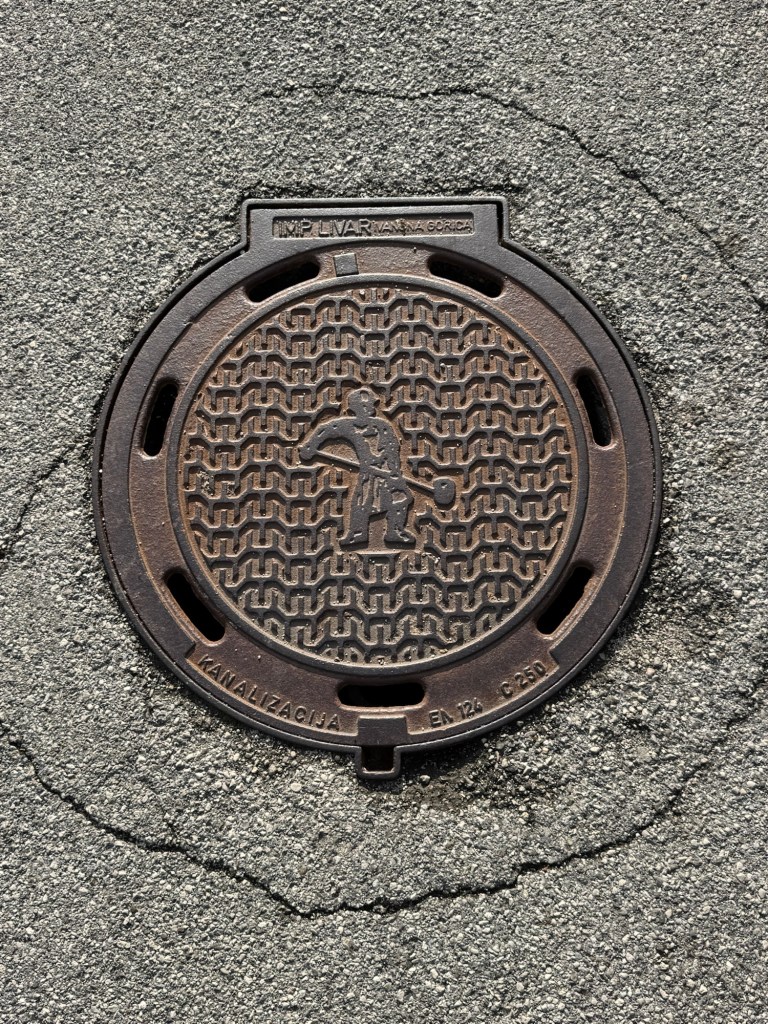
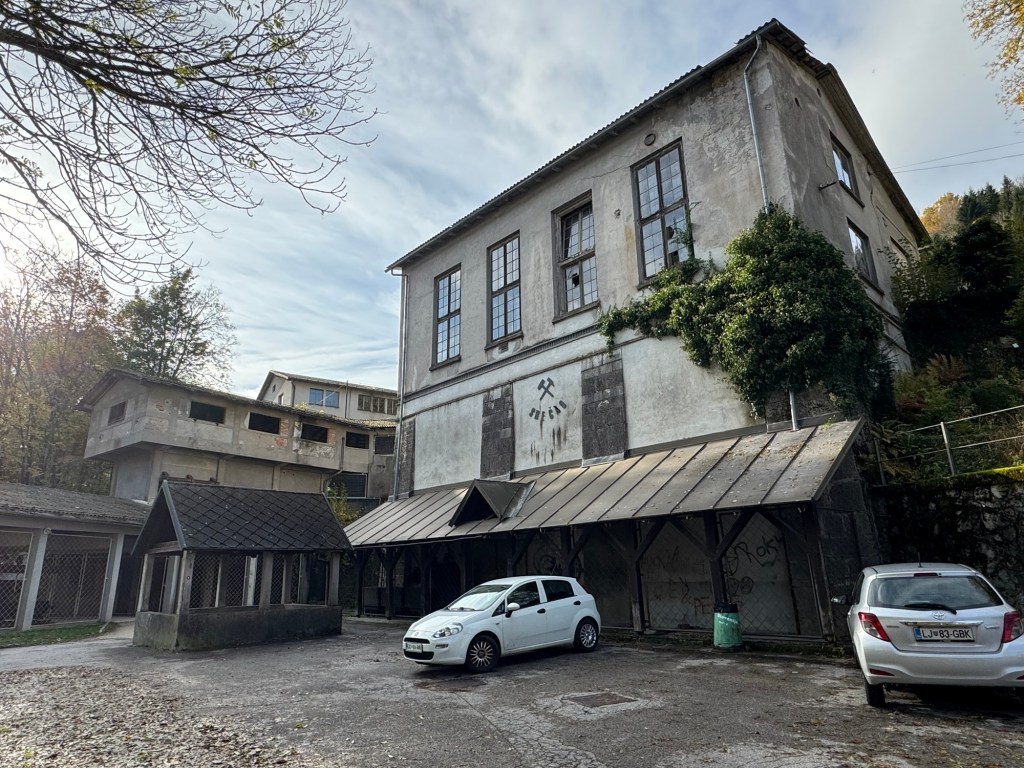
And sure enough, after walking just a few hundred meters, passing pedestrian crossings that were decorated with white lace ornamentations, we were standing in-front of an old factory building that once housed the World’s second largest mercury mine. This harmless looking 19th century structure produced up to a ton of the liquid metal every year, feeding the world wide demand of gold prospectors in the Americas, thermometer manufacturers in the Rhine Valley, hat makers in Saville Row and even that of 19th century confectioners in Europe’s capitals.
While mercury’s unique ability to contract and expand considerably depending on its ambient temperature, had helped to advance science and in particular medicine, it had left its trail of chronic illness and death not only in the work shops and the gold mines all over the world, but also in the local community of Idrija, who’s inhabitants still had some of the lowest life expectancies in Slovenia and who were still discouraged from growing vegetable in their own gardens.
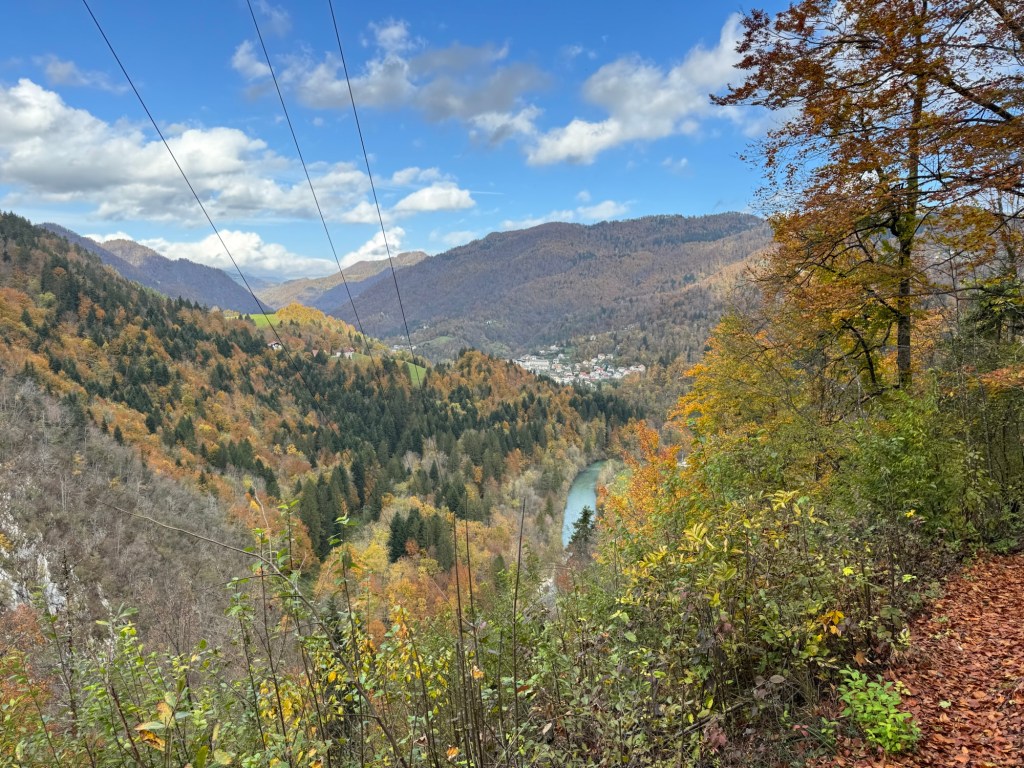
A yet, once mining had stopped, nature had reclaimed the valley and the surrounding mountains and the slopes on both sides of the local Idrijca river provided some of the most striking hiking opportunities in the country.
With winter having made an early appearance with very low temperatures and snowfall on the mountain tops, Ana had wisely decided to go easy on her charge by sticking to the valley.
Setting off alongside the Rake Water Channel, a four-hundred year old aqueduct that once supplied water to the sawmills, pumps and crushing devices of the mining company and that now drove a small hydroelectric power plant, we were walking right into the rays of the low lying morning sun. This was easy hiking and with only very small packs to carry, it was no effort to have a conversation at the same time.
After a few kilometers, a suspension bridge leading to the other side of the Idrijca, had to be crossed. While walking high above the alpine stream, I became progressively concerned about the severely deteriorated state of quite a few planks and I started to take great care to only step on the points that had an additional steel support directly underneath them, so that I couldn’t break right through one of the planks. While Ana had walked ahead of me, it was of little reassurance, as she was so much lighter than me.
Reaching the end of the bridge, the final three planks were missing so that a large step was required to reach the concrete abutment. Just then we noticed a flimsy line of tape and a warning sign that was informing us, that under no circumstances one should try to use the bridge, as it was extremely dangerous….for some strange reason, a similar warning and barrier had been missing on the other side.
Hiking with Ana continued to be an adventure…..
Joining a small road for a short while and then climbing up the hillside next to the road, we reached the ‘Feldban’, a comfortable, wide hiking trail that been cut out of the rock to support a narrow gauge railway line to transport vital supplies to the nearby frontline during the 1st World War. While the rails and the sleepers had been removed a long time ago, a small tunnel had remained to add character to this hiking route.
Our next opportunity to get killed or at least severely injured, was a ten meter steel ladder that without any additional safety features went up a straight, but at least not overhanging concrete wall.
Before now returning to the trailhead, it was time for a picnic while taking in the peaceful autumn scenery around us. Needless to say that my mountain guide had prepared for this in form of bread rolls and Kiwi slices.
From here, the trail went mostly downhill right next to a small, meandering mountain road and then alongside the river, back to Idrija with its lace patterned pedestrian crossings.
What better way to finish then off our hike with a plate of ‘Idrija žlikrofi’, the traditional small dumplings that as Ana told me were so typical for this place as the lace making and the mercury mining.
I am already looking forward to the next hike with Ana – that time hopefully together with her black Labrador, which with hindsight for this hike of many surprises, ,wisely had stayed at home.
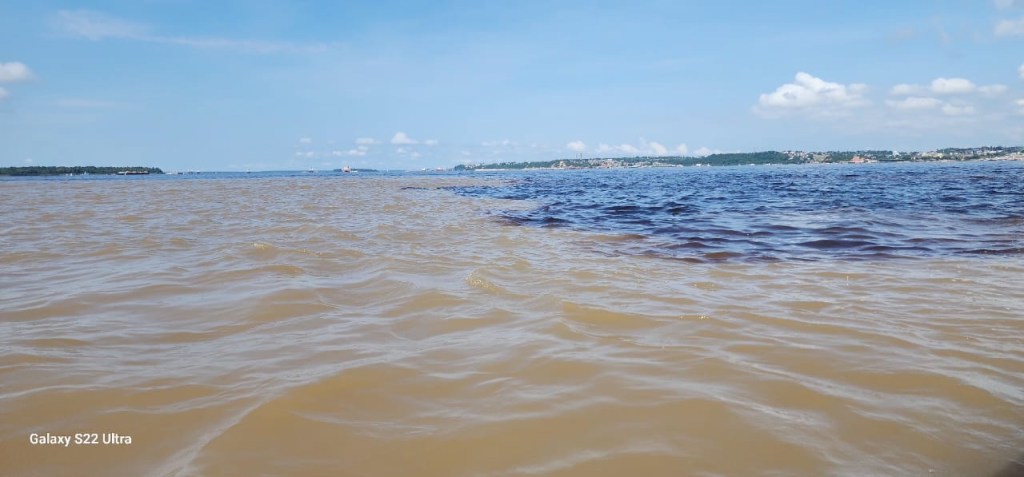
It was when the waters of the Rio Negro tried and failed to mix with that of the Solimões, to form the mighty Amazon, that we saw them for the first time – hunting dolphins, a whole pod of them.
These clever mammals were taking advantage of a phenomenon that was once described as “the greatest hydrologic spectacle on the planet”.
Image courtesy of Bülent and of Anna Trett
The very fittingly named “Meeting of Waters” was a bit like an attempt to mix a Café au lait with Yorkshire tea…. something only done with hesitation. And in the case of these two large watercourses, the matter was far more complex….
The milk coffee coloured water of the Solimões, the upper Amazon, originates from the Andes, has a temperature of about 22 degrees, carries far more sediment and flowes at a speed of up to 6 km/h, when it meets the water of the Rio Negro. As this river has its source not in the mountains above the tree-line, but in the rainforest of Colombia, it is considerably warmer with 28 degrees and has a much darker tea-like colour, due to the degrading plant material it is carrying. This also results in a much lower ph of between 2.9 – 4.2, which has the not inconsiderable advantage, that it is not particularly conducive for the development of mosquito larvae. In addition to this, the speed of the Rio Negro is much more sedate with not more than 2 km/h, so that when these two large water masses meet, they first run just alongside each other for about 6 kilometers before they are starting to mix and it takes them another 50 kilometres, before they get used to each other and blend completely to form a uniform water mass.
Video courtesy of Bülent and of Anna Trett
The difference in nutrients and water temperature was attracting a lot of small fish and the dolphins were taking full advantage of it. While their prey was struggling with the reduced visibility in the tannin stained water of the Rio Negro, the dolphins benefited from their echolocation that made hunting so much easier.
These were grey river dolphins, easily identifiable by their prominent dorsal fin and their more predictable direction of movement.
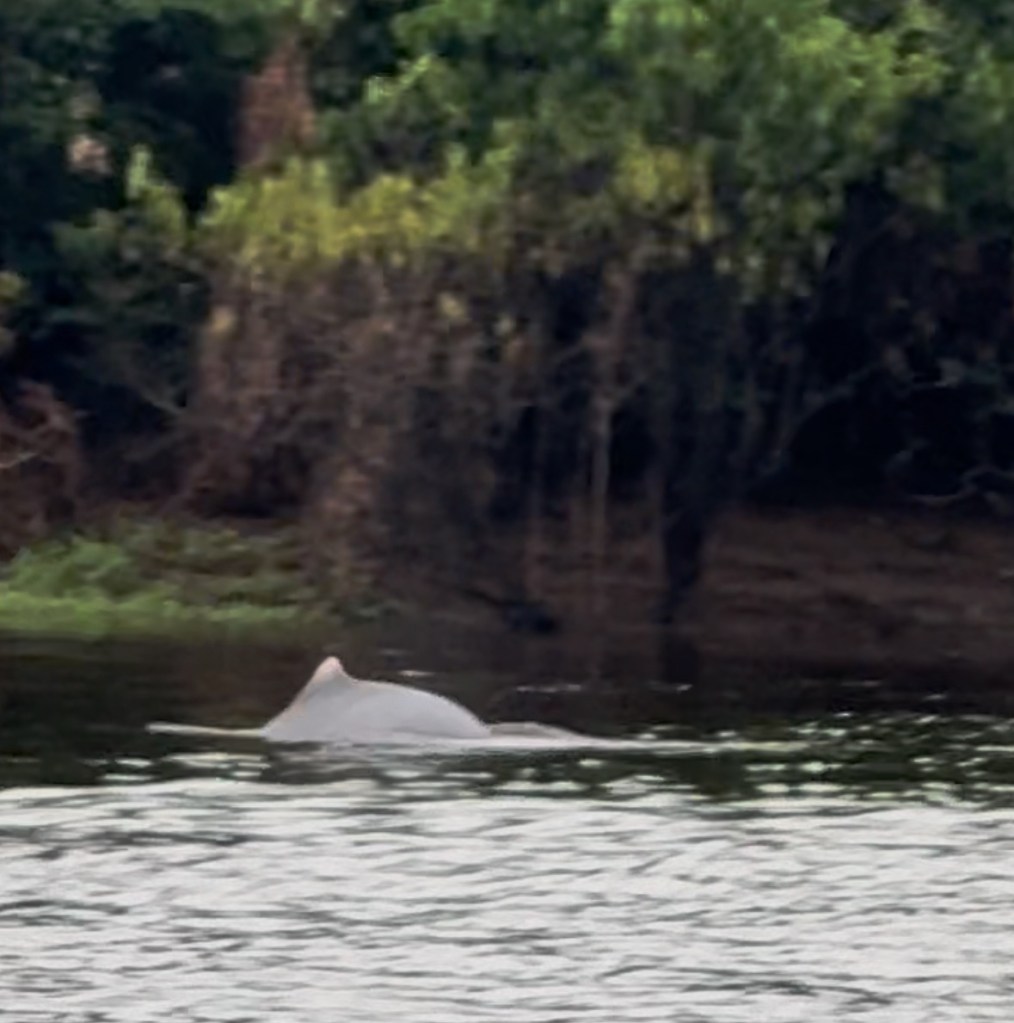
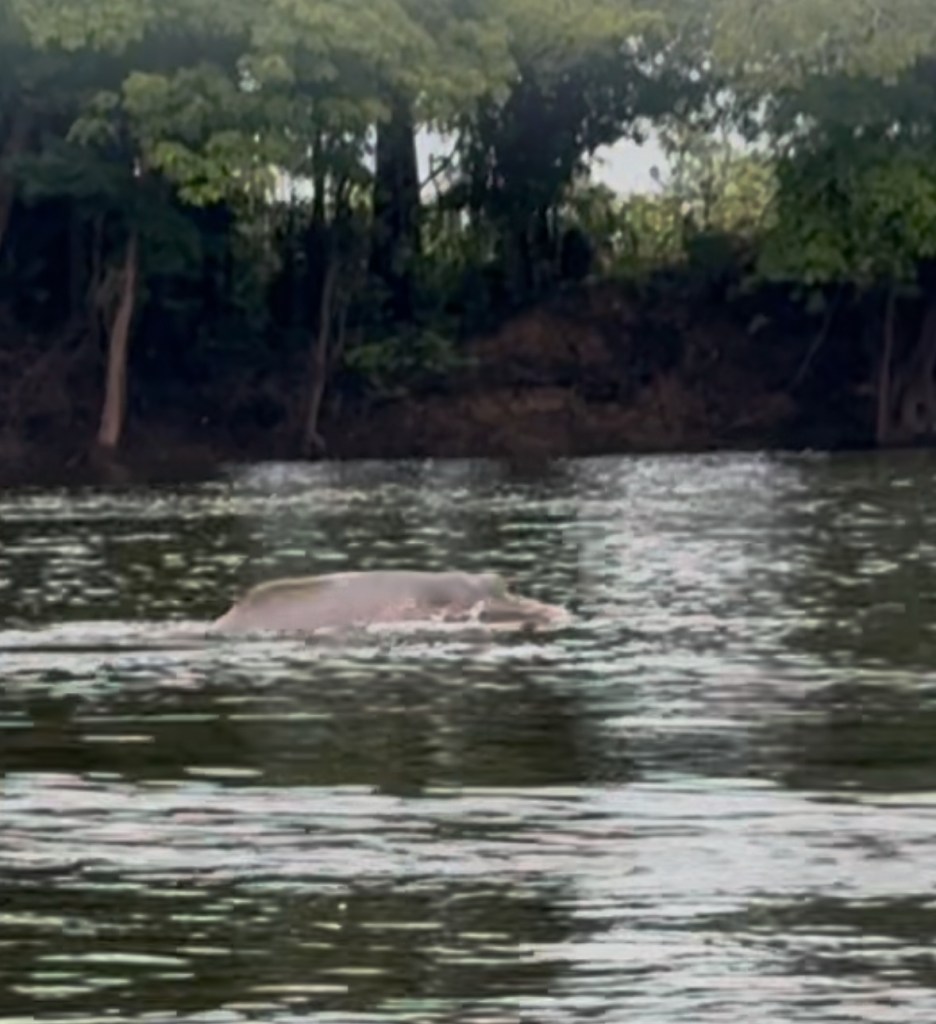
For my first encounter with their more elusive, much larger, pink cousins, the Botos-cor- de-rosa, I had to wait for a couple more days.
While looking for a sloths in the canopy of the rainforest on the Paraná do Mamori South of Manaus, I noticed a familiar sound that transported me immediately a few thousand kilometers to the other side of the Andes, to the Pacific coast of Northern Peru, where I had heard for the first time the blowhole of a whale.
While not as large as its Cetaceaen cousin, the exhaling sound was the same and sure enough, looking to the other side of the river two distinctive pink backs, nearly devoid of a dorsal fin, were breaking the surface of the water.
Unfortunately this remained my only encounter with these strange animals while staying on the Amazon.
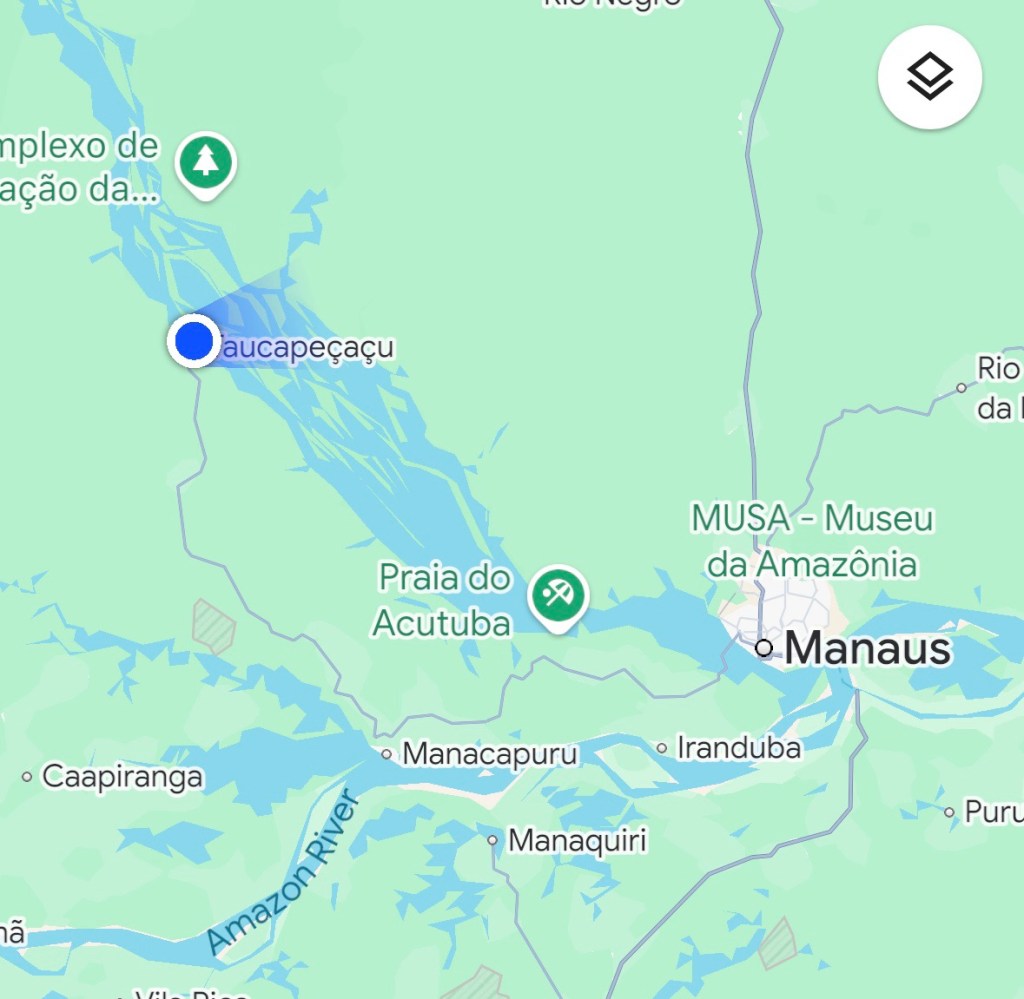
Returning to Manaus, with a few more days to spare, I did some research and found out, that there was a small place in the North, right next to the Anavilhanas National Park, a Labyrinth of half submerged islands in the middle of the Rio Negro, where it would be virtually impossible to miss them.
While the adventurous way to get to the park would have been to hitch a ride on a seaplane that would cover the 160 km from Manaus in less than ½ hour, the 3000 $ price tag was just too eye watering, so that I chose for the second best option – a three hour lasting joint taxi ride along the partially tarmaced road to the village of Novo Airão for less than 20 $.
As it turned out, this ride was no bit less audacious, with the driver, glued to his mobile phone, frequently exceeded 120 km/h on a road with numerous, often unexpectedly appearing, large potholes, while his wife, riding shotgun, was balancing their unsecured small child on her lap….
I didn’t dare to check if at least her airbag was disabled…..
When entering the village, it was not difficult to tell, that I had arrived at the right place:
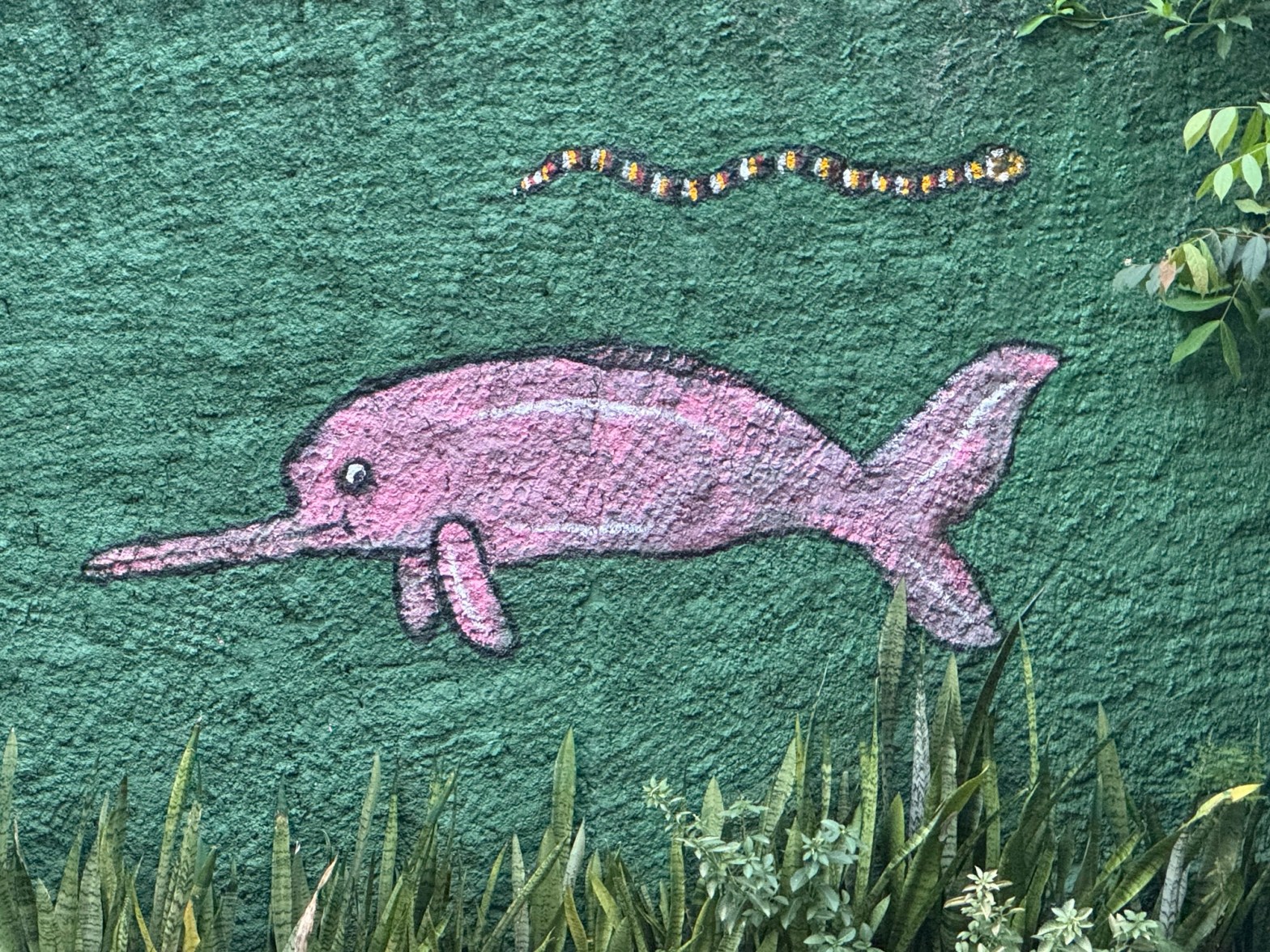
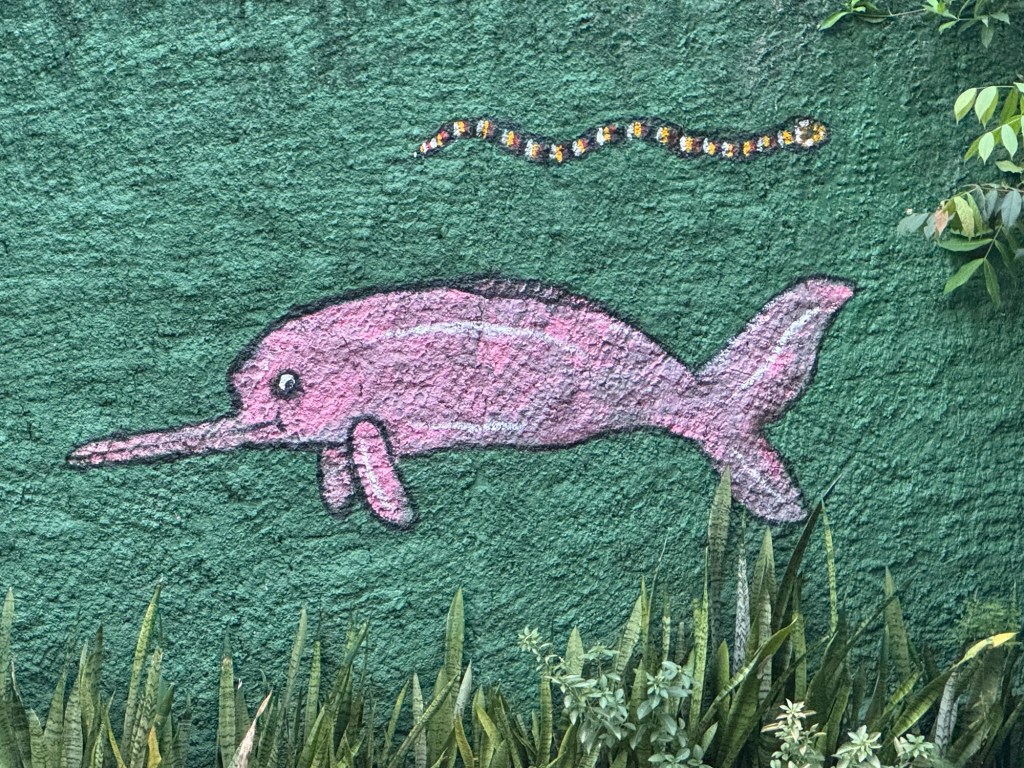
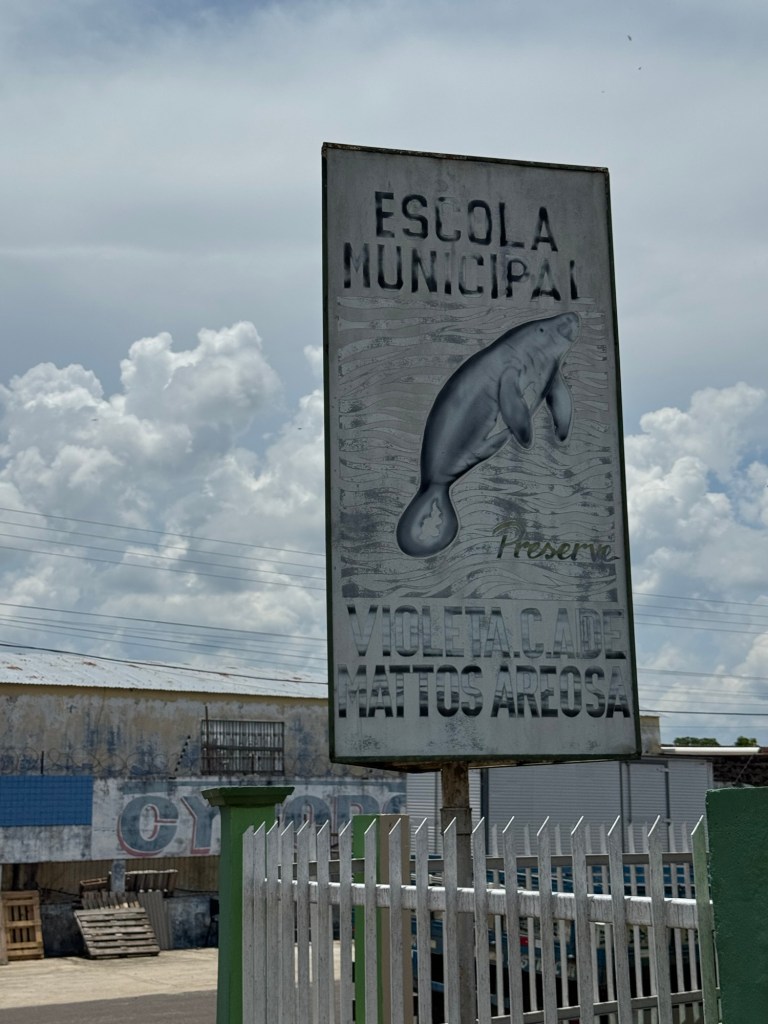
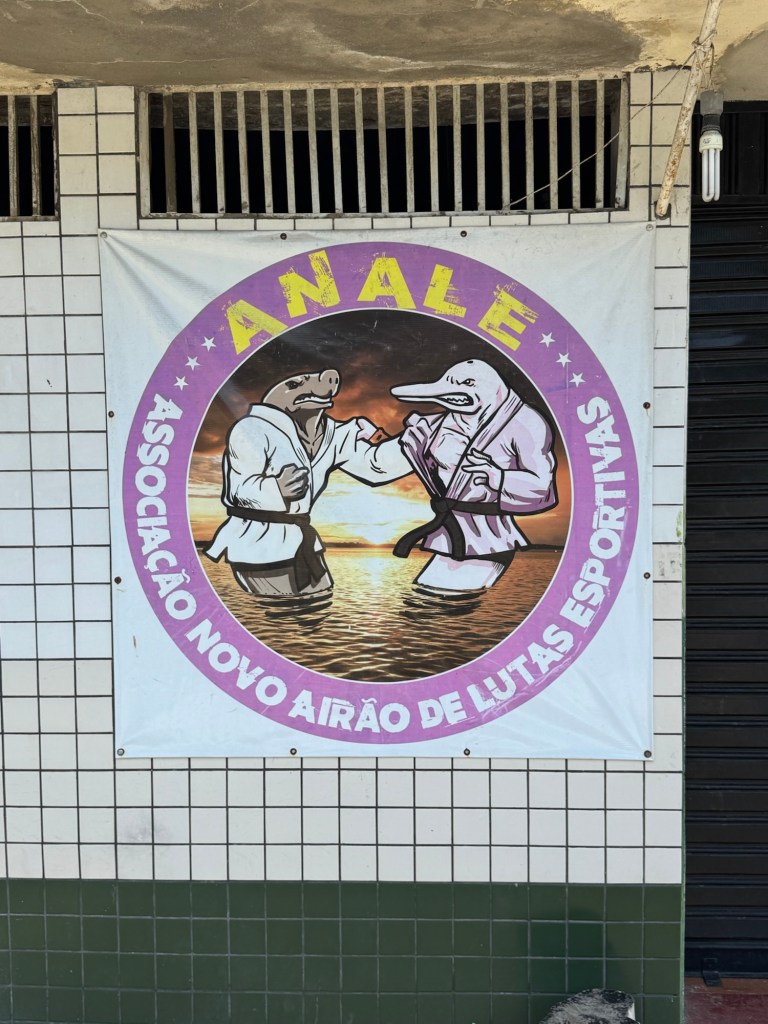
images of botos and of manatees could be seen everywhere. Several house fronts and property walls provided the necessary canvas, the local karate club displayed them as their mascots and even the village’s carnival float had the shape of a manatee.
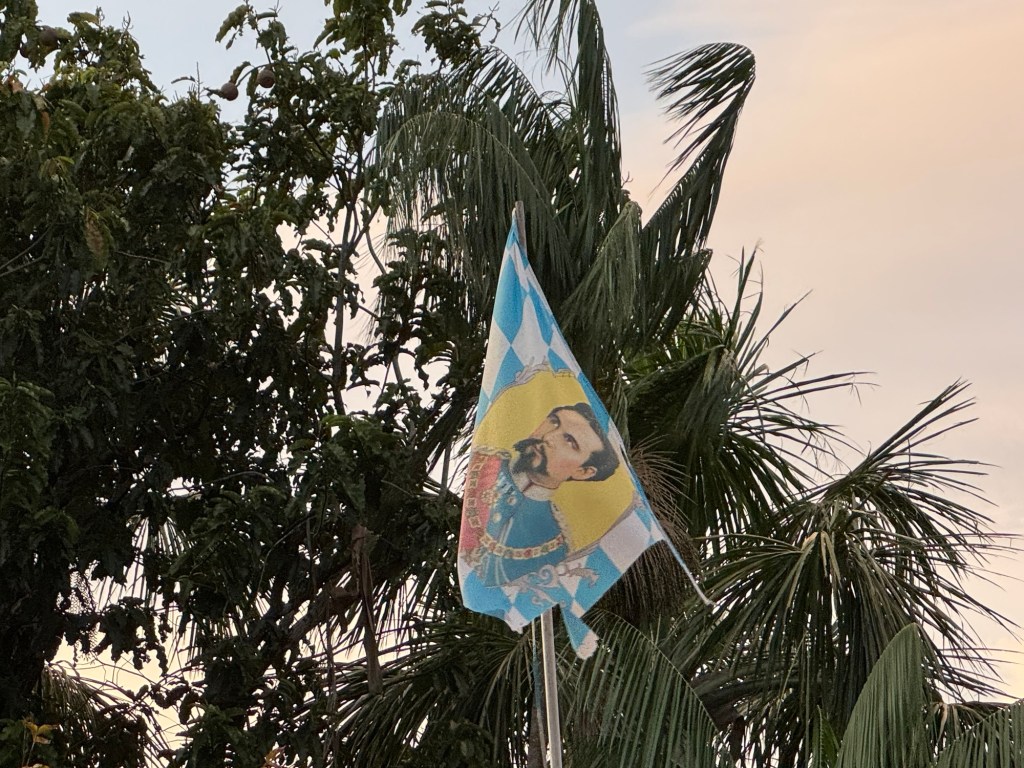
Once I had checked into my hotel, which alongside an excellent internet connection and a Bavarian flag on its roof (which no one could explain why it was there….) featured a massive, very inquisitive iguana and his hareem.
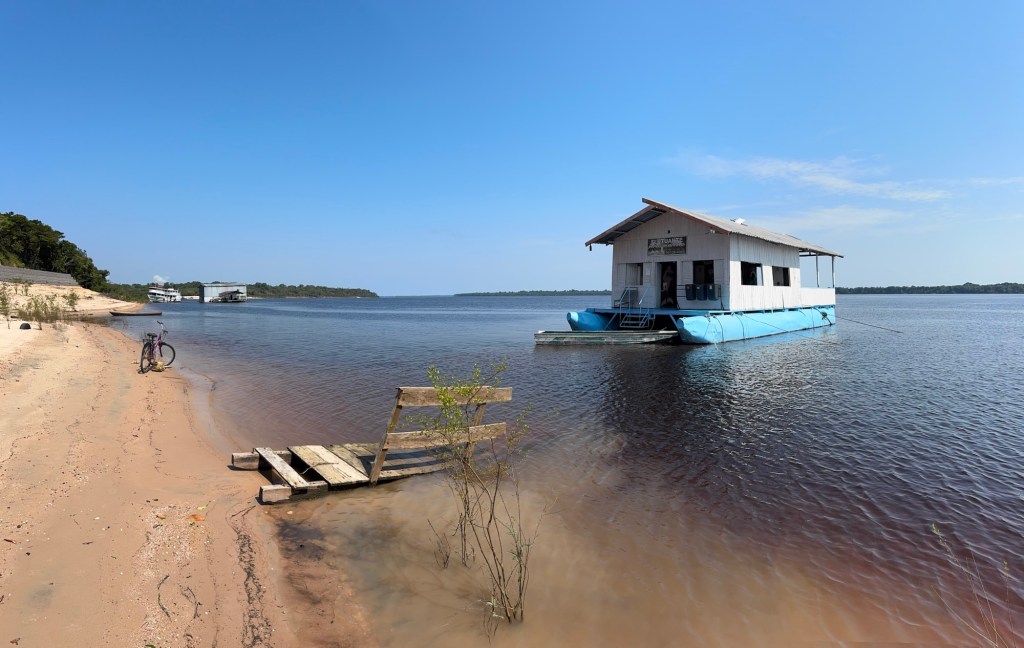
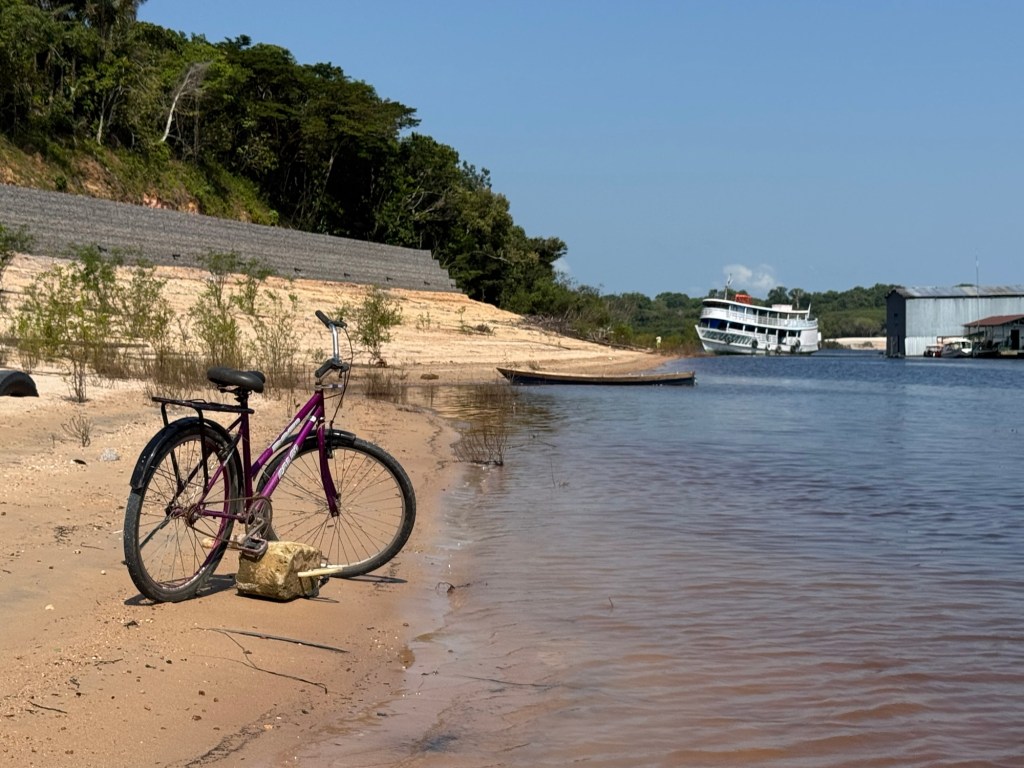
It didn’t take me long to find out, that the best chance to see a boto was to head down to the beach in the morning and to look out for the bicycle of a young girl that was working on a small floating house that contained a simple information centre about the national park.
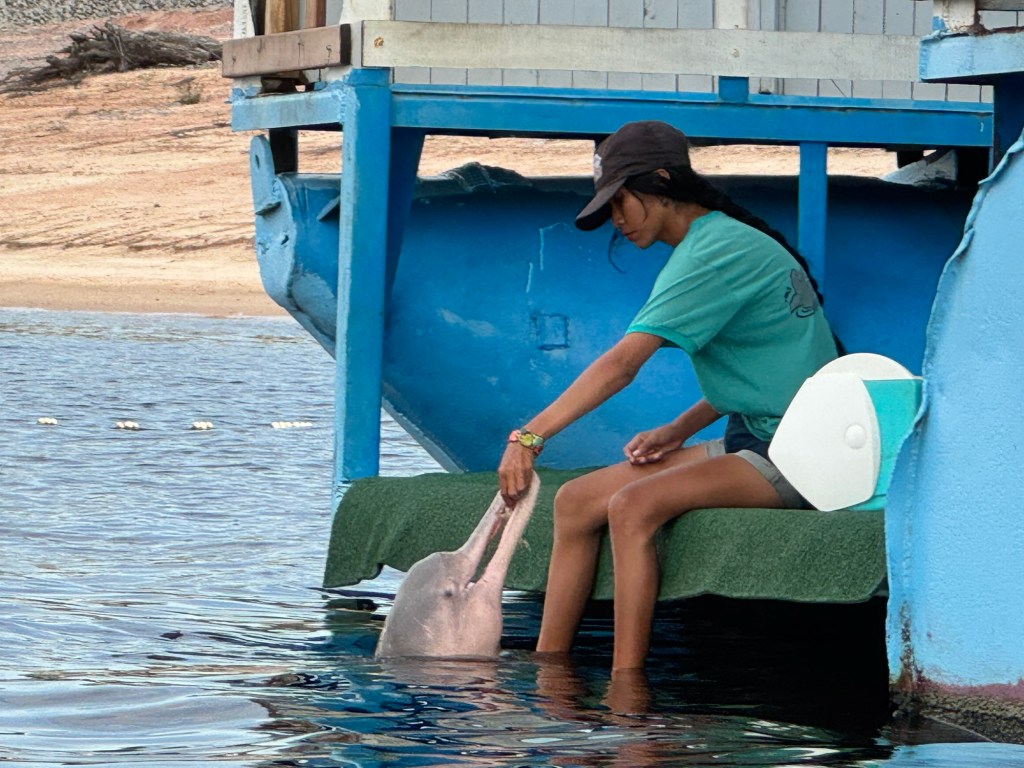
Helped by occasional treats, the girl had befriended a pair of river dolphins, that were usually visiting her both in the morning when she opened the place as well as in the evening before closing it.
But this time it wasn’t that straight forward….. the bicycle was there, so was the girl and the floating house, but what was missing were the dolphins….
“Probably somewhere down the river”, said the girl and shrugged “They are free and you never know…..”
And sure enough, despite turning up twice daily for the next two days, I always left empty handed….
At least I had found out that staying at the hotel included the free use of a kayak, which eventually would give me a front row seat when the botos finally returned….
With underwater visibility less than 30 cm, not seeing one of these river dwellers did not mean that they were not there….The river dolphin has the ability to stand motionless in the water and especially while swimming – which I did every morning – you might pass one just a few centimeters away from you, which is a bit unsettling, considering that these creatures that resemble somewhat the embryo of an Ichthyosaur, can easily be larger than 3 meters. Thankfully – like their grey cousins – they are completely harmless piscivores.
When paddling towards the floating house at the end of the third day, starting to get frustrated about my poor luck, a pink, an indeed primeval looking shape jumped out of the water right ahead of me, but disappeared below the surface before I had a chance to reach for my camera. Well – not everything could or should be kept on film I thought….
But this time my lucky run endured, and shortly after this brief encounter, the girl appeared and sat down at the edge of the float to give the botos their evening treats.
“Surely some of the most unusual creatures I have ever set my eyes on”, I thought. Certainly not particularly pretty, actually slightly spooky, and yet an alluring sight in this remote corner of the Globe.
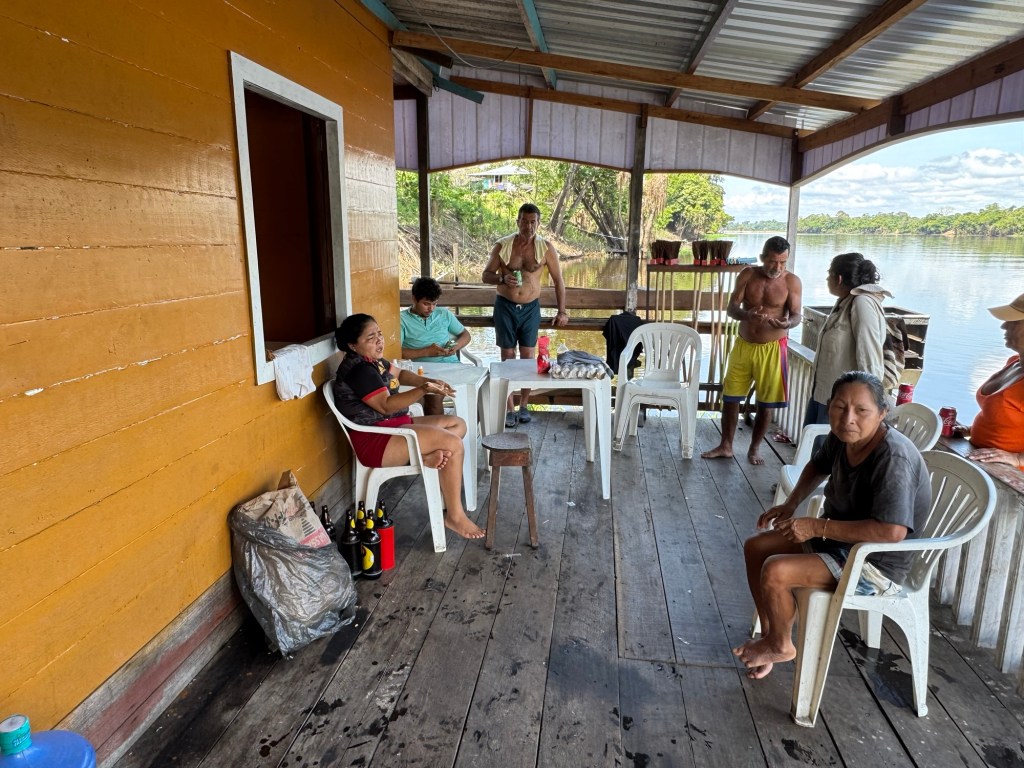
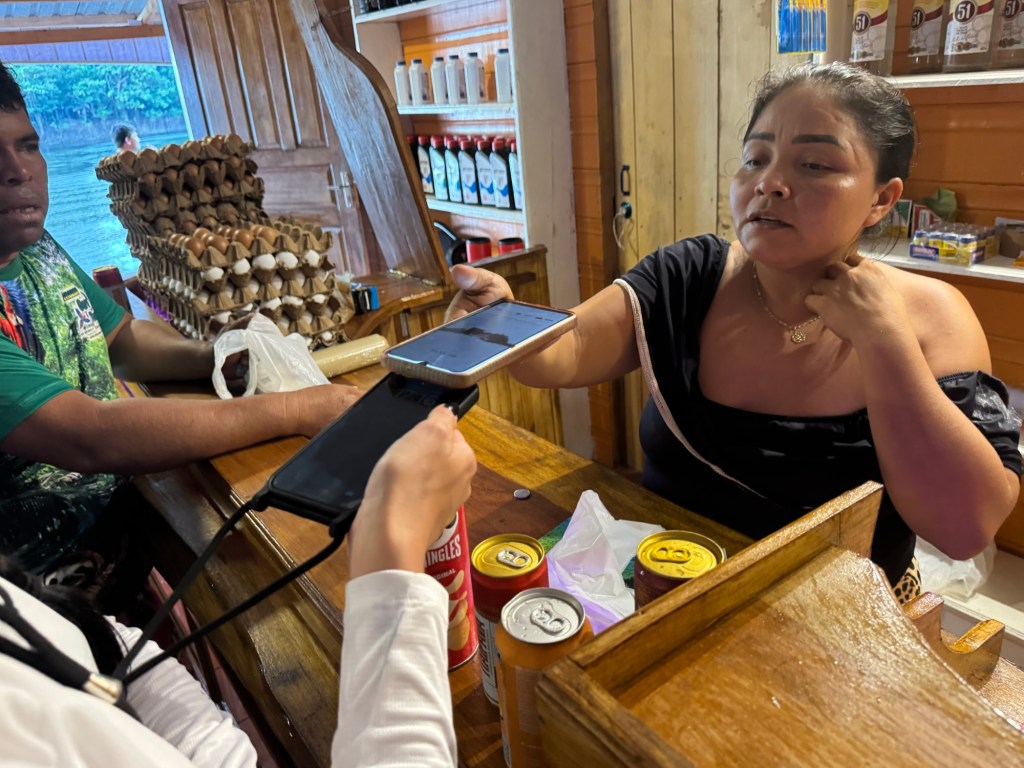
Senhora Silva might not have been much taller than five feet, but she was running a “tight ship” in her little supermarket on a small Balsa wood float, on the Parana do Mamori, one of the many contributories to the Amazon just South of Manaus.
Together with Josef and João, my companions, we had spent the previous night sleeping in hammocks in the middle of the rainforest.
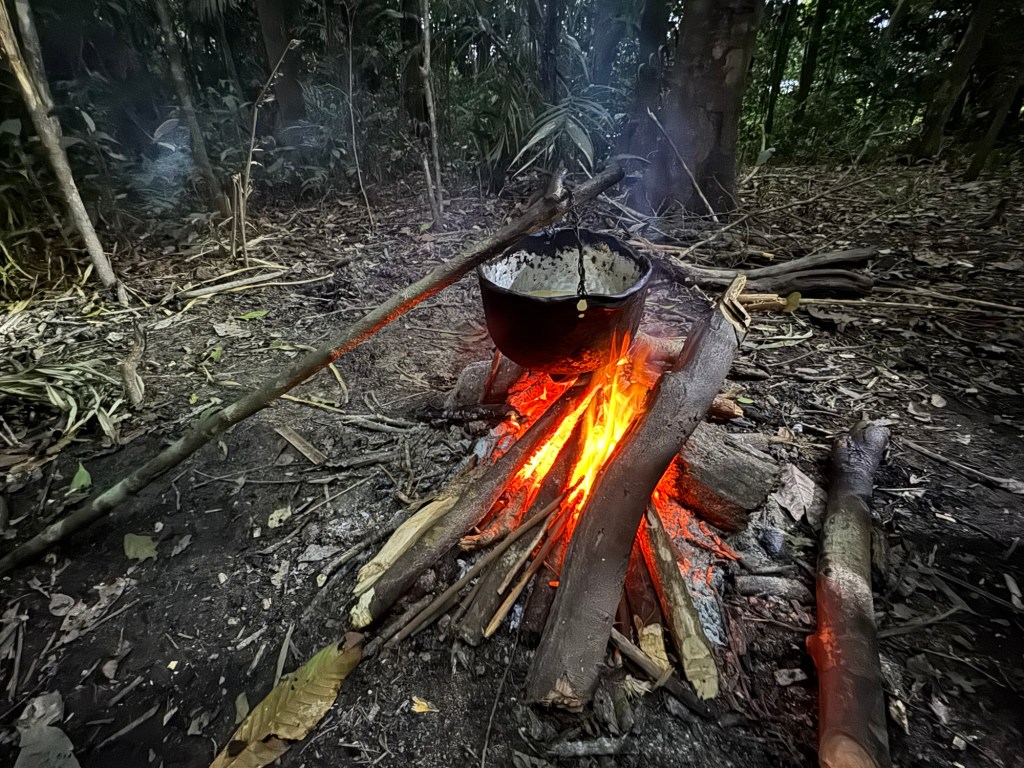
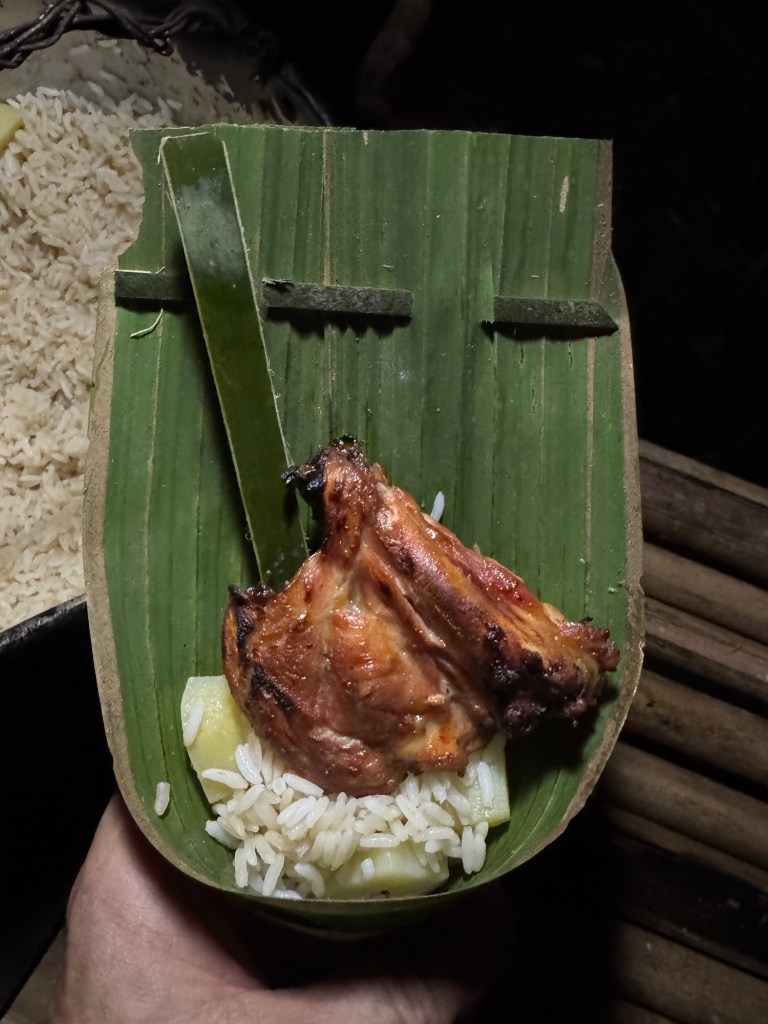
Helped by a surprisingly good campfire meal and a few cans of cold Brahma beer, I had – against my expectation – managed to find a few moments of sleep, despite the unusual sleeping position, the occasional mosquito that had still managed to get inside the mosquito net and despite the sounds of the jungle, caused by cicadas, tree frogs, tropical birds, howler monkeys and by occasional movements on the forest floor, which were ideally not further investigated.
Falling out of the hammock once in the middle of the night, very much to the amusement of my fellow travellers, had not added to the recovery a good night’s sleep should normally provide.
Shortly after sun rise we had broken camp and had continued to explore the nearby Ipanema lake and the shores of the adjacent river.
Senhora Silva’s little store was usually passed during these outings and especially when the heat in the middle of the day started to become unbearable, a brief stop for a cold drink was a must.
Most of the local riverside residents, who lived far apart from one another, made once a day their appearance here as well, both to have a chat and to stock up on Camelinho, a headache invoking, cheap Cachaça variety, that for many seemed to make the life in the jungle just about bearable.
At the Supermarket they were all welcome, but there was one single, all important rule: under no circumstances was credit given, especially when it involved the sale of alcohol.
This posed a problem for me, as I had not taken any cash with me into the jungle.
“No problem ” said Josef, “just pay by card !”
And sure enough, deep in the amazon, due to a Starlink connection, even in Senhora Silva’s simple shop, I could make a contactless credit card transaction for an ice cold beer at less than a pound including the 5% added, as it was a credit and not a debit card.
As it turned out, the Senhora in fact preferred card payments, as it reduced the risk of her getting robbed.
A further tried and tested crime prevention measure was her male Rottweiler, that while locked away during the day, had the free run of the landing at night. The dog was renowned in the area for just tolerating the Senhora and her teenage son. Taking into consideration her small size, the fact that I had no equipment with me and that I didn’t speak any Portuguese, I kindly declined her offer to take a closer look at the animal….
Back at the lodge I caught up with Milos and Hobo, some fellow travellers from Poland, and I mentioned to them my amazement about the cashless payment option in a remote place like this and how much this was contrasting with my native Germany where still a surprisingly large number of businesses, including many veterinary practices, do not offer this service, insisting on cash payments or direct bank transfers following the issuing of a written invoice.
My Polish friends agreed, but said, that they could go even one better….
On the Copacabana, they had been able to purchase drugs from a dealer with a credit card terminal, that was also used to sell Caipirinhas. The slight downside was, that when they checked later, they found that instead of the 15 RS/2 £ they were supposed to pay, they had been charged 5000 RS/800 £.
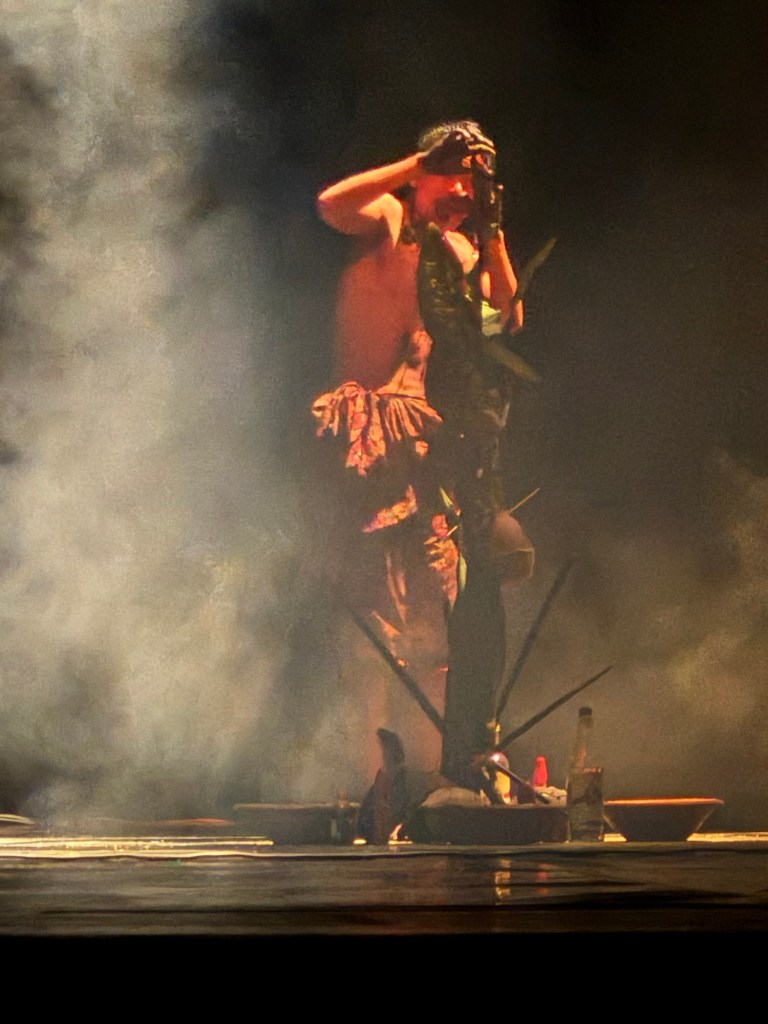
The non-binary actor was walking fast in small circles carrying a oszillator , that was producing some alien, distorted words or just sounds that filled the room. Then the light went off and there was a scream ….
A few moments later the actor was suddenly walking through the audience, cast into the rays of an ice-cool, blue spotlight, which contrasted the slim body only slightly against the unlit surroundings. The spectator’s eyes had difficulties to adjust to the darkness and …. was that a stick, or even a knife they was carrying ?…..
The actor worked their way through the aisles, talking in heavy accented Portuguese, in an indigene language or in tongues – it didn’t matter, as I (and probably most of the mostly young audience, that had filled the stalls to the last seat) didn’t understood a word anyway…..
Again, the light went off, a heavy rhythm of drums started to fill the room and the half naked actor, now again back on the stage, cast into bright red light, was dancing provocatively around a small totem pole (?) positioned in the middle of the stage.
At this point, this solo performance had lasted the best part of an hour. There had been no real start or a defined first act of the play, as the actor had already been performing when the audience entered the theatre to populate the burgundy velveted seats.
Eventually, the actor took an interval while on stage, indicating that this was all just too hard work, while the audience remained seated, unsure if this was a genuine part of the performance.
After rehydrating themself first with water, then with Cachaça, the very popular, local sugar cane based moonshine, the performance was allowed to continue, but seemed to descend now into a state of utter chaos.
The Cachaça bottle appeared again and members of the audience sitting in the front rows, were filled up with the clear liquor. This was followed, judging by the response of the audience, by progressively rude and suggestive comments chanted repeatedly by the actor and eventually the stage was invaded by members of the audience, who joined in with the dancing.
The theatre goers in the stalls went wild. People of all ages were now off their seats, clapping, dancing and joining in with the repetitive chanting.
Eventually the actor left the stage and walked through the central aisle, still chanting, under the rapturous applause of the whole audience.
Speaking to the people next to me after the performance, no one exactly knew or understood what the play was about, but everyone had an absolutely great time….
Just another night at the Theatre of the Amazon.
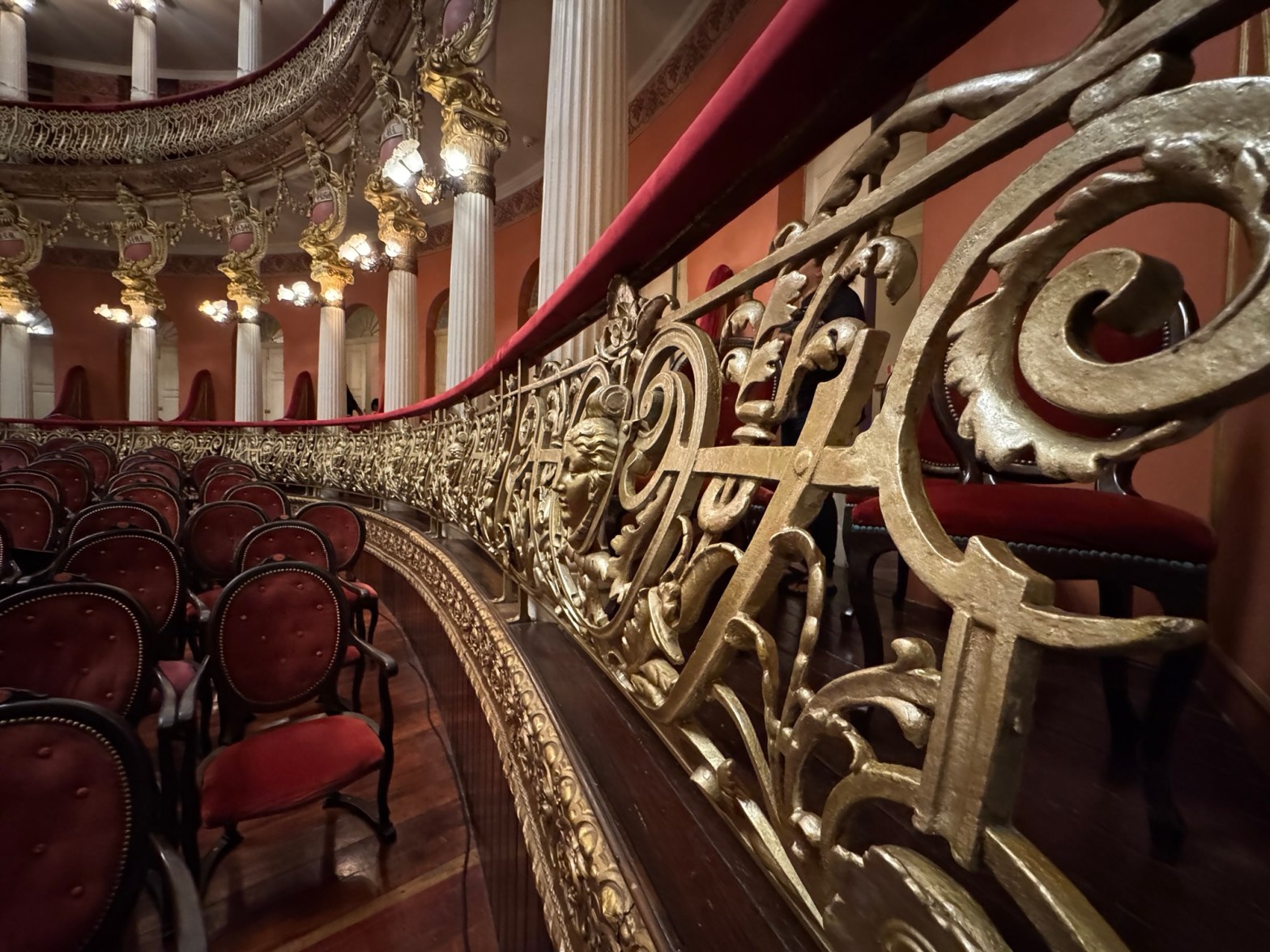
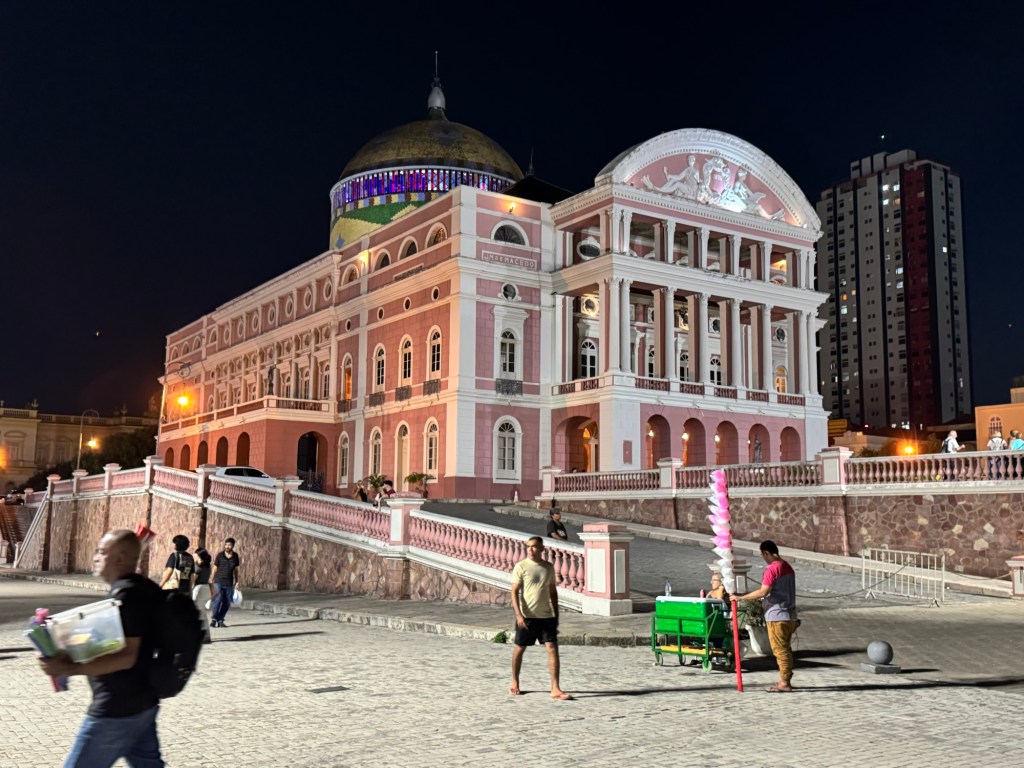
When I had arrived earlier that day in Manaus, in the tropical North of Brazil, I had not planned to see a performance at this building, that Vogue at some point had identified as one of the most beautiful opera houses in the World.
Yet, when I mentioned my plan to visit the building to Agatha, the girl who was running the reception at my stay, she pointed out that I had arrived at just the right time, as for a period of 2 weeks all theatre performances were free. One only had to start queuing well in advance to grab one of the tickets, as the demand was high.
An hour later, I had joined local residents and some far travelled theatre enthusiasts in a queue that was stretching halfway around the building….
Like Brian Sweeney, the main character in Werner Herzog’s epic movie “Fitzcarraldo”, I realised that one had to make an effort to see a performance here, even if Enrico Caruso was not starring that night.
I had seen the movie shortly after its release, but must admit, that at the time I neither appreciated nor entirely understood Herzog’s work – and little has changed since then…
But not only for the performance, but also for seeing the inside of the theatre building itself, it was well worth the effort.
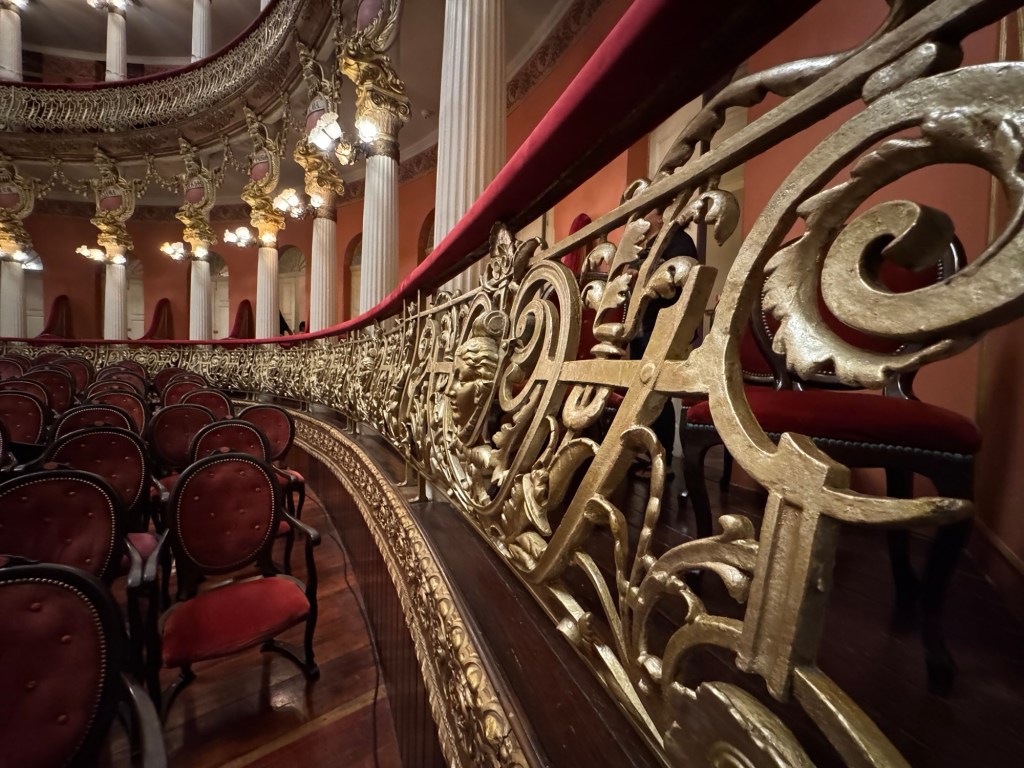
When the theatre was built during the height of the rubber boom at the end of the 19th century, when the city was flush with cash, only the best architects, artisans and materials were good enough for this project. Built in a “Renaissance Revival” style, not so different from the Holloway buildings near my former veterinary practice in Surrey, based on plans drawn up by an architecture office in Lisbon, Celestial Sacardim, an Italian architect had been tasked to oversee the building works.
The roofing tiles were source from Alsace, the steel supporting the walls from Glasgow, and the marble – of course – had to come from Carrara in Italy. What had been used on the Pantheon two millennia ago, was just about good enough for this project. The nearly 200 lights and chandeliers had been produced in Italy and some were even made of Venetian Murano glass.
While the main structure of the building was held in pink and white, the domed roof was bearing the National colours of Brasil: yellow, blue and green. In my opinion a brave combination of colours, but it worked for Manaus and even the fashion critics seemed to have agreed.
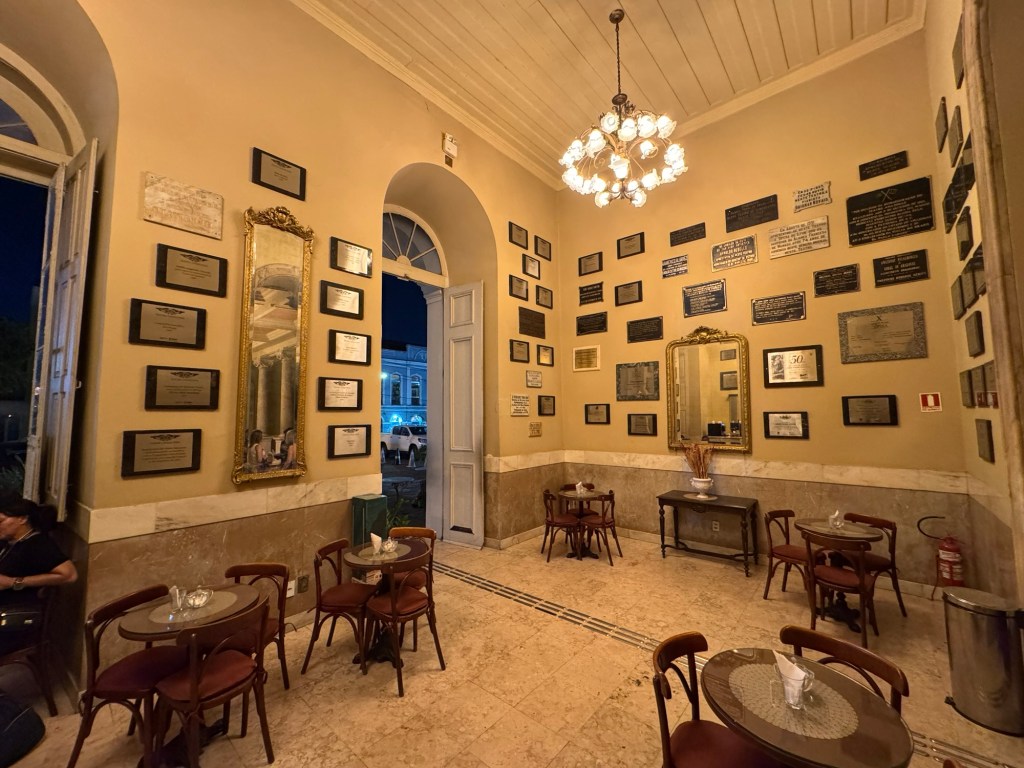
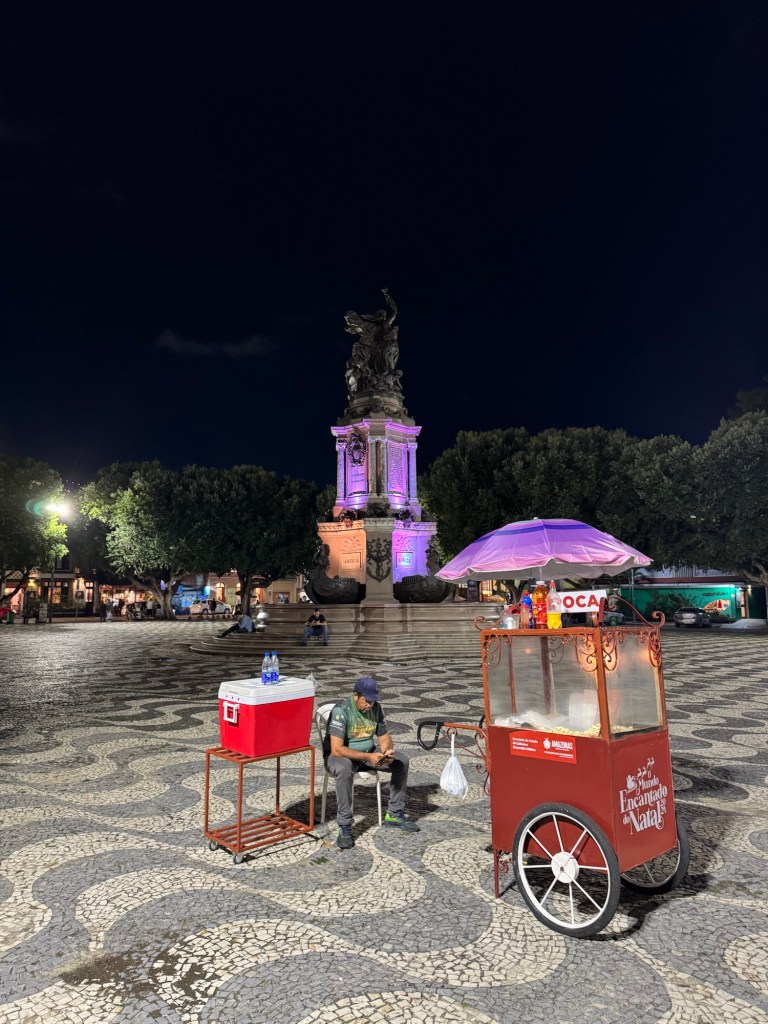
Both the historic café on the side entrance of the building, as well as the restaurants around the theatre square, with its Copacabana patterned pavement and its equally impressive Monument Abertura dos Portos,
were great places to recover from this unexpected evening entertainment, and so my journey into the Amazon went off to a great start.
I couldn’t have been more than eight or nine years old, when at our local church, which was a converted farmhouse with a thatched roof in the North of Germany, the villagers had been invited to an unusual spectacle:
a member of the parish had travelled to Brazil and had come back with a Super 8 footage of this journey. The flickering film included images of Brasilia, the then still very new capital of this so distant and exotic country.
The images I saw, could have featured in an episode of Star Track, so outlandish appeared the architecture of the buildings of this city in the tropics to me. In the world I grew up in, most houses had a pitched roof and were made out of red bricks or were, if they had survived the war, even timber framed. And yes, since the nearby naval port of Kiel had been mostly flattened by British and American bombing raids, most of the post-war office and retail buildings had come directly out of the textbook of the Bauhaus, as the objective had been to build fast, efficient, and ideally at low cost.
However, the buildings in Brasilia were just on a different level. Here functional architecture had been combined with impossibly light, organic structures that were supporting the over hanging roofs. Waterfalls were coming from somewhere inside the buildings and were feeding into moats filled with colourful fish and a large square leading up to these buildings was decorated with equally beautiful, abstract sculptures.
What grew inside me on that day, was the desire to – at some point in the future – visit this place and to see these unbelievable buildings with my own eyes…..
What I didn’t know at the time, was that most of these buildings came from the drawing board of one and the same man, who is widely considered the most outstanding architect of the 20th century: Oscar Niemeyer.
Niemeyer, despite his Germanic surname, was a Brazilian native, a lifelong communist and strongly influenced by the work of Le Corbusier. Without doubt, Dessau and the Bauhaus movement must have played its role in Niemeyer’s development, but at some point he had started to go his own way, and he despised famous peers like Walter Gropius for their all too commercial approach to architecture and for their inability to take into consideration the geographical aspects of their projects.
For Niemeyer, Bauhaus was just too far removed from organic lines.
When Juscelino Kubitschek became president of Brazil in 1956, he started immediately to implement the by then already long-established idea, to move Brazil’s capital away from the coast and into the center of the country.
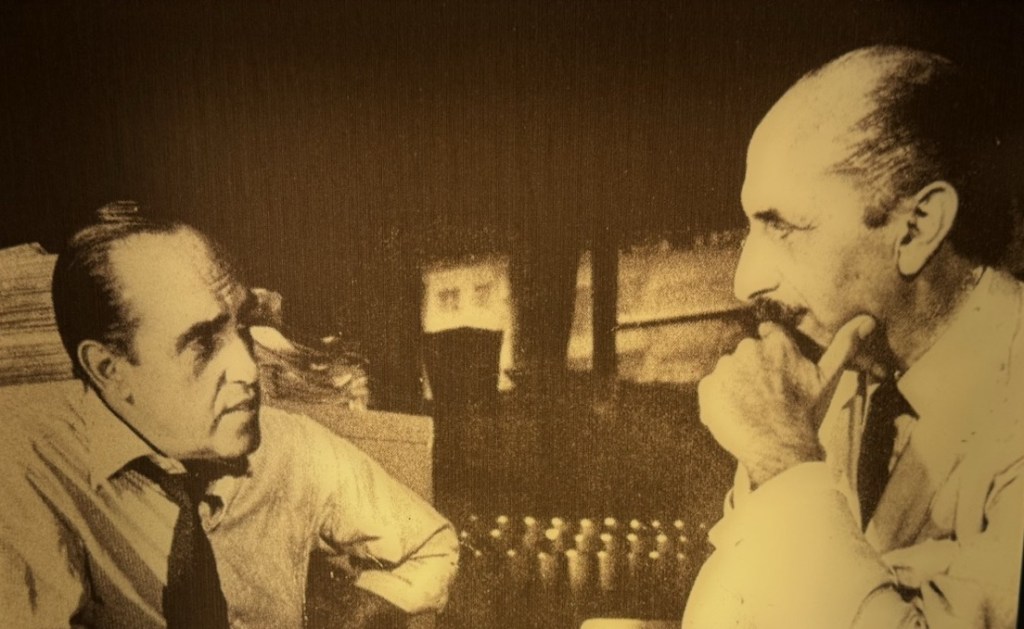
Oscar Niemeyer and Lúcio Costa
The ground breaking urban plan for this project, submitted by Lúcio Costa, had the shape of a plane, a bird in flight or a bow and arrow, that were hugging the western shore of a lake on the central highland. Part of Costa’s team was Oscar Niemeyer, who had received a lot of praise for – among others – his involvement in the designs of the building of the Brazilian Ministry of Education and Health in Rio de Janeiro and of the building of the United Nations Headquarters in New York. For Brasilia, Niemeyer was tasked with the designs of all the major government buildings.
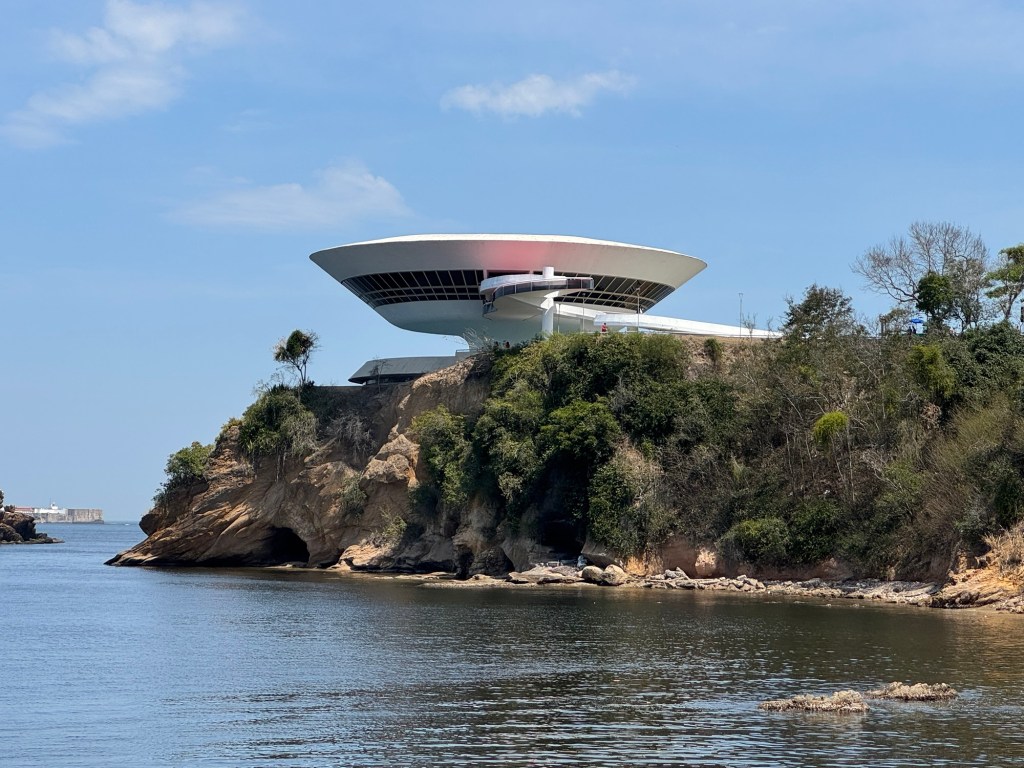
My first encounter with Niemeyer’s work was not in Brazil’s capital, but just outside of Rio, when I visited the Museum of Modern Art in Niterói. While this is a later work of Niemeyer, it didn’t disappoint with its originality.
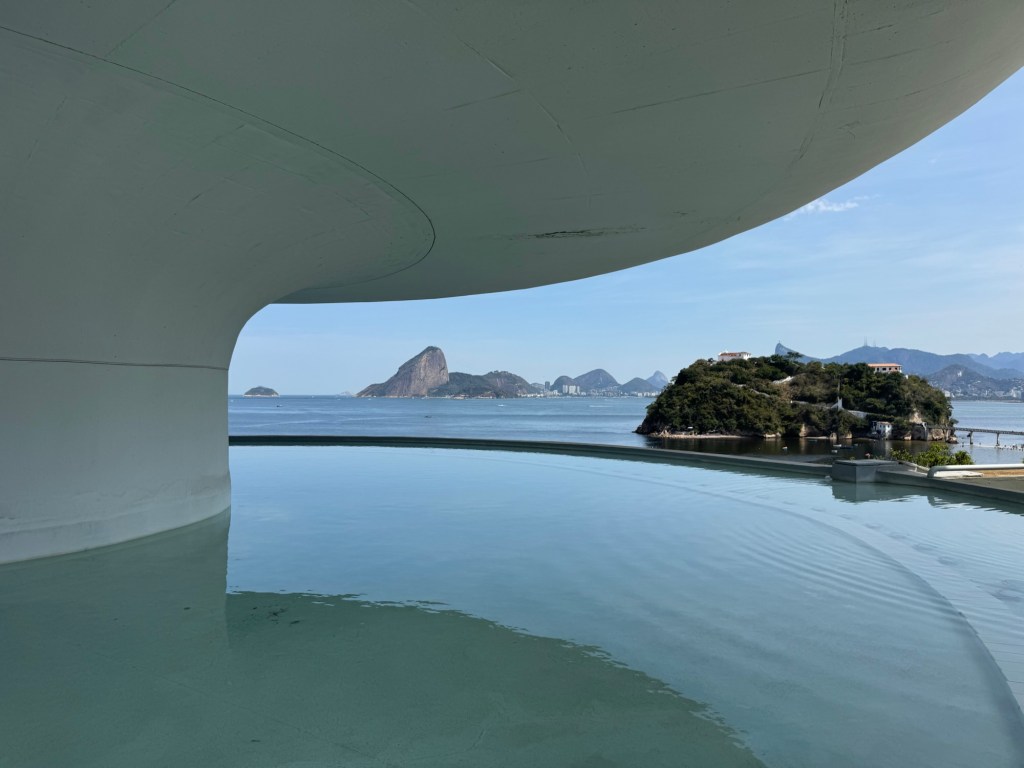
Resembling something like a flying saucer with a long, trailing, red and white scarf, perched on a rocky outcrop overlooking Guanabara Bay and beyond that, Rio de Janeiro and Sugarloaf mountain, this building is more than just a museum, it is a design statement.
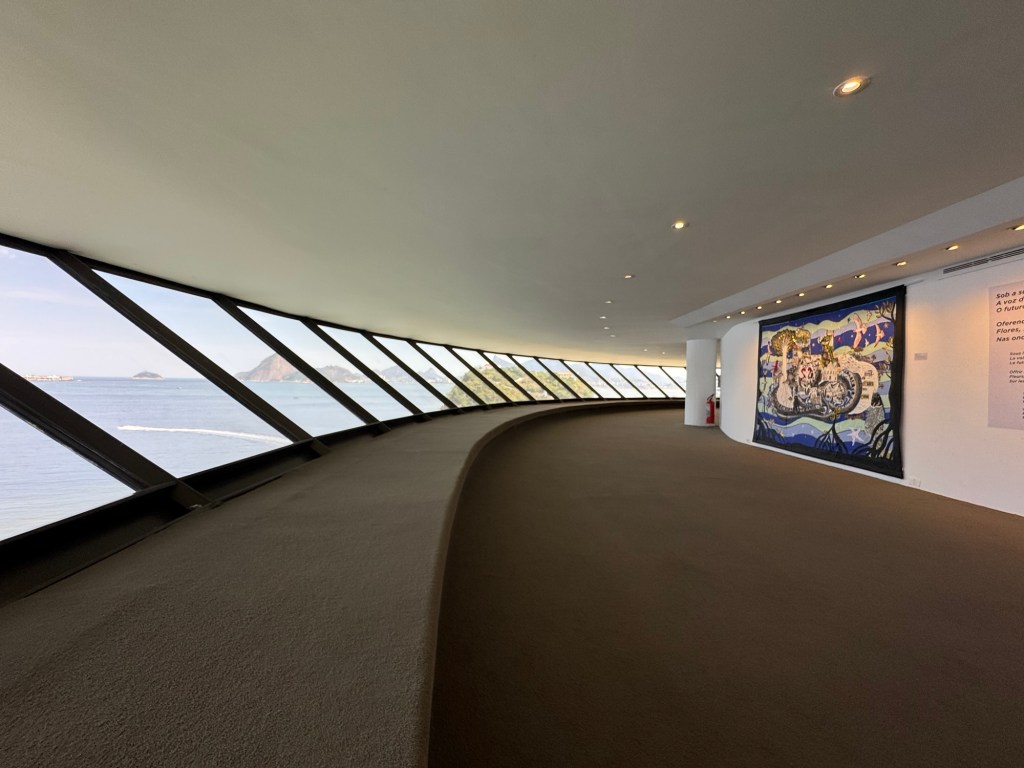
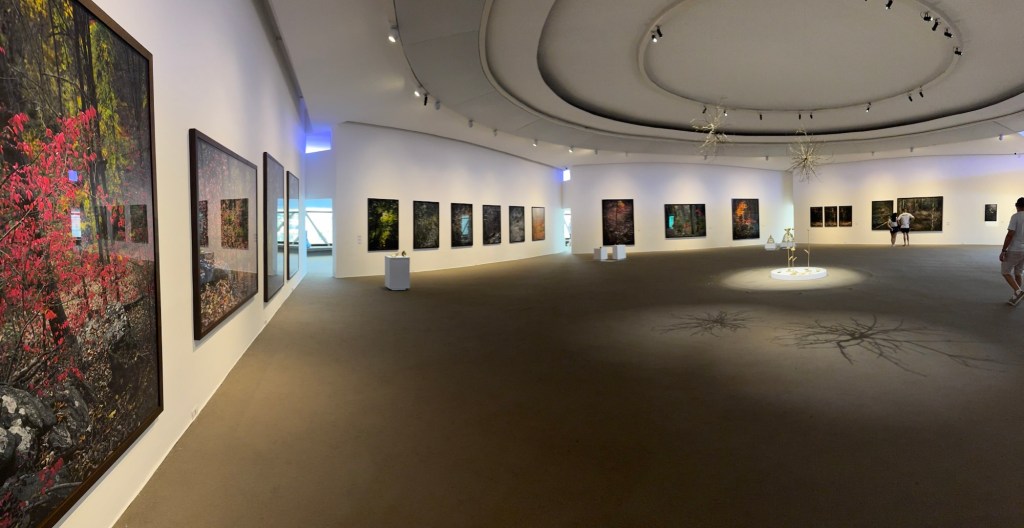
The windows on the first floor offer a 360-degree view, while the exhibition space, mostly sheltered from the daylight, is kept in the center of the construction. Standing on a single, slim column in a pool of water, which reflects the sunlight on to the underside of the building, the whole structure appears to float in mid air.
In addition, the museum features an upmarket restaurant in its basement, where the eyes of the guests are kept just above the ground level, so that every little detail and every small reptile or bird on the lawn outside the windows can be viewed, combined with the city on the other side of the bay.
A few days later I arrived in Brasilia, and as it was already night by then, the only Niemeyer structure located near my hotel was the TV tower, which, illuminated in lavender indigo, appeared to levitate in mid-air, as the lights on the supporting columns had intentionally been turned off. Sadly, I had to leave it by this first impression, as a nocturnal stroll along the mostly deserted streets towards the government buildings had come with a serious health warning…
Getting up early the following day, a short taxi ride delivered me to the entrance of the Metropolitan Cathedral and by this to the starting point of this so long scheduled visit.
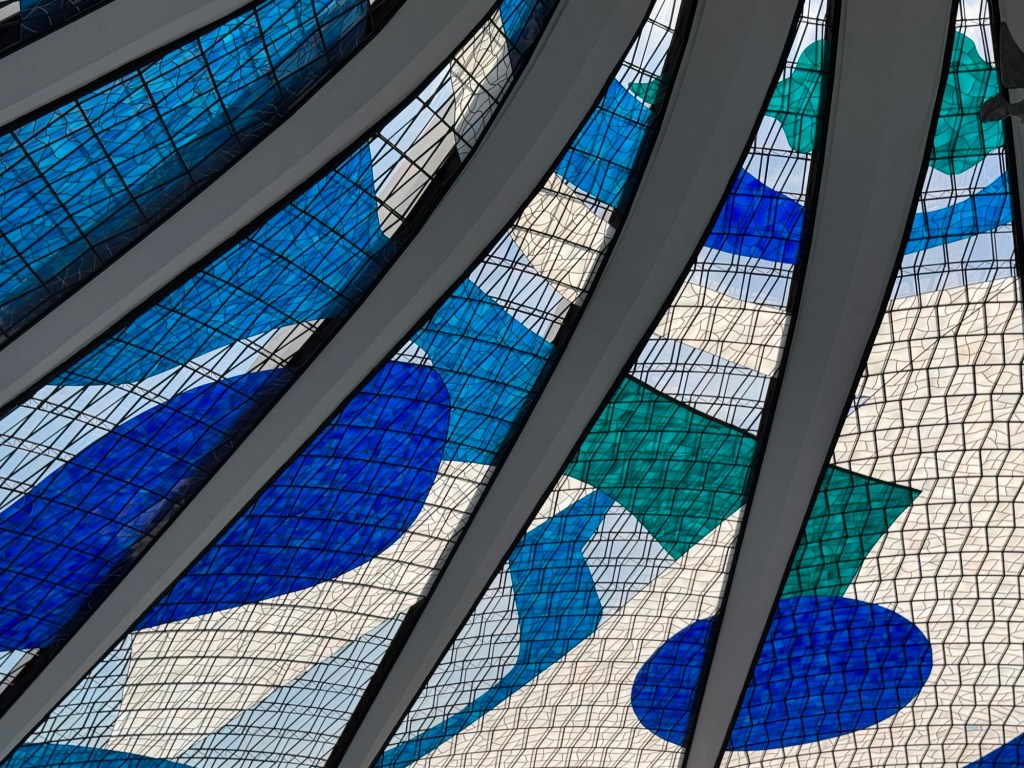
A circular structure of colourful glass and white reinforced concrete, this building looked nothing like a church, but more like a glass bowl for sweets one might have found on a nineteen sixties urban dinner table. Even the bell tower had been kept quite a distance away from the building and faintly resembled an oversized fork or a candle holder.
The inside of the cathedral was bright, with the glass of the roof kept in white and in different shades of blue and green. Suspended from the ceiling were a couple of angels.
The only feature that could have reminded an unprepared visitor of a traditional clerical building, was an abandoned wooden cross placed a bit out of sight against the wall. There was nothing here that produced the sometimes dreary, depressing, self flagellating, dark and guilt-ridden atmosphere of a traditional church. No crucifixion, no martyrdom of saints and no graphic portrayal of the final judgement.
Well, I thought, that is what you get, when you ask a communist to design a church….
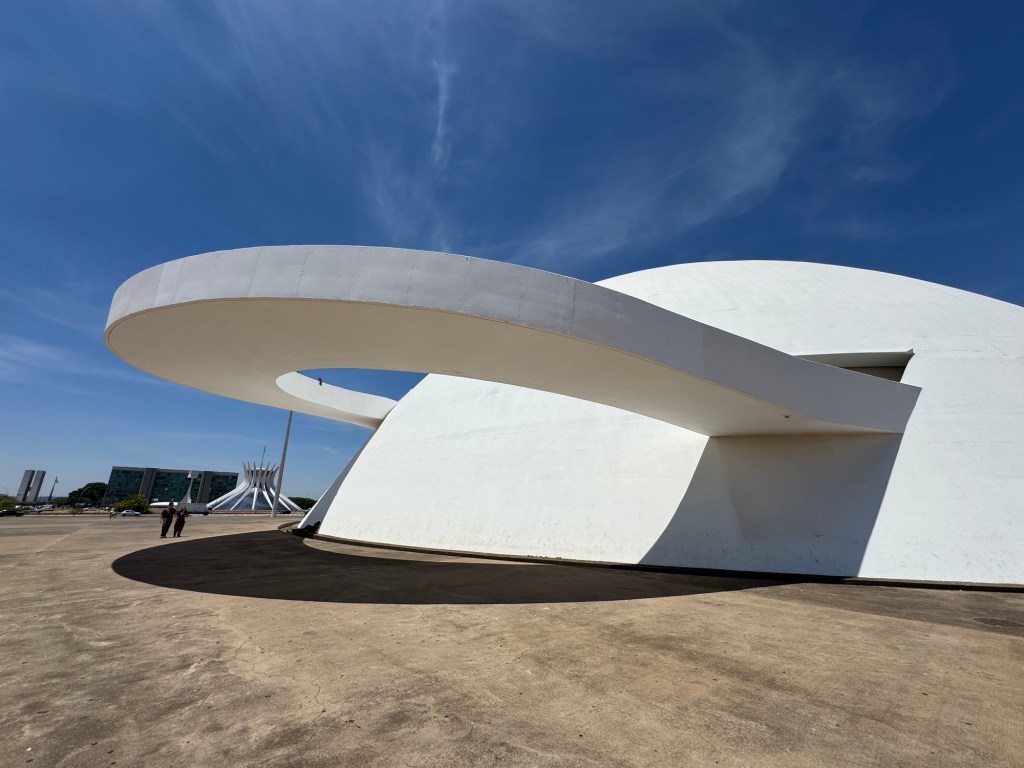
Next to the cathedral, slightly uphill, were the National Museum and the National Library.
The first one, again a domed structure, reminded me of an Igloo with a near impossibly suspended gangway circling a fair part of the museum. Without doubt this feature must have given the structural engineers a few sleepless nights.
The nearby library looked far more like a plain office building, if there wouldn’t have been the delicate rounded supporting arches at the first-floor level, that made all the difference and that aligned this building with some of the central government buildings further down the road.
Walking now along the “monumental axis”, the central highway towards the main state buildings, one had to pass a double row of plain and functional office buildings that housed most of the individual government departments.
At the end of these columns of administrative buildings, followed the more upmarket Palacio Itamaraty, which housed the Department of Foreign Affairs and on the contralateral side of the axis, the Department of Justice. Both of these buildings were surrounded by water and were accessorised with abstract sculptures. The Palacio da Justiça featured the above mentioned waterfalls. A white circular sculpture in-front of the Foreign Office, was by Bruno Giorgi, symbolising the five continents.
These buildings were the entrance to the center of Costa’s urban plan, to the head of the arrow, to the cockpit of the plane – the Square of the Three Powers, the Praça dos Três Poderes, featuring most of the buildings that had impressed me so much, many years ago.
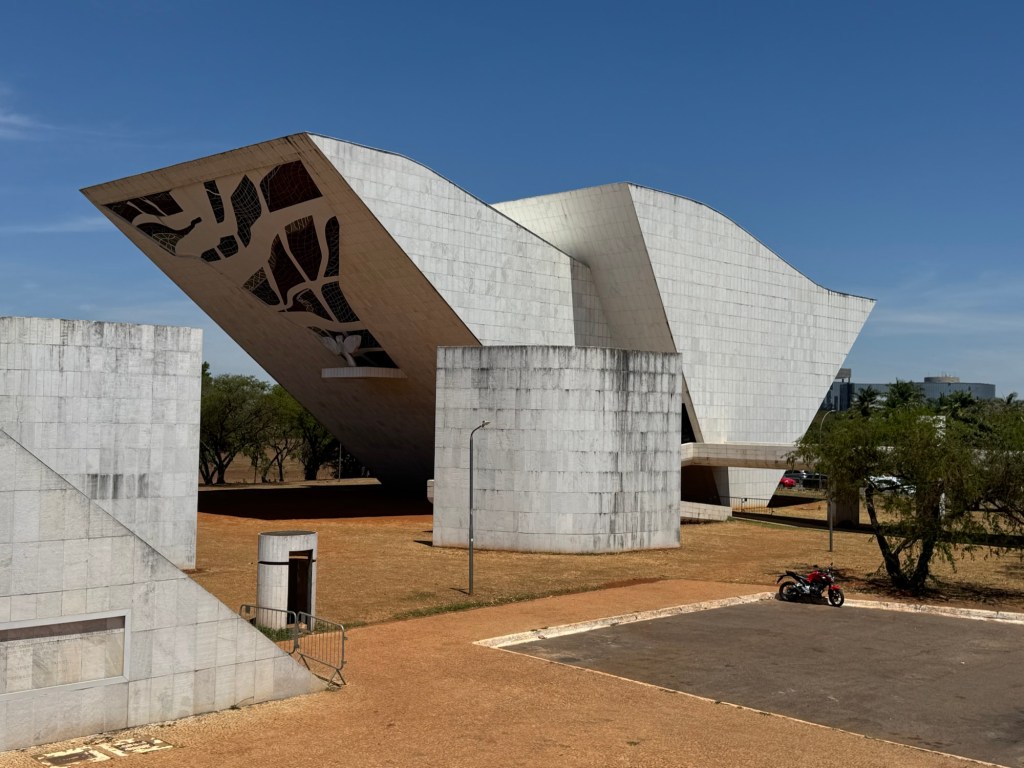
While dominated by the tall twin towers of the National Congress building on the west side of the square, which was facing on the other side of the square a giant flag pole (which was added later, under Niemeyer’s protest….) and a much smaller, more delicate building, that symbolised a dove and remembered a list of National heroes in a book of steel,
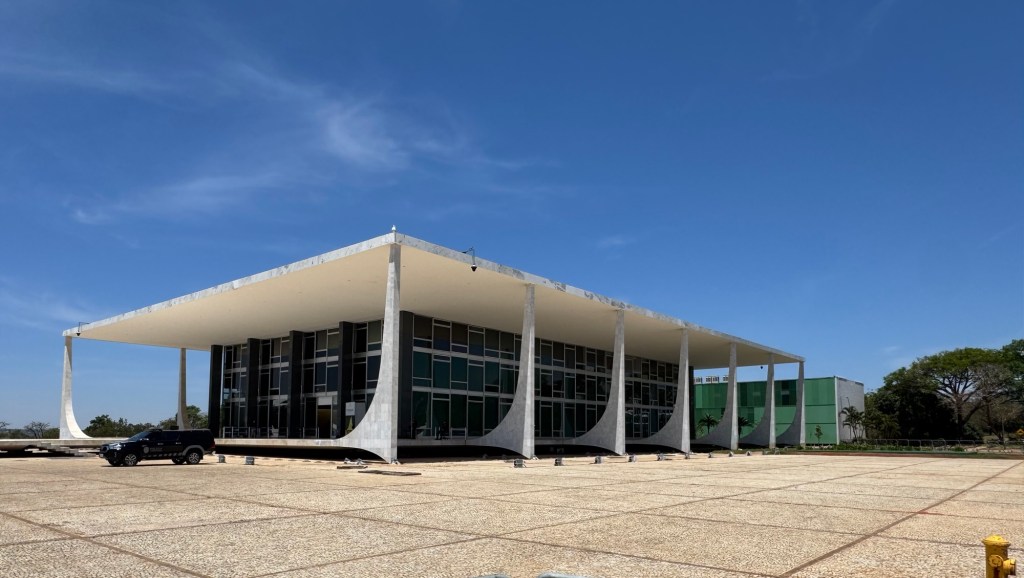
the real architectural stars were without doubt the Federal Court building on the southern side
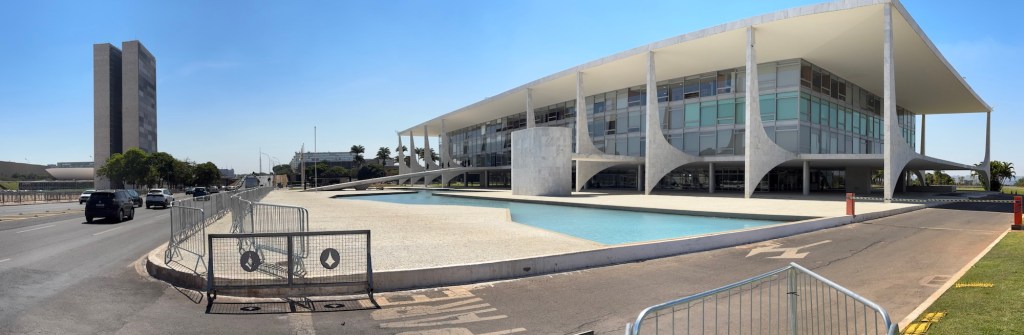
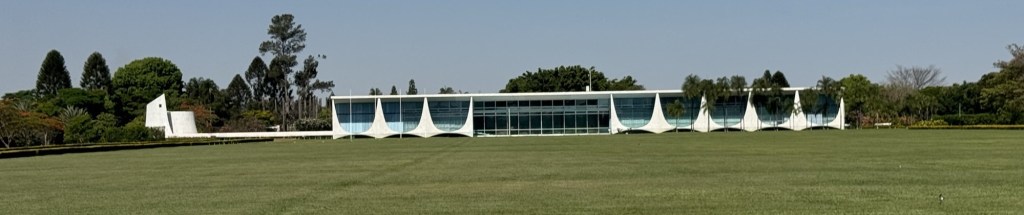
and the stunning Palacio do Planalto, which housed the Presidential Offices, on the northern side.
This building in particular, with its huge marble ramp and the large overhanging roof, supported by gently curved and yet very pointed columns, was quite rightly considered one of Niemeyer’s master pieces.
The distance between all these buildings was covering the best part of two kilometres, and with the mid-day heat now transforming the square into a frying pan, there was some much needed shelter provided in a small café on the eastern side of the square.
This stylish place – of course also designed by Niemeyer – was a partially subterraneous structure, which kept once again the eyes of the guests, once seated, at a level with the surface of the square, a detail that was later repeated in Niterói.
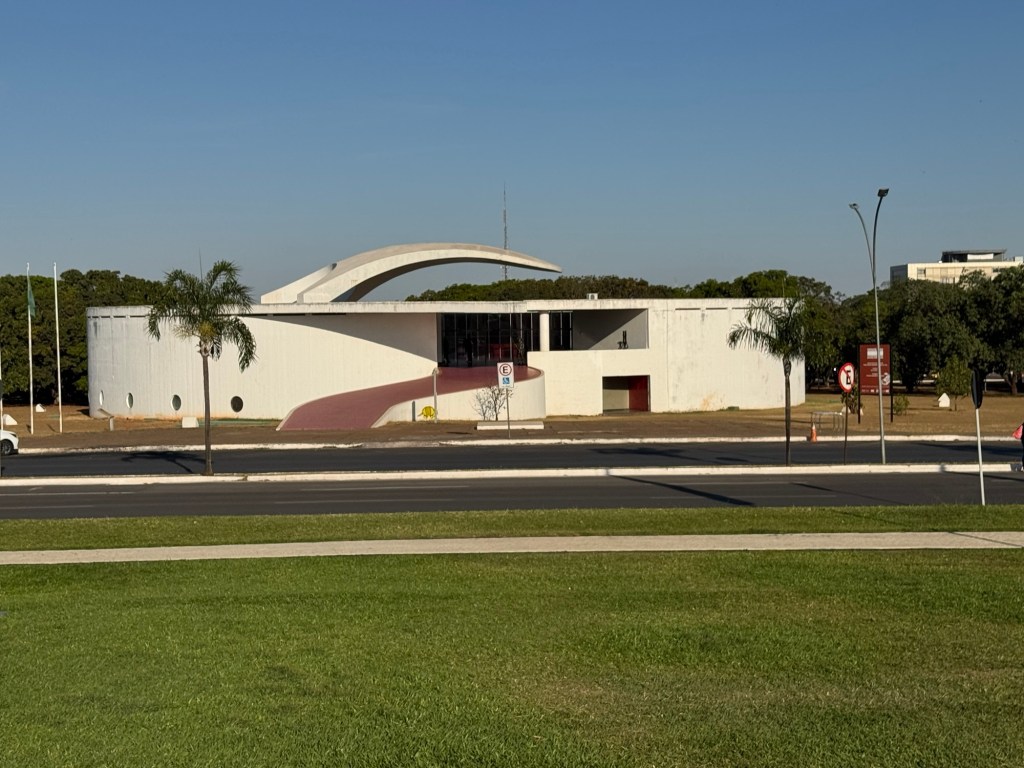
While recovering with a cold drink, it became clear to me that all the other famous buildings had to be explored with the help of a taxi. The equally stunning Palacio da Alvorado, the presidential residence, which features similar columns as the Palacio do Planalto, the pyramid-shaped National Theatre building, the National Football Stadium with its exoskeleton of seemingly a thousand columns, the dome shaped giant food hall next to it or finally, at the tail end of the Axis, the JK Memorial and the Memorial dos Povos Indigenas – all of them outstanding architectural statements and each of these buildings worthy of a chapter of their own.
Palacio da AlvoradoNational Football StadiumMemorial dos Povos IndigenasJK Memorial
At the end of the day, I was exhausted, but unexpectedly well hydrated because of the half litres of freshly squeezed strawberry juice, which cost the equivalent of 50 pence (I think I enjoyed three of them…) at the restaurant inside the JK Memorial.
Walking up the hill from the Congress building towards the Department of Justice, I noticed a man with a large cowboy hat, who had befriended a small white heron.
For some reason, this looked out of place….
Here was an interaction between an animal and a human being that hadn’t been planned, that wasn’t part of the design, that distracted from the grandeur of all the monumental, once groundbreaking structures and from the system of highways around us.
And with this, the giant floor of places like Brasilia became apparent.
Cities that have not grown, but that have been conceived in an urban planning office, based on plans that then had been dictated by an autocratic ruler or – as in this case – that had been agreed on by a committee of a few men (and often no women…) and that finally were build as a giant national project, usually fail to make the people happy, who have to live in them.
While Dubai might have an appealing warm climate and might be a great place for shopping, while Milton Keynes might offer great work opportunities and affordable housing and while Songdo might offer a Free Economic Sone, Satellite Campuses of renowned foreign universities and an excellent road infrastructure, no one is drawn to these places because of their beauty, of their appeal as a place just to live there. No one, unless forced by financial or by other constraints, would seriously choose to retire in these places.
There is a good reason why cities like Barcelona, like Istanbul or London are continuing to grow, despite the poor infrastructure, the strained health services and the social economic problems they might have. It is because they have a soul, they have a history, because they have a personality that has grown over hundreds if not thousands of years and that have stood the test of time.
Brasilia, with its astonishing, monumental buildings, which quite rightly deserves its World Heritage site status, is like a carefully arranged dish without taste, like a Burgundy wine with a deep red hue, yet without flavour, body and finish. It is like a beautiful person, but without wit, charm or character, completely devoid of personality.
There was a good reason why Niemeyer, while enjoying the time during the construction of all of these buildings in Brasilia, eventually decided to spend the final days of his long life in a flat on the Copacabana in Rio de Janeiro.
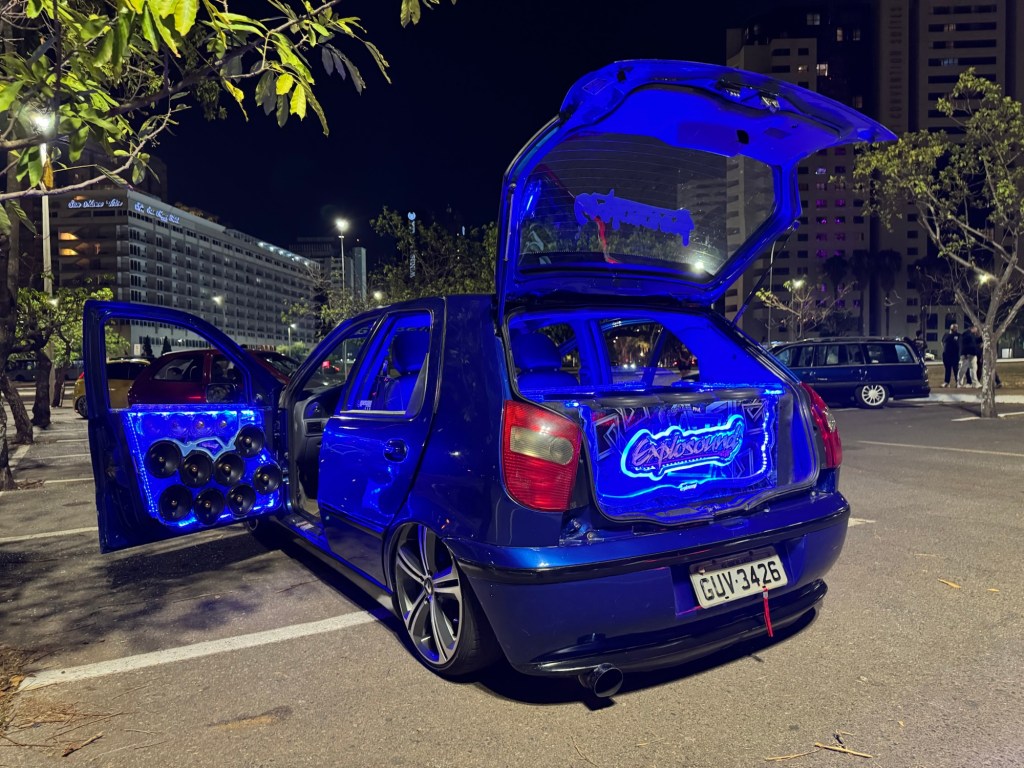
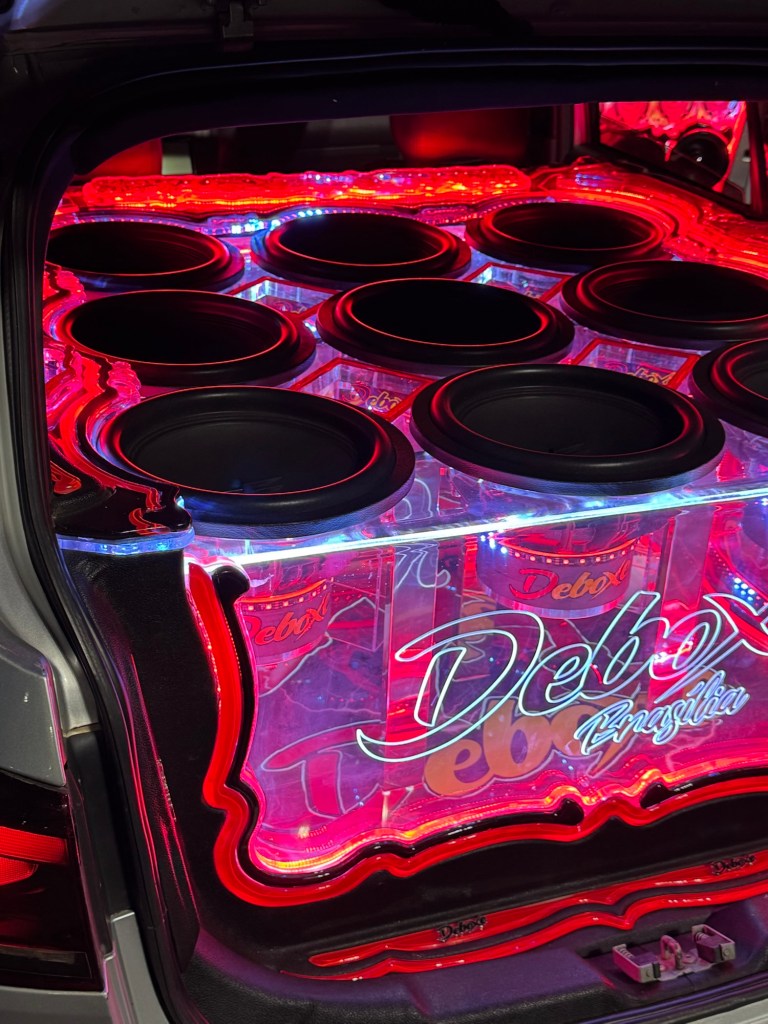
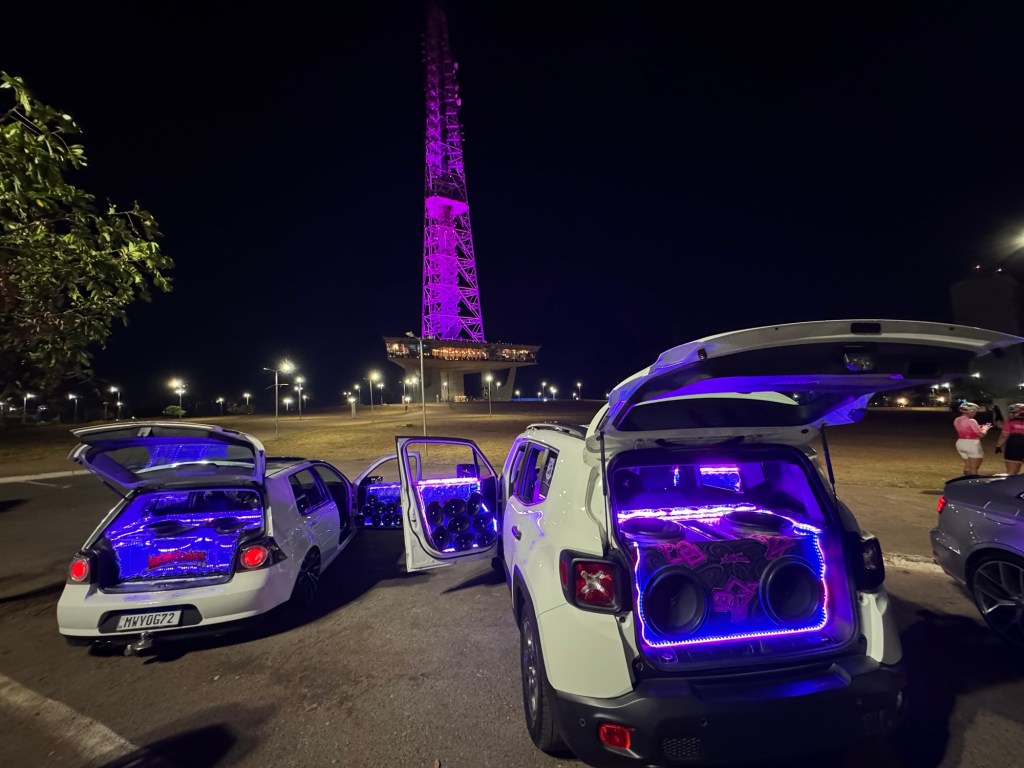
Strolling back from dinner at the restaurant at the base of the TV tower, I walked straight into a gathering of tuned cars.
All lowriders on steroids, that had a ground clearance of not more than 10 centimeters, their bodies polished to a lustrous shine and the interior of all of them packed with obscene numbers of loudspeakers and LEDs, which probably required a second alternator to provide them with the necessary power.
While the TV tower made a perfect backdrop for this rally, I considered it to be a very fitting end to my stay: Brasilia, I found, is probably more a city for cars than for people and it is unlikely that I will make again a detour for a visit.
It was 4 o’clock in the morning, the power cut had started 6 hours earlier and it was 32 degrees in a room with next to no ventilation.
It was then, when a group of howler monkeys were starting with their morning concert in the wildlife camp I was staying at in the end of September. What sounded as if someone had started to deploy an industrial cleaning device in the adjacent bathroom, originated from the top of the trees above my cabin. All hope for at mere hour of sleep before sunrise was finally dashed….
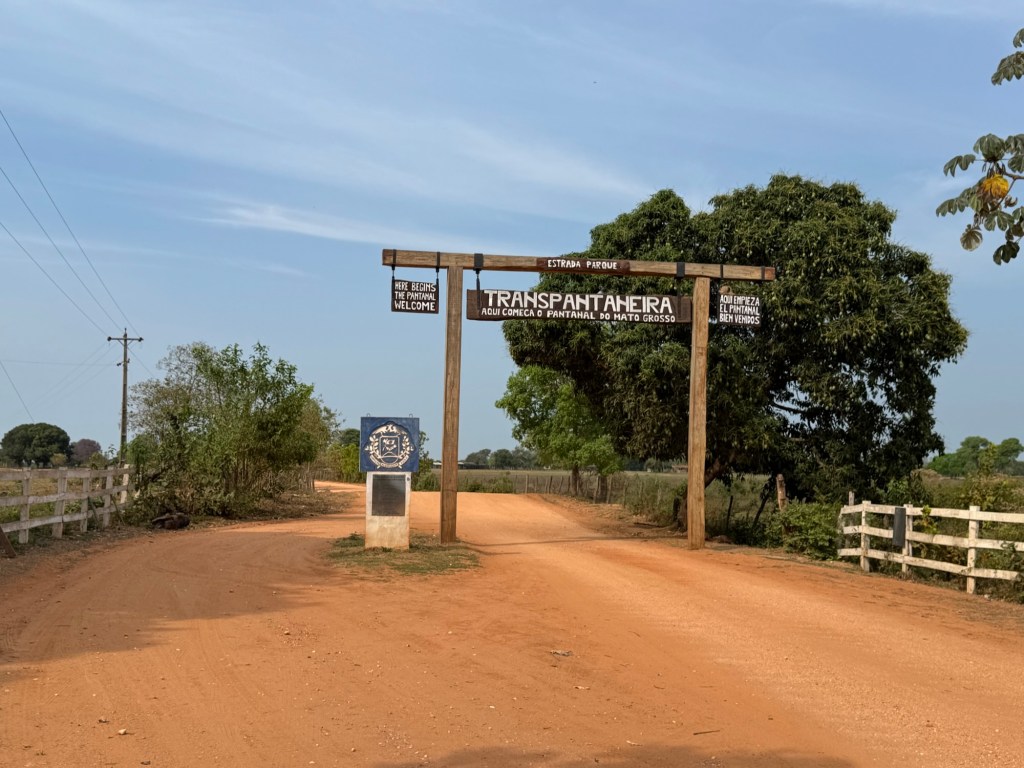
Following my visit to the World Small Animal Veterinary Association Congress in Rio, I had travelled to Cuiaba, a Brazilian city not far from the border to Bolivia and Paraguay, that is a gateway to both the Amazonas region to the north and the Pantanal to the south.
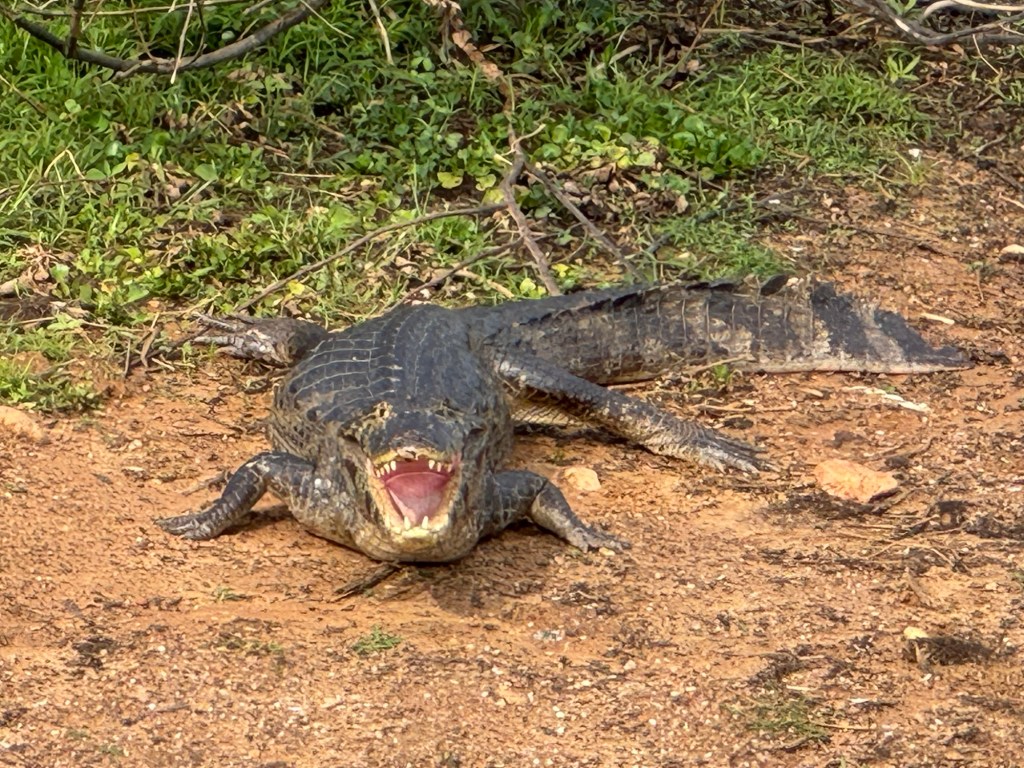
The Pantanal is a godforsaken giant swamp area, that is for most of the year waterlogged with impassable roads. It is mosquito and caiman infested and altogether an undesirable place for both human settlements or for any sort of farming.
With the exception of some gold prospecting over the last few years, which had left the affected areas with giant craters, mountains of discarded soil and with a few untarmacked roads, the environment and the wildlife here had been left mostly untouched, with the result that the Pantanal had established itself as a Mecca for wildlife watching like no other place in Latin America.
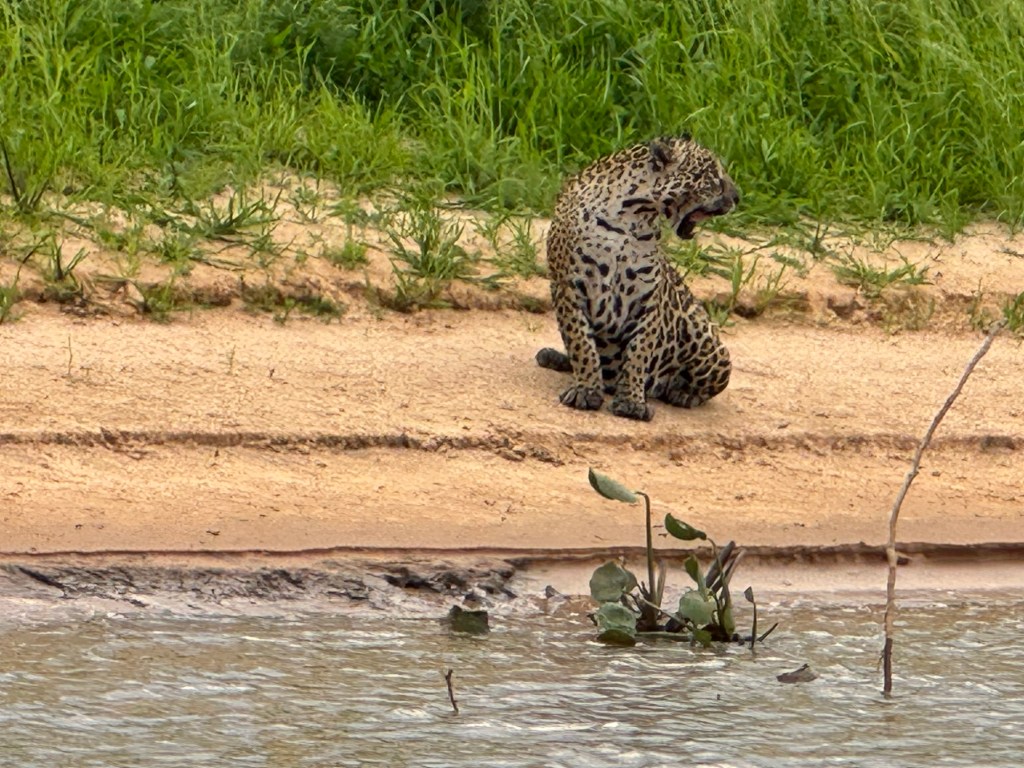
This is particularly true for the Jaguar and it was not difficult to see that a whole industry had evolve around it.
Image by Eva Lau and Qi Shuai
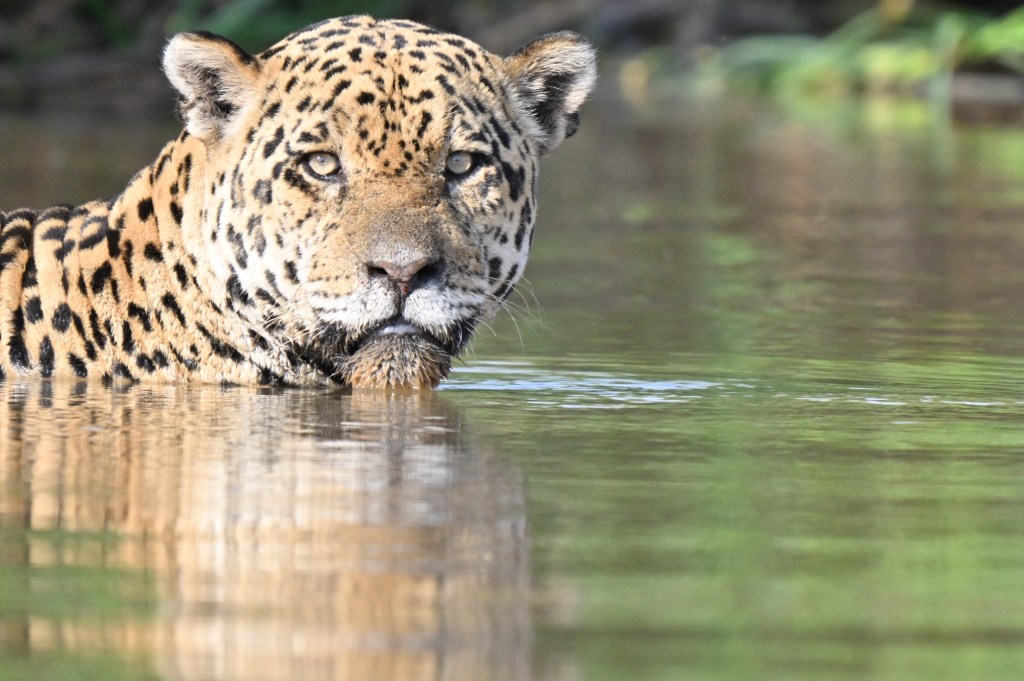
This elusive, third largest wild feline predator, which in the rest of South America is considered to be extremely rare, is thriving here and occurs in large numbers. This is of no great surprise, as for a big cat that loves to swim, that can of course climb any tree and that feeds not only of deer and capybaras, but also of caimans, fish and any waterfowl it can get hold of, in the Northern Pantanal the table is always abundantly stocked.
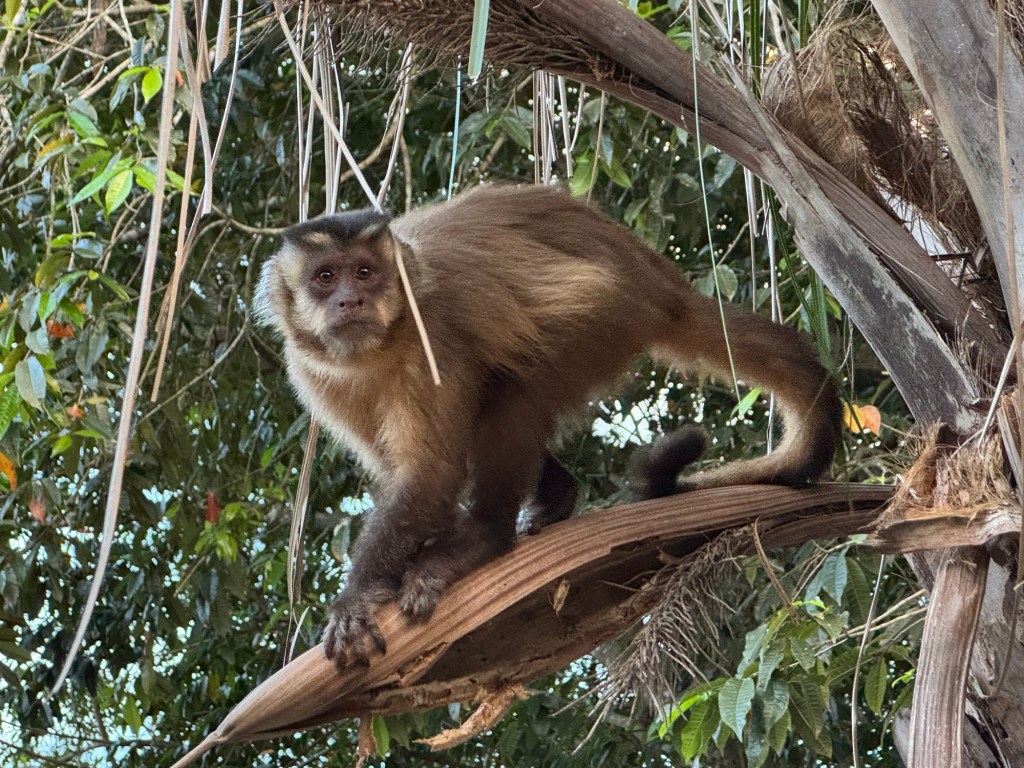
At first daylight, I crossed the yard when I was greeted by a young Capuchin monkey that was rummaging around in one of the palm trees for its breakfast.
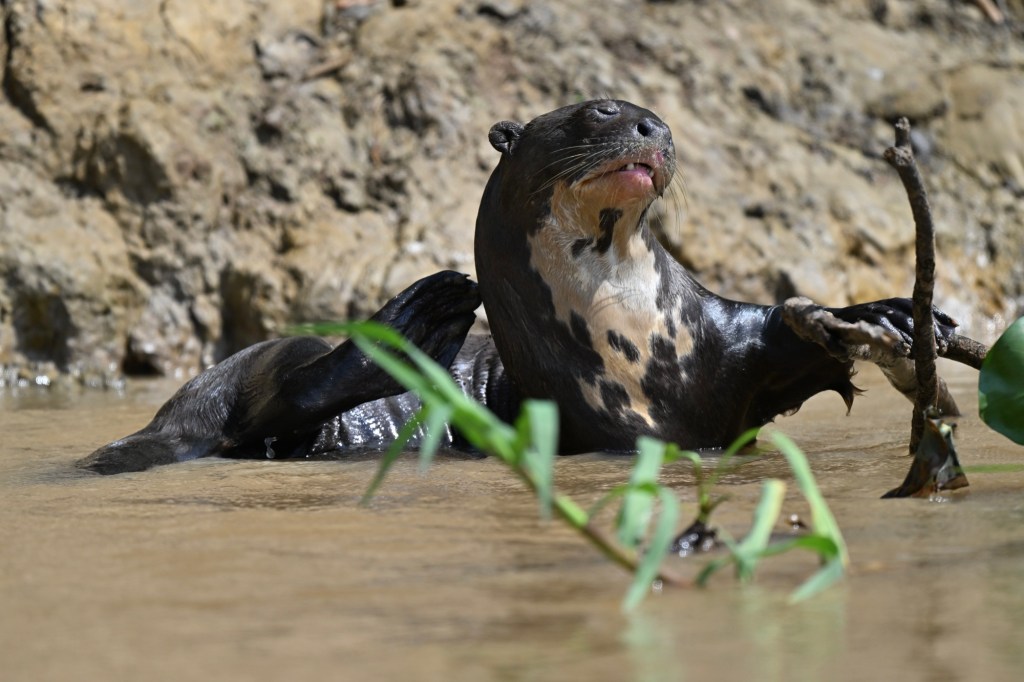
Image by Eva Lau and Qi Shuai
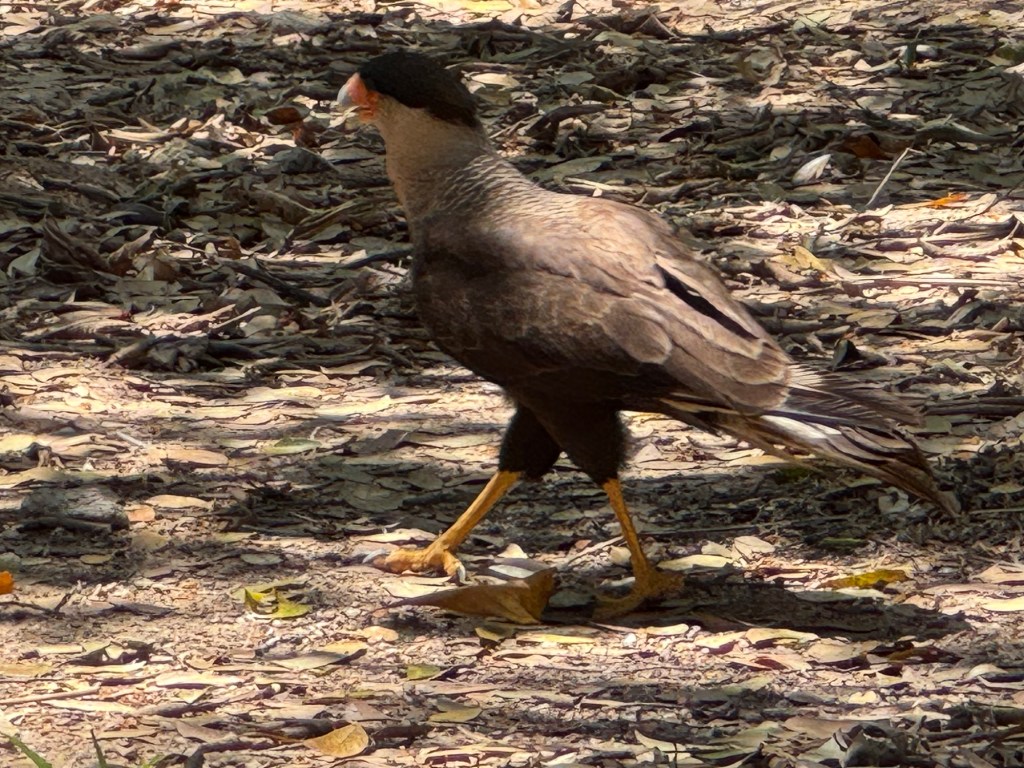
The monkeys, together with the resident caracaras, colourful birds of prey that were patrolling the premisses like a flog of chickens,
had already tidied away any scraps of food or faintly edible waste that might have been dropped or forgotten outside the previous night.
High up on a tree branch, a pair of rare Hyacinth Macaws were busy grooming each other and screeching from time to time in response to the activities on the ground below.
Joāo, our guide, was mortified – it would have been his job to start the emergency generator when the power had cut out, but by being more adapted to the heat, he had not noticed it and had slept right through it.
Well, a lack of sleep was nothing that a strong cup of coffee couldn’t fix….
When a short while later we turned up at the small beach of Port Jofrey, a place of not more than three brick buildings, a small cluster of house boats and a short, bumpy landing strip for brave pilots and small planes, Markus, the captain of our aluminium bottomed speed boat, was already waiting for us.
The local river and its contributories were the real transport links in this part of the world and most of the wildlife, similar to deer peacefully grazing next to a busy motorway, had adapted to the activities on the water. Little to no hunting was happening here, only with the exception of the occasional deer or capybara taken by one of the local residents, so that most animals continued with whatever they were doing, completely unaffected by any observer or passing vessel.
By pure coincidence, it turned out that the timing of my congress had coincided with the end of the dry season in the Pantanal. This meant that most of the wildlife was more concentrated on the remaining pools of water and on the river sides, which made wildlife watching so much easier.
This window of opportunity would only last for a few weeks, until the rain and huge amounts of flood water from the Brazilian Central Plateau were due to arrive.
Natale, our friendly and always helpful driver had explained that during that time the roads, that were bone dry sand tracks at the moment, would be impassable and the wildlife camp would have to shut down for several months. Using the road on a daily basis, he had been caught out a few times by unseasonably early downpours a few times and had experienced the effects the hard way.
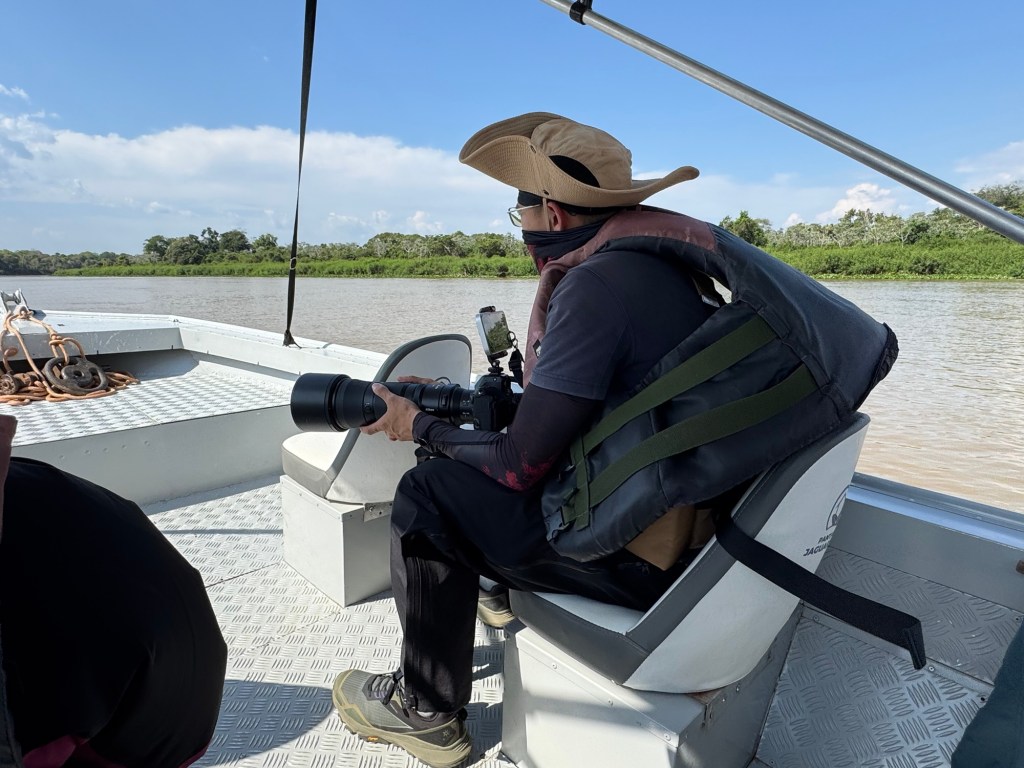
With the help of a a powerful outboard engine, our boat had made fast progress and we soon found ourselves in a more remote part of the reserve. With me on the boat were Eva Lau and Qi Shuai, a couple from South China, that were using all of their five days annual leave on this excursion. They had arrived far more prepared with professional looking Nikons, fitted with powerful tele-lenses. Their gear enabled them to capture even the finest details of the smallest birds and reptiles over a long distance.
Luckily, they were more than happy to share a few of their images, so that I could relax with my far more inferior smart phone camera set up, sticking to larger objects and to the scenery around us.
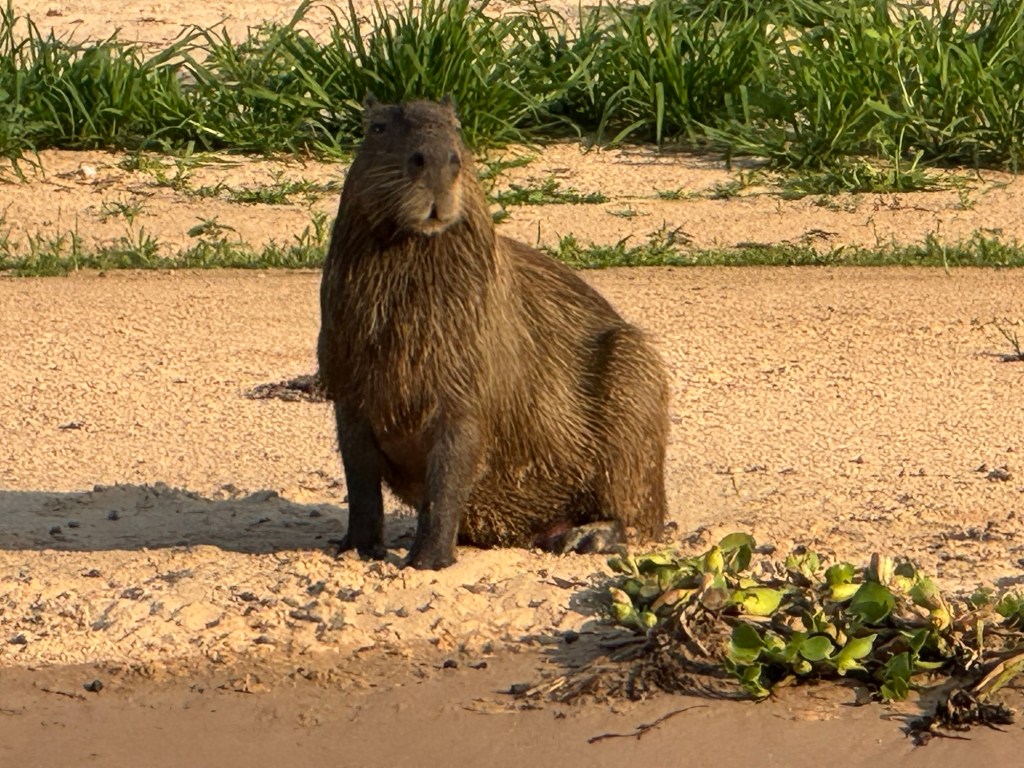
After passing a few groups of capybaras on the river bank, we didn’t have to wait long until we spotted the undisputed rulers of this half submerged world – a couple of jaguars, in fact a female with her nearly grown up cup, which were just emerging out of the water and then disappearing into the lush vegetation near our boat. Despite a cataract in one eye, the mother was still an excellent hunter and she was seen later that day catching one of the at this time of the year numerous caimans.
The next jaguar we saw was less camera shy, sunbathing on one of the small sand beaches that could be found alongside the river, which were normally populated by groups of capybaras. The automated shutter mechanisms of the cameras next to me went wild…..
Less than an hour later, when it was starting to get progressively hot, we spotted another jaguar resting underneath a tree and shortly after that another two swimming across the river ….
That was when the Tiramisu effect hit – there can be too much of a good thing….
Like having the famous Italian dessert for breakfast, lunch, afternoon coffee and for dinner, you eventually will get tired of it. It was, what happened to us.
The cameras clicked less frequently, less dramatic or partially obscured shots were no longer taken and the initial excitement of a sighting was replaced by just respectful admiration.
When we ventured out for a second excursion in the afternoon, the jaguar, from having been the main attraction, had now been relegated to the ranks of an average member of the cast and we were elated by the first sightings of a group of giant otters, a toucan on a tree branch, a nesting giant owl or of the first tapirs.
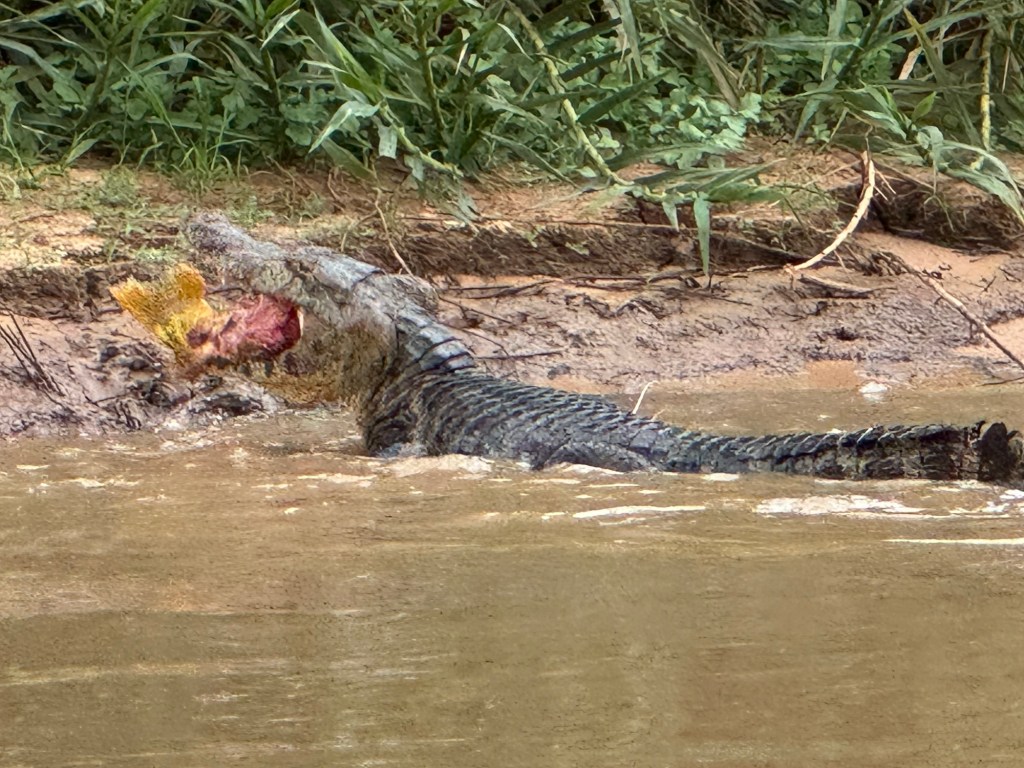
Image by Eva Lau and Qi ShuaiImage by Eva Lau and Qi Shuai
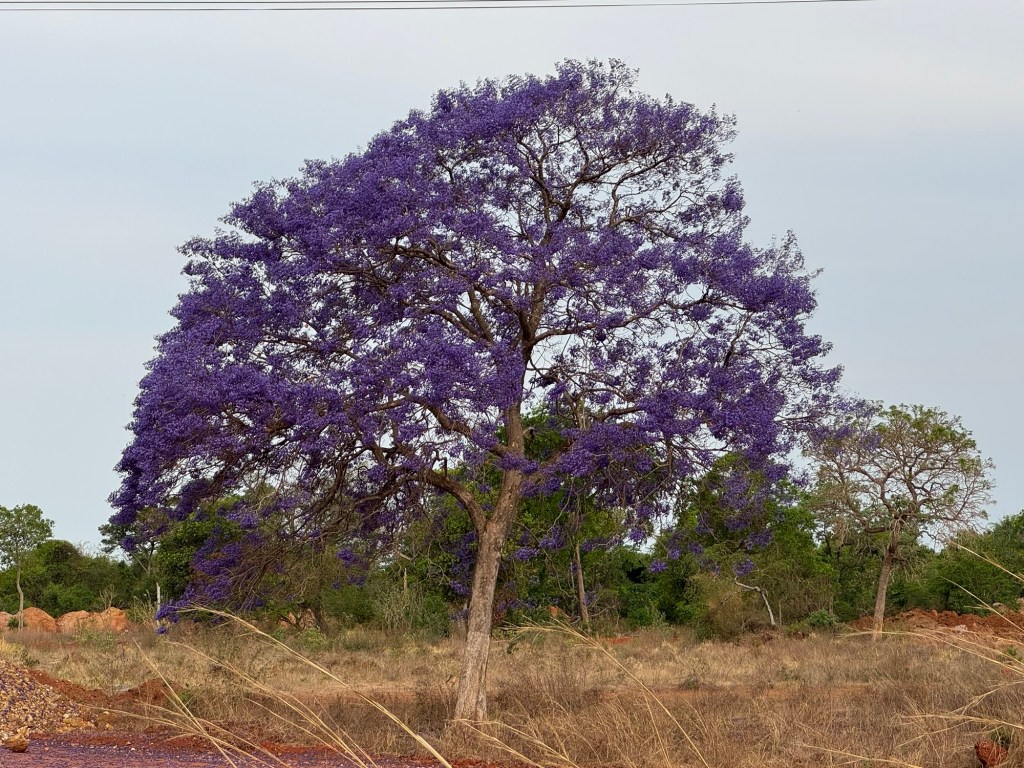
Smaller birds, rare herons and feeding caimans, even Taruma trees in full bloom and individual smaller plants were now recognised and only then, real appreciation for this unique part of the Globe was allowed to emerge…
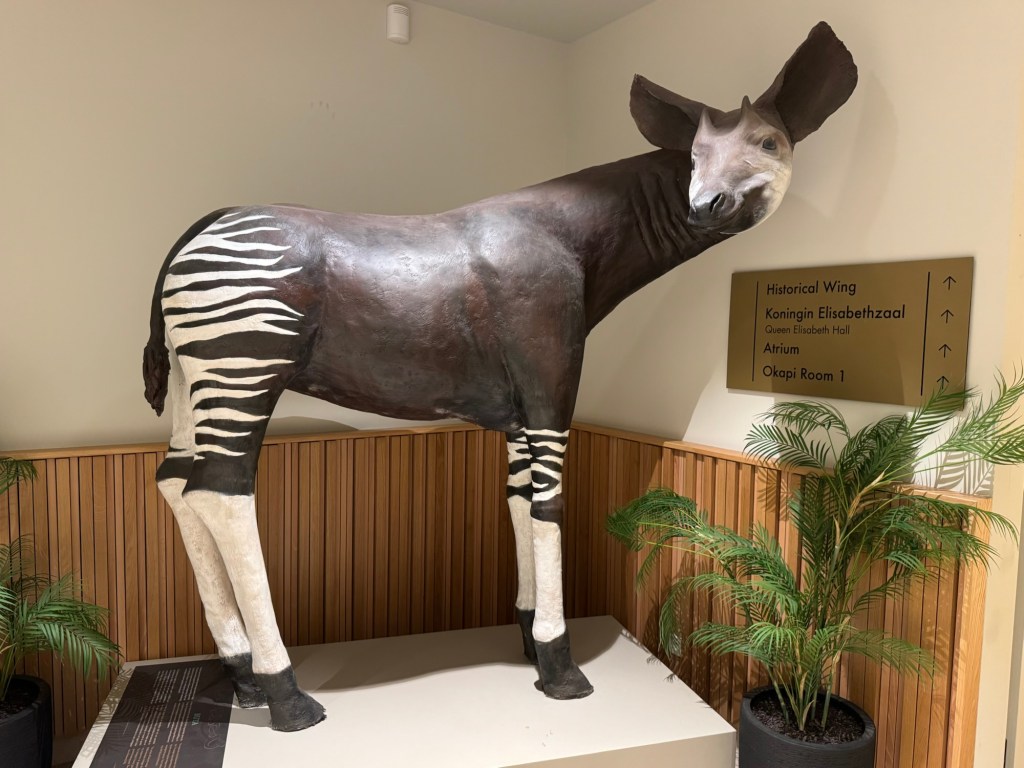
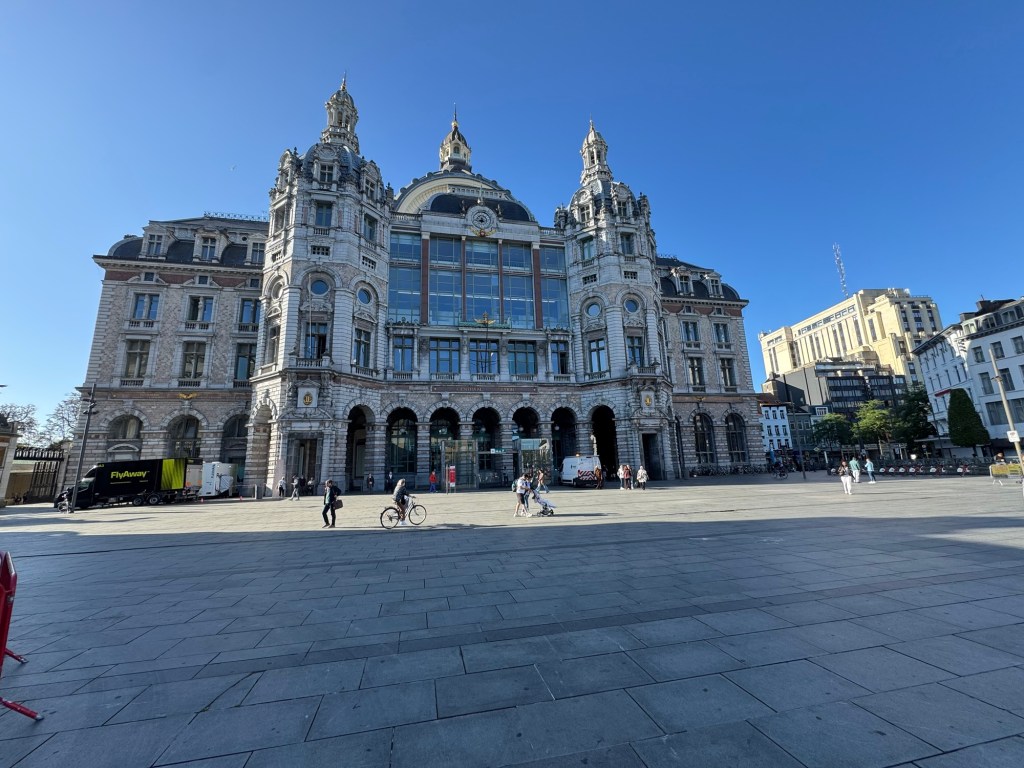
The early September sun is about to climb above the roof of a conference centre in the middle of Antwerp, that can claim to feature a “Room with a Zoo” as well as a meeting room guarded by the life-sized model of a Central African Okapi.
The first rays of direct sun light are starting to warm the pavement at Koningin Astridplein, the busy square in front of the venue, for another day of comings and goings, meetings and partings, arrivals and departures.
At the congress I am due to meet friends and colleagues, all likeminded veterinarians from all over Europe, who have descended on the city of diamonds to renew and to extend their knowledge and their skills to improve the treatment and care of their patients, where ever on the continent they require veterinary attention.
But yet there is time….
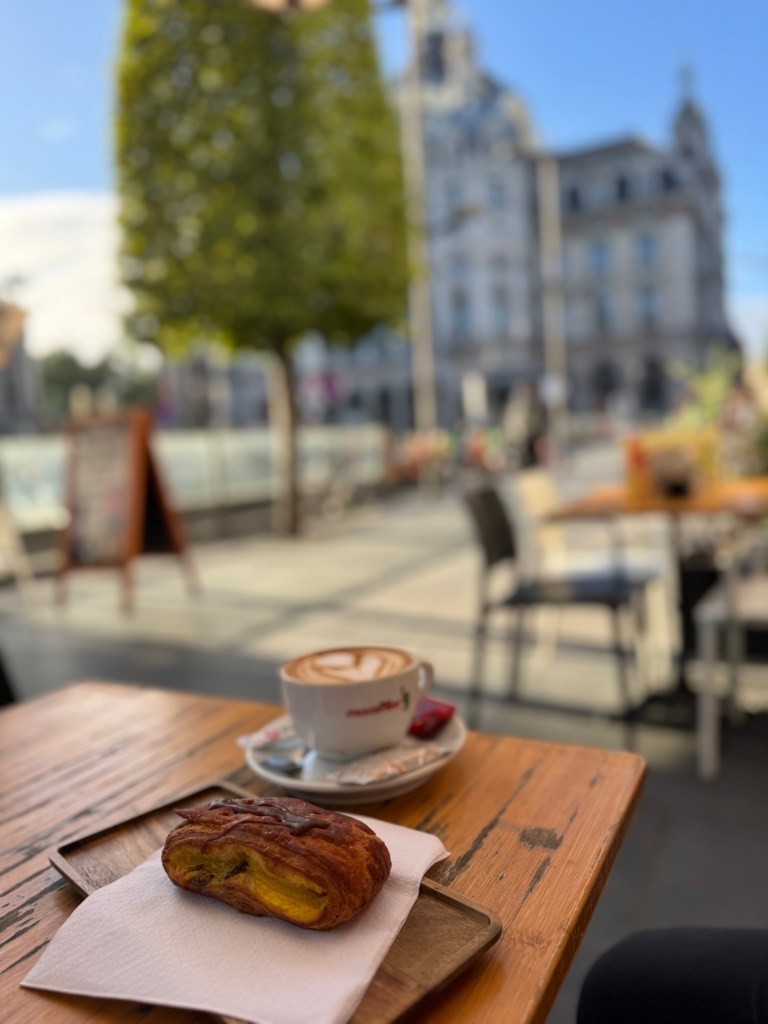
Time before the first lecture for a coffee and for some Belgian pastry for which there seems to be no better place than at the Mocambo Cafe, a small joint on the western fringe of the square, just a stone throw away from my apartment.
Antwerp, like Brussels, strikes me as a place of many contrasts, but I am a patient, at times surprised and at other times a somewhat puzzled observer.
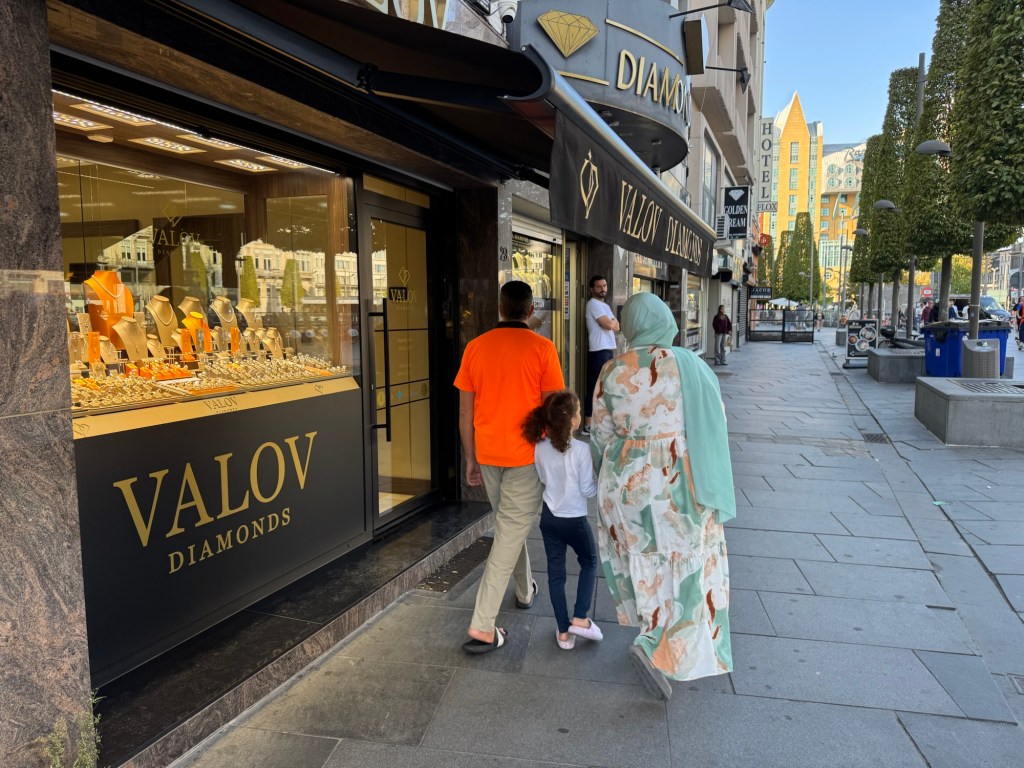
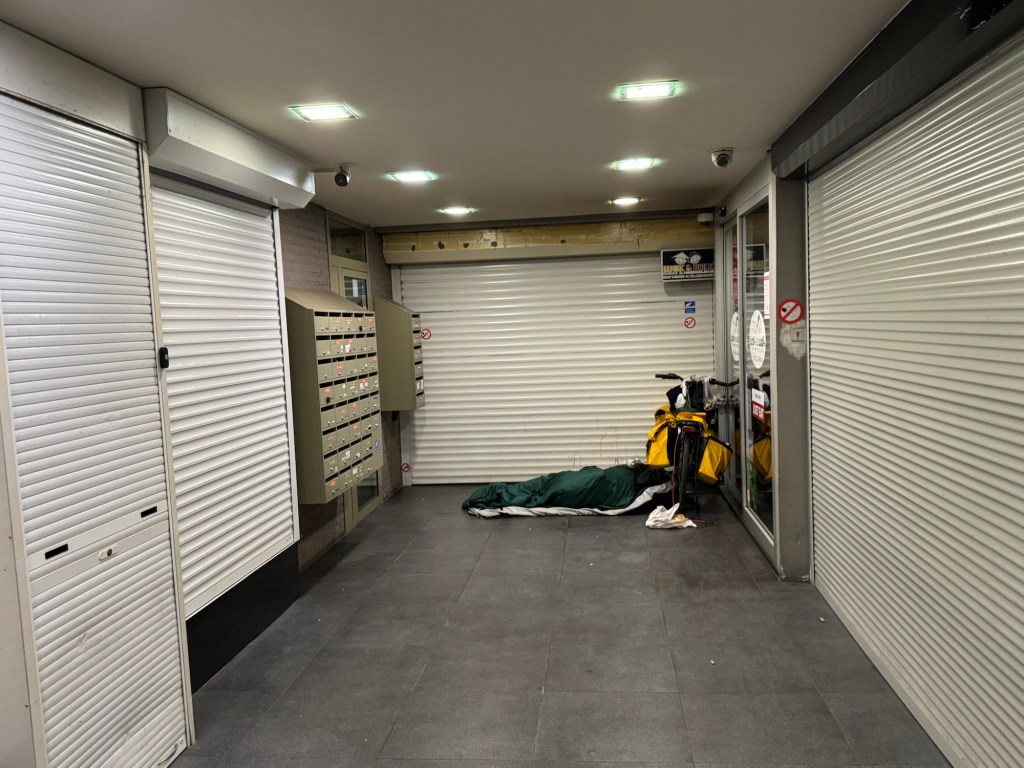
While staying at probably the most central place in town, right above a row of jewellery shops packed with precious splinters of translucent carbon, that can cost the multiple of a man’s monthly or even annual salary, I have to step at night when the shutters are down and the outlets are closed, over the bodies of homeless rough sleepers, to get to my dwelling that is secured with a couple of solid steel doors.
Settling at a small table outside of the coffee shop, I am turning into a member of the audience, seated in the front row of another daily performance at the theatre of life on Koningin Astridplein.
The hissing sound of the espresso machine, the clinging of cups and saucers and the clattering of the cutlery is blended with the cacophony of conversations and the shouting in multiple languages, underlined with the sirens of an ambulance, the ringing of bicycle bells and the hooting of cars. A child is crying because it was woken up too early, a couple is arguing because they are about to miss their train, and a police whistle fails to stop a car that is driving in the wrong direction.
The smell of coffee and warm pastry is interlaced with that of an expensive perfume of a passing business women, with the faint stench of urine from the nearby doorway that had to substitute as a lavatory for a drunken dweller the previous night, with the oriental spices of the Arabic restaurant next door, with the odour of some bags of rubbish that should have been cleared away already a couple of days ago, as well as with the smoke of a just lit cigarette on the table next to me.
The square in front of me is a rich palette of delivery drivers on colourful electrical bikes, of vailed women, next to bare bellied young girls and heavily tattooed men with professionally trimmed beards. Ray Bans on heads with dyed hair, air pads and high end headsets, bicycle helmets, gold jewellery and stainless-steel piercings are accessorised by brightly coloured scarfs, expensive handbags and urban bagpacks.
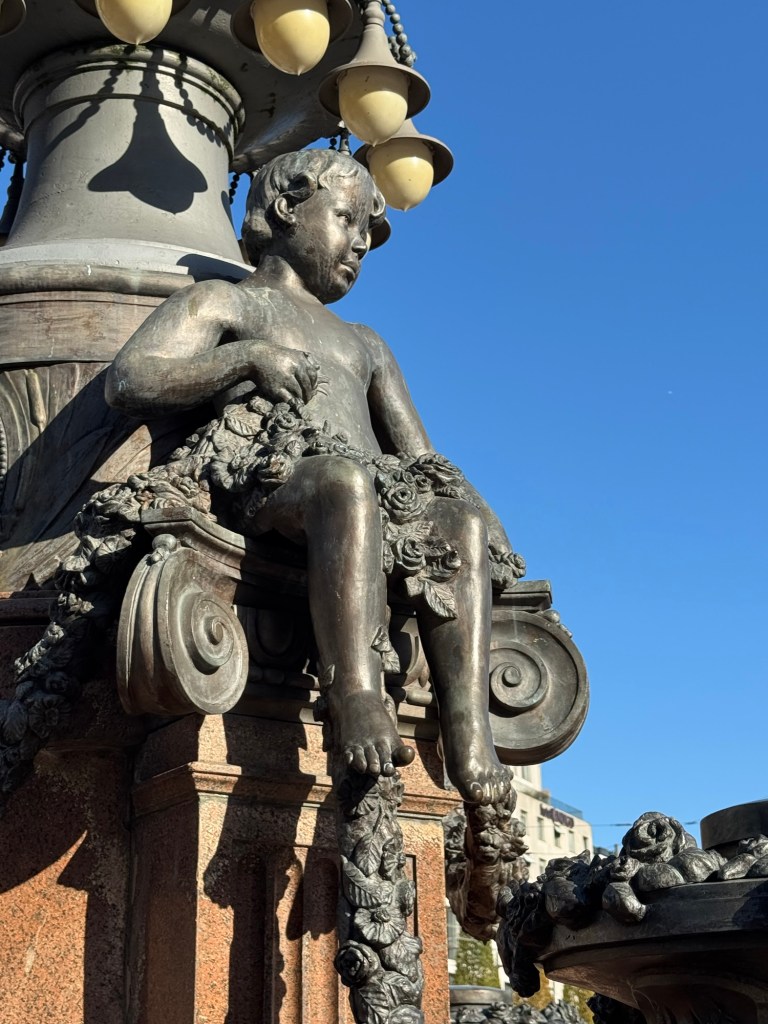
A tourist appears to be lost next to the bronze statue of a naked child sitting on the base of one of the two elaborately decorated lamp posts in the middle of the square, a couple is hugging and kissing not far from a long row of rental scooters, an old lady is walking her equally aged and clearly overfed toy dog and a delivery driver and a shop keeper are engaged into a heated argument, all under the watchful eyes of a young boy riding on a camel that is precariously balancing on a pedestal high above the roof tops.
And yet, Koningin Astridplein is just the fore court, just the prelude to the main act, to the central character in this play:
A cathedral, fit for a king (and commissioned by one), but dedicated to Mercury, to Hermes, to Saint Christopher or even to Ganesh, the gods and patron saints of travel, of timetables, of restlessness and of transience. In its nave populated by creatures fed with coal, diesel or high voltage, that were once just arriving and departing here, but that are now running right through it.
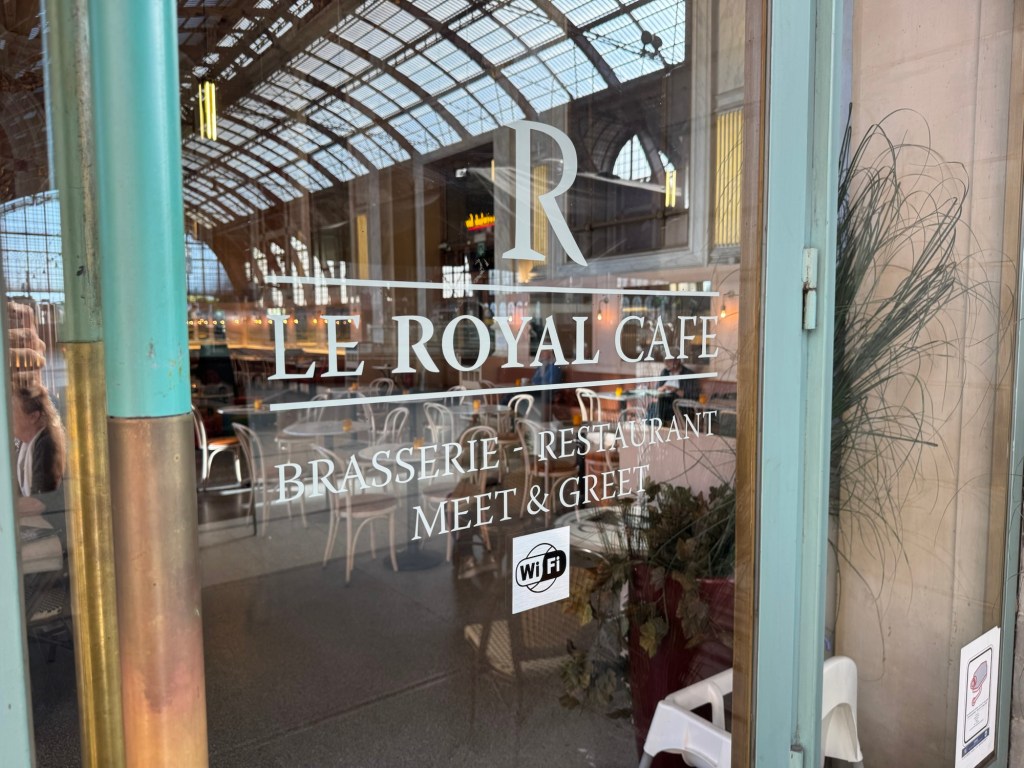
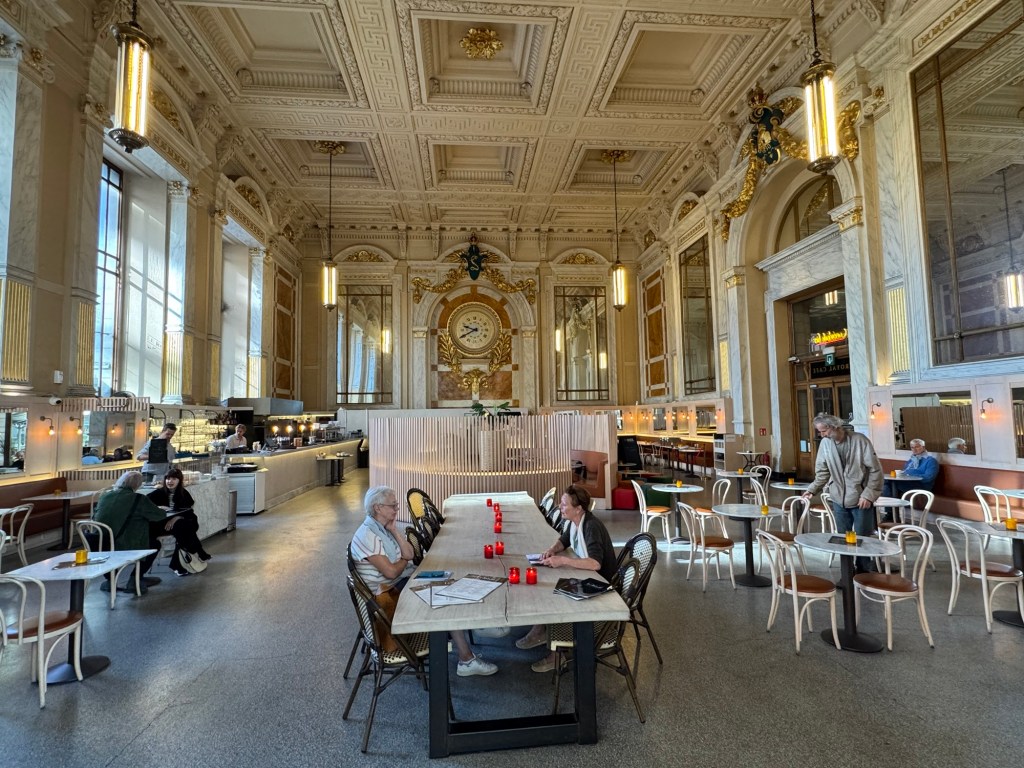
There is an entrance hall that appears to have integrated the fronts of palatial houses as its walls. Crowned by a sky-scraping, domed roof that would be the envy of any clerical building, it is currently been used as a concert hall. The not ordinary, but ‘royal’ railway café, might still serve coffee but has the appearance of a 19th century ballroom.
Dorian marble columns and in the main hall of the railway station, a huge freely suspended roof of glass and steel and delicate ornaments along the walls, elevate the transient traveller here to fleeting royalty and transform the food vendors, the waiters in the cafes and the ticket sellers to their willing courtiers.
Ruling this never ceasing cortege with an iron fist, are golden rimmed clocks, high up on the ceilings of all of these rooms. Without mercy the seconds on the clocks are ticking away and when the hour is struck, even the longest cup of coffee has to find its end…
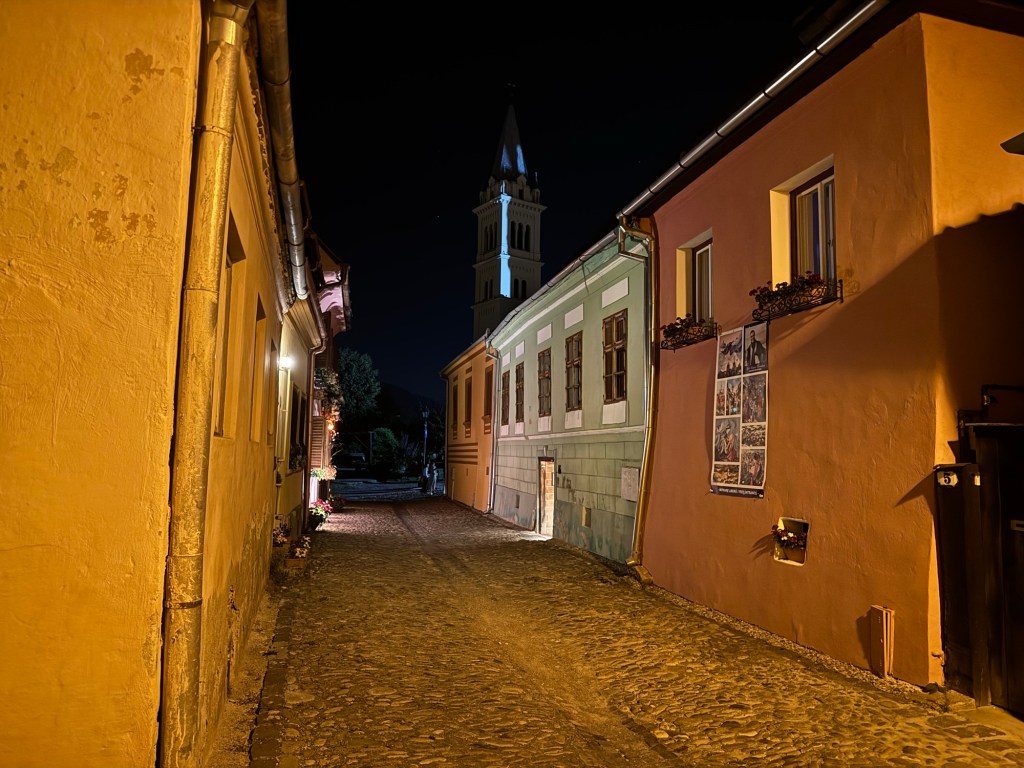
The last bar had just closed and with the streets now deserted, I took a stroll through a world that had disappeared over a hundred years ago, in a place that was so charming and peaceful, that it provided the canvas for one of history’s most chilling narratives…..
I was in Sighisoara, one of a ring of seven fortified medieval towns in the lush hills of Transylvania, in the heart of Romania. Sighisoara and neighbouring towns like Sibiu and Braşov are unusual, because they were part of a network of German speaking settlements of Transylvanian Saxons, deep in the East of Europe, that were frequently attacked and often raided and from time to time ruled by Tartars or Ottoman invaders. As a consequence of centuries of geographic isolation, these communities developed their very own customs and traditions, which might have appeared to a visitor from the other side of the Continent as more quintessential German than Germany itself.
In addition to this, due to a combination of local autonomy and a lack of funding during the communist time, the local buildings and infrastructure enjoyed a period of fairytale sleep, where most of the historic Saxon dwellings were neglected, but remained untouched and were thankfully not replaced by the functional but characterless architecture of that time.
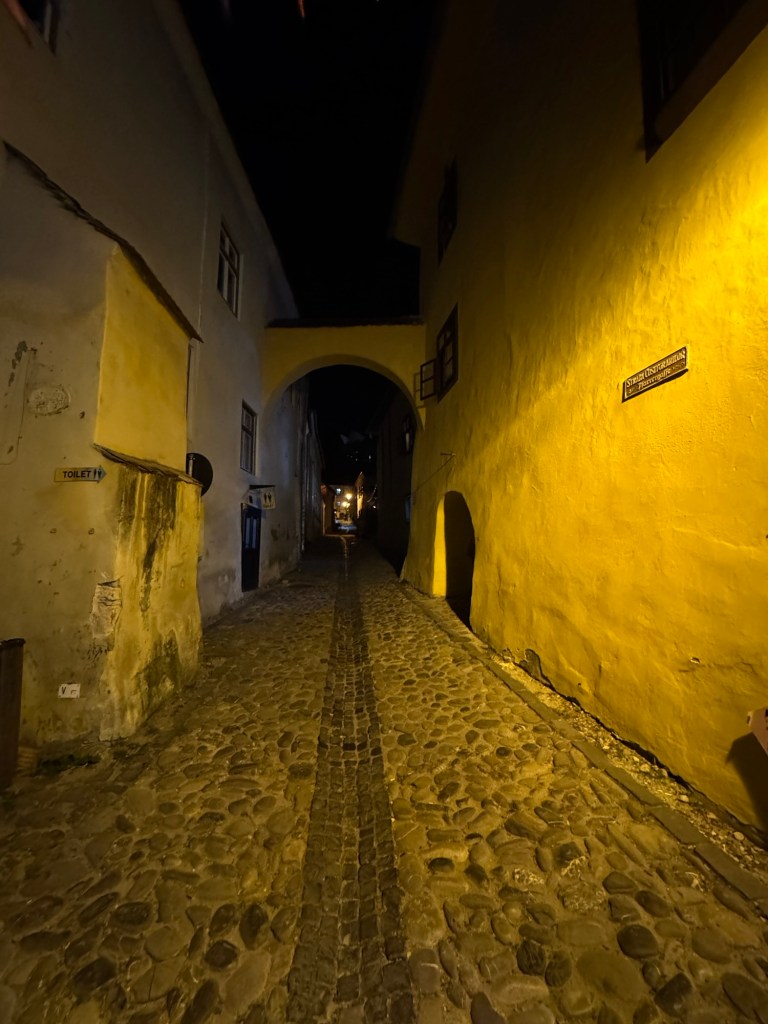
As a result of this, I found myself standing on a dimly lit cobblestone street in a German town, somewhere in the middle of the 19th century….
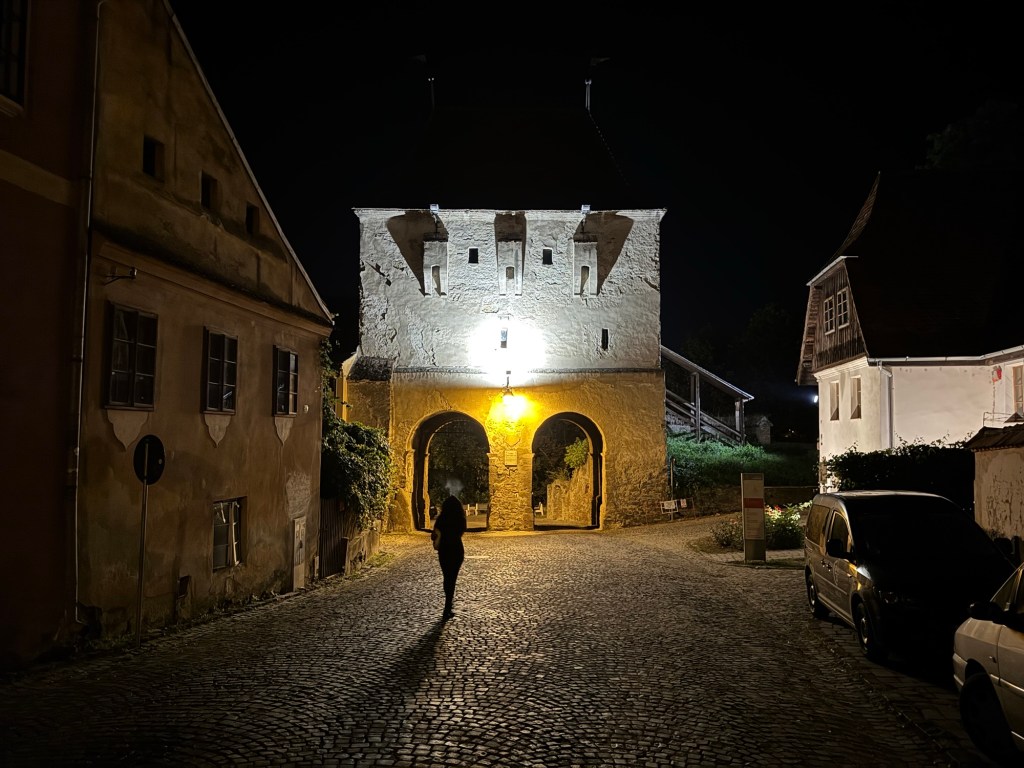
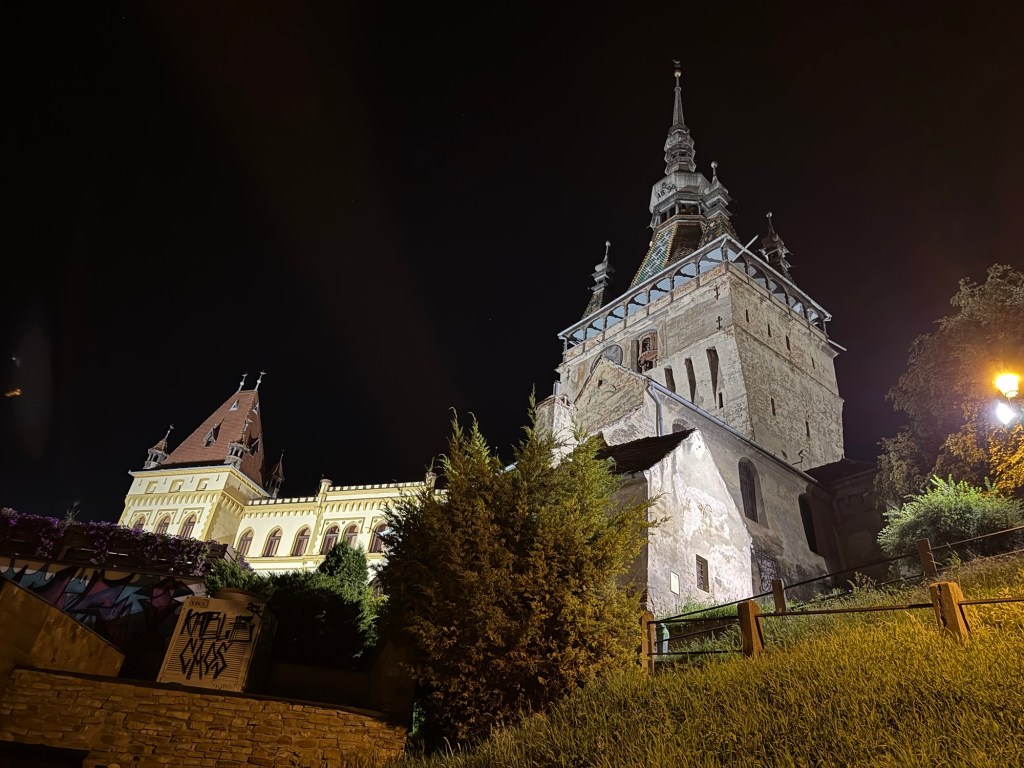
On the street corners were German street names in Gothic script, the town was surrounded by medieval gate towers that were assigned to individual guilds and an impressive clock tower with an elaborate pattern of roof tiles and fitted with multiple spires was next to a town square where every house was carrying a reference to a Saxon name.
This cocktail of German and Balkan trades and traditions, combined with the questionable heritage of being the birthplace of one of medieval’s most vile war lords – Vlad “The Impaler”, better known as Count Dracula – must have felt so utterly alien to an Irish novelist and to his readers living thousands of miles away on the other end of the continent at the outgoing 19th century, that it became the opening scene of a narrative that, together with Mary Shelley’s “Frankenstein” and Victor Hugo’s “Hunchback of Notre-Dame” enjoys a seemingly never ceasing popularity – even today.
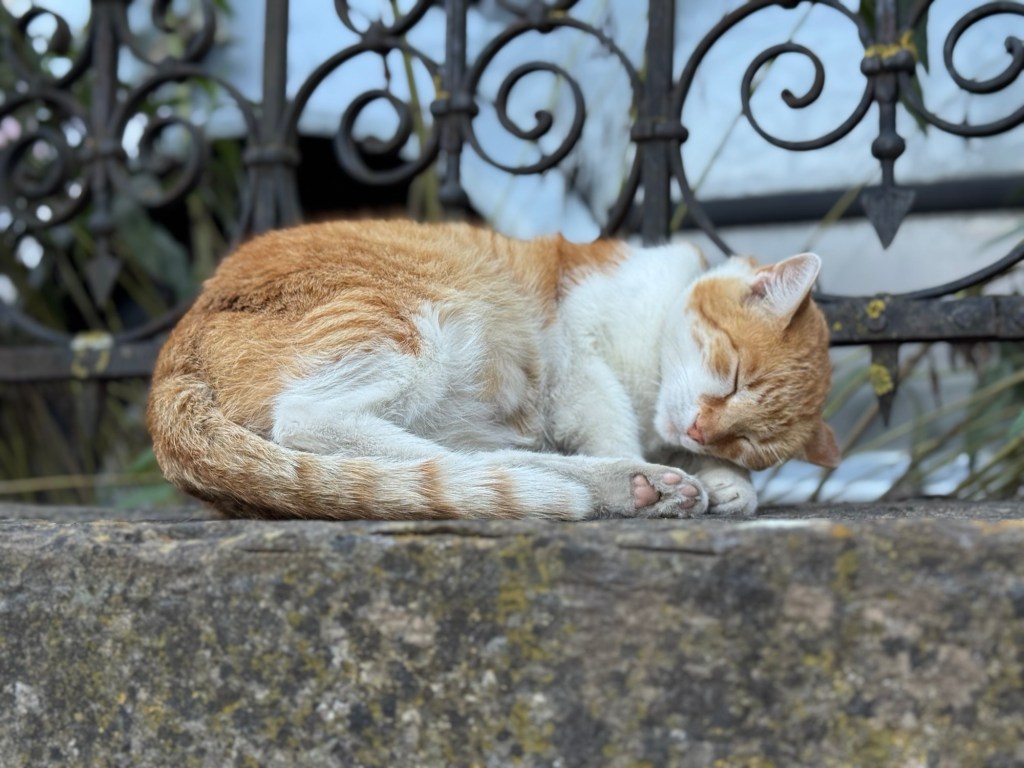
Bram Stoker never visited Sighisoara, but the medieval streets, devoid of people in the middle of the night, the deserted covered staircase leading up to a gloomy church on a hill and to a graveyard filled with ancient Saxon tombstones, overgrown with moss and neglected for decades, with an evasive cat as the only living being in sight, would indeed have been an unsettling destination for a lonely visitor from London, not familiar with the language or with the local customs.
Stoker’s novel struck so many points of unease and preconception about this part of the world: languages no one understood or really couldn’t be bothered to learn, the mentalities of the Balkan that were so different from that of a privately educated Anglo-Irish university graduate of that time, communities of people who lived isolated in a mountainous location, surrounded by forests that were the home of bears and wolfs, animals extinct on the British Isles for centuries and in addition to this the hidden threat of something unknown und unspeakable, that had the ability to strike a chord with the paranoia of the British soul like an epidemic of rabies.
For me, the flighty cat on the church yard remained my only encounter with a creature with prolonged canines that night, and returning to my car the next day, it became clear that these descendants of the infamous Count were even able to enjoy their well deserved rest in broad day light without vanishing into a cloud of smoke….
I realised that it had been a mistake to pass the last petrol station on the fertile plain near Sibiu, before starting the long ascend along the Transfăgărşan Road, which is crossing the Transylvanian mountain range from the North to the South. The forecasted 150 km of reach, the fuel gauge had indicated, had melted down to just 45 km, with the nearest petrol station on the other side of the pass still over 60 km away….
I had driven the whole day from a mountain camp in the North of the country near the border to Ukraine. The gathering had been organised by Alex Bogdan Vitalaru and an enthusiastic group of Romanian veterinarians. For a whole weekend I had thoroughly enjoyed their company and particularly Alex’ guitar playing while sitting around a campfire. I was still humming to myself the melody of the song of Andrii Popa, Romania’s own version of Robin Hood, when suddenly a dark shadow appeared from the side of the road, trying to cross right in front of my car – a bear !
Not huge, but still probably 150 kg of fur and muscles, I certainly didn’t want to hit….
Thankfully, I had closed all the windows, and I considered myself lucky for not sitting on a motorbike or – even worse – on a bicycle.
The mountains of Transylvania have some of the highest density of brown bears and wolfs in the whole of Europe. Direct encounters with these large predators are becoming now more common and reports of even fatal attacks feature more frequently in the news.
After deciding that I, surrounded by a reassuringly thick layer of steel and glass, would be “too much work” for a decent dinner, the bear crossed the road and disappeared back into the forest.
Only 40km of fuel left…..
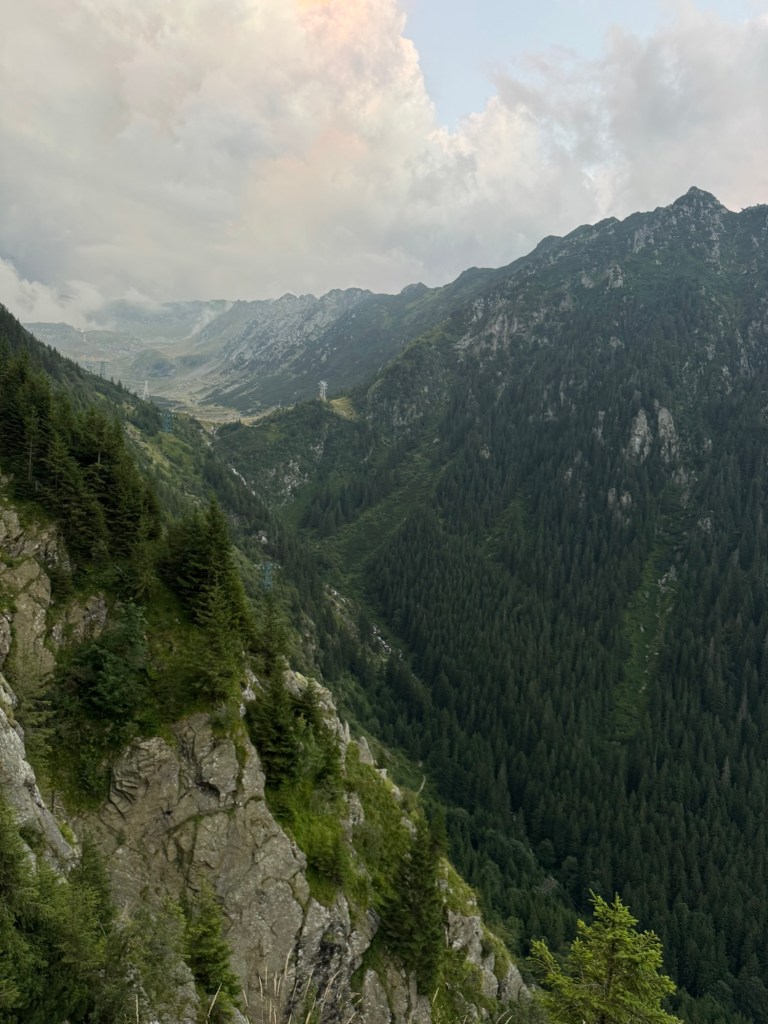
The road continued to climb and eventually I passed the tree-line. The vegetation was reduced to frost and wind resistant low growing shrubs and sharpe edged battle hardened grass, which only the toughest of ruminants were able to digest.
The temperature had dropped significantly and as the last daylight was fading, light rain was starting to fall.
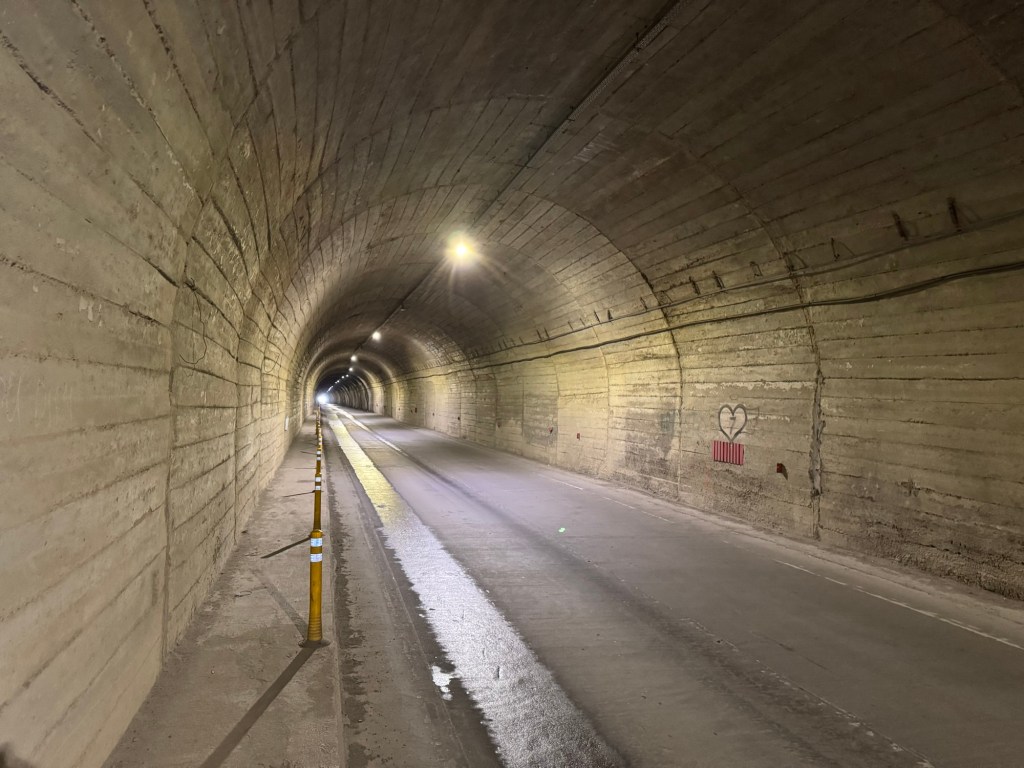
Eventually I reached a poorly lit tunnel, just below the central ridge of the mountain, that was connecting the Northern to the Southern side of the massif.
Emerging from the other end of the tunnel, I finally parked the car and from here it was now just a short hike in total darkness to reach the small refuge.
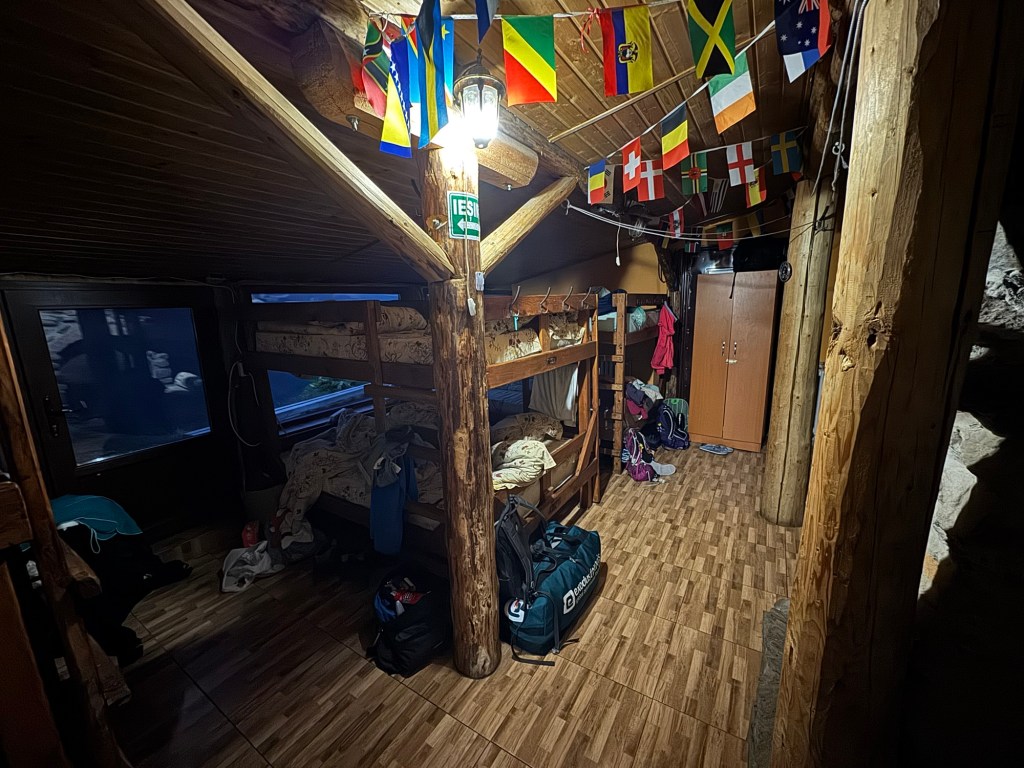
Passing then the closer inspection of a guard dog, that was not much smaller than the bear I had just seen, I entered the battered cabin and found out that I was in luck after all: there was not only a spare bed for me in one of the dormitories,
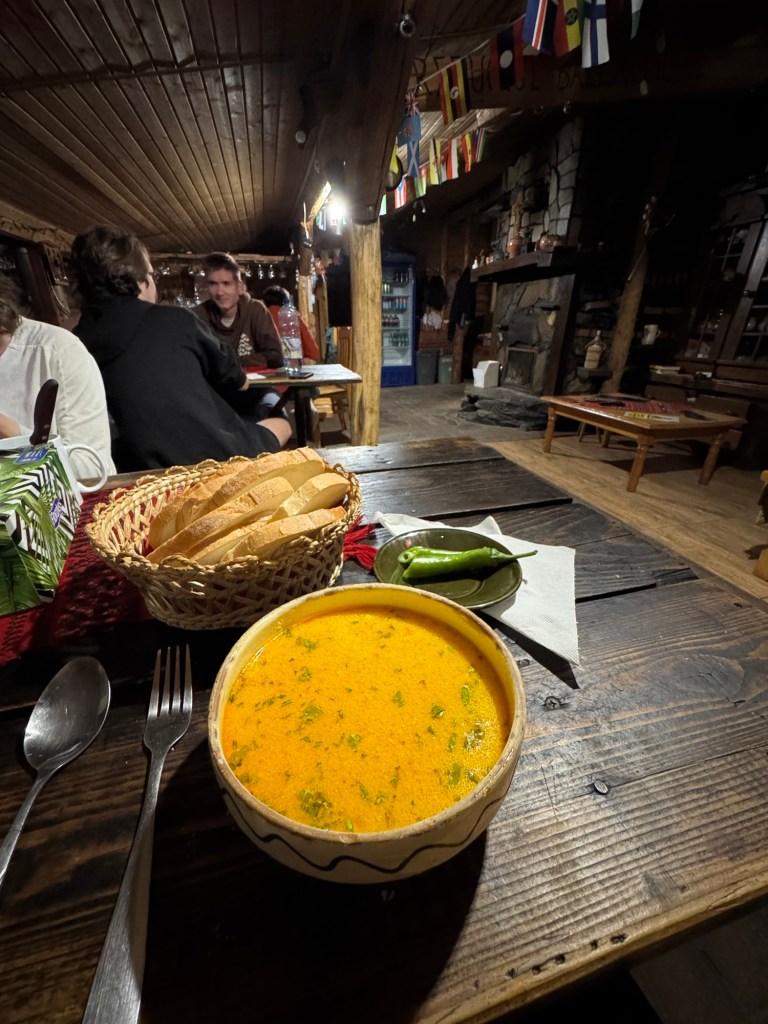
there was even a cold beer and a hot soup waiting for me, before turning in for the night.
When I woke up the next morning, the clouds were hanging low over the mountains and it was still raining. While the hospitality at the hut had been great the previous night, it seemed to have run out of steam in the presence of early daylight. The fair this morning was some dry bread, an egg without salt and some plain cheese that had the texture of rubber, all washed down with some lukewarm instant coffee without milk. When I asked to get my thermos flask filled with some hot water and the manageress just took it to the kitchen sink turning on the warm water tap, I realised that it was time to leave….
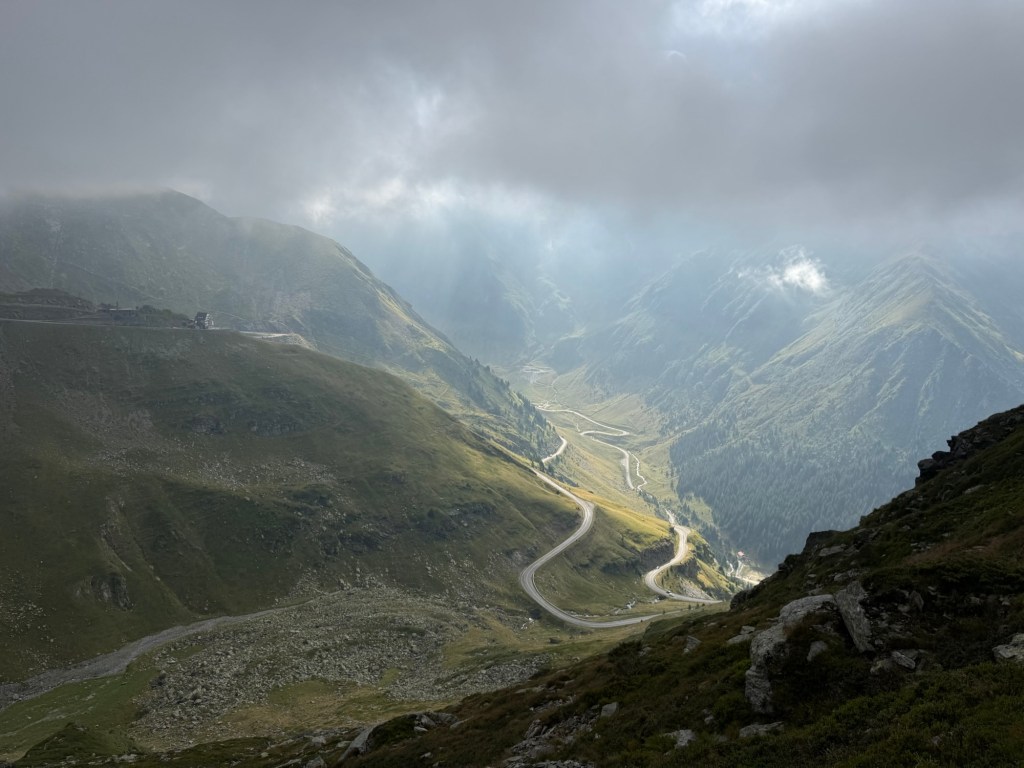
Passing the now chained guard dog, which in day light looked much smaller than previous night, I ventured into the misty tundra landscape and found myself alone on a small path, while below me the road, filled with cars and motorbikes, meandered its way up the southern slope, with only individual rays of sunlight breaking through the thick cloud cover.
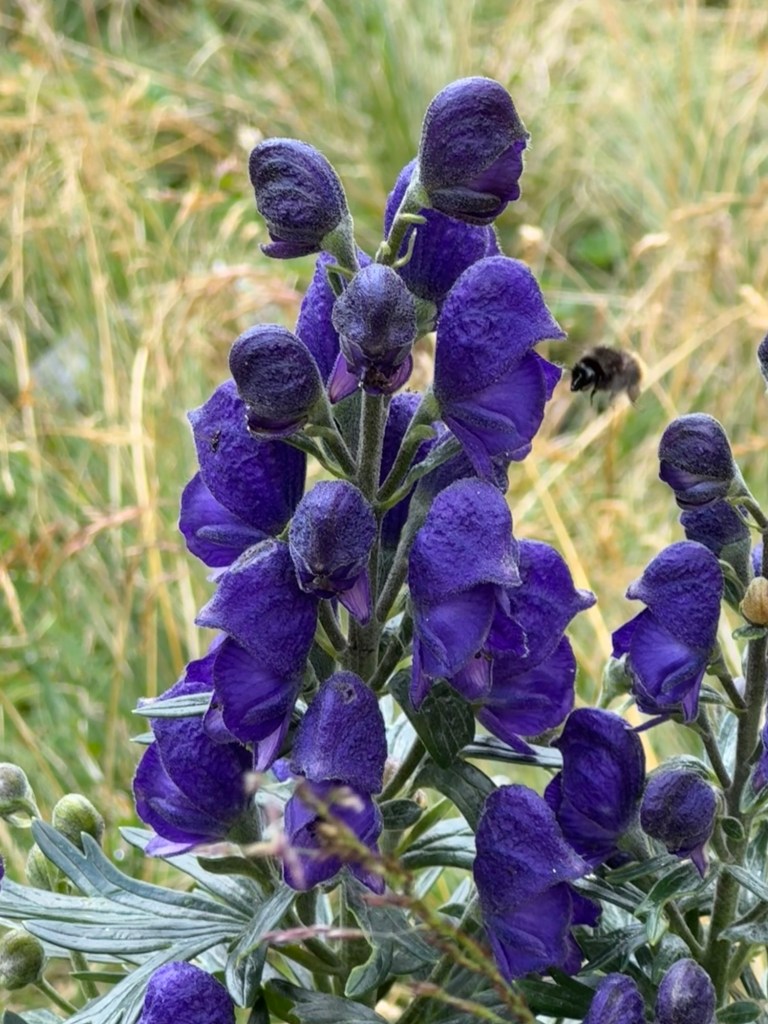
Being less than a mile away from the tunnel and the road, I was in complete peace and there was not a single sound around me. Next to the path I noticed beautiful blue aconites, that were frequented by industrious bees and more clumsily operating bumble bees.
I was just starting to enjoy the sensation of freedom and tranquillity, only the high mountains or the open Sea can give, when I noticed a movement next to a rock in front of me.
Rearing its head, completely covered in a thick coat of brown fur, moving the next moment at considerable speed straight towards me and coming to a halt just a few meters away, displaying a fine set of long and yellow front teeth…….was a…marmot…. that had clearly not been prepared for a visitor at this early hour…..
An earsplitting, high-pitched screech was to follow, before the large rodent disappeared into its nearby burrow.
Once I had rounded the side of the mountain, the path descended slightly into a small green valley, with a small stream running right through the middle of it. On the other side of the valley I first heard, then saw a large flog of sheep. The bleating of the livestock was occasionally augmented by the barking of a dog and I instantly knew that I had to give this seemingly peaceful setting a very wide berth.
The valley was eventually crossed without getting mauled, and then another mountainside had to be rounded before the final ascend was right ahead of me.
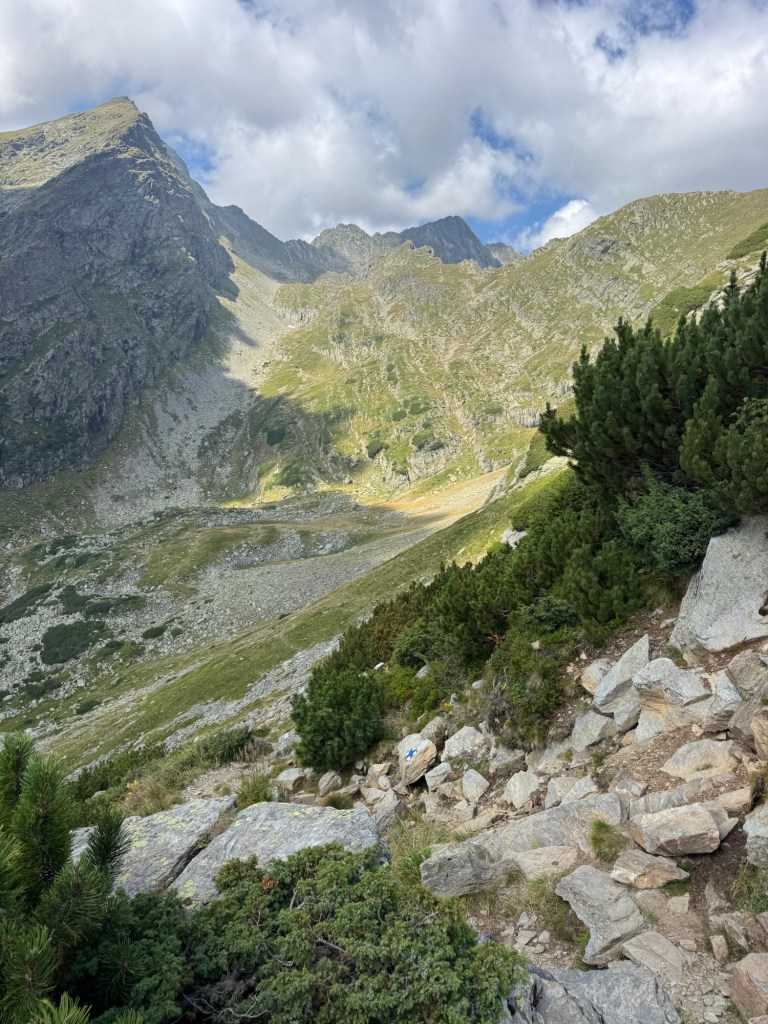
Now the path zick-zacked its way relentlessly up towards the ridge and to the only slightly higher summits of the Transylvanian mountain massif.
Finally I was standing next to a small lake – the sad remainder of another long disappeared glacier – and just a few meters away from it, was the destination of this solitary hike – the probably ugliest mountain shelters you will ever come across….
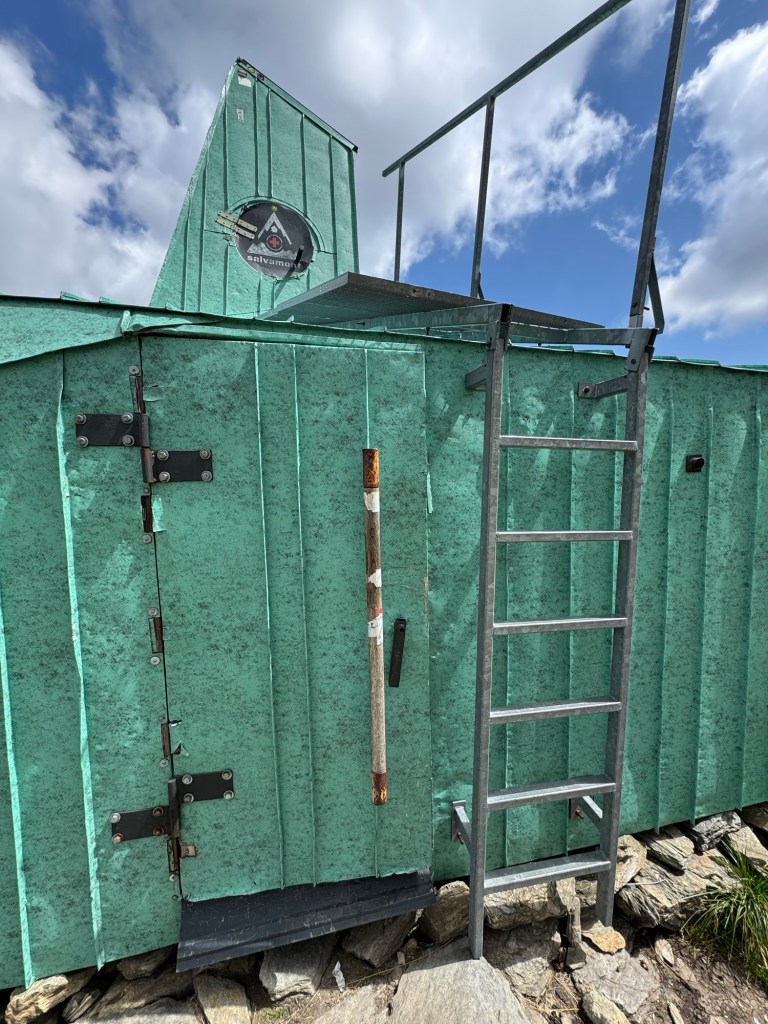
Something that resembled a crude hybrid of an oversized turquoise plastic dustpan and an illegally parked combine harvester with a large handle on it’s roof, had taken center stage on a small plateau.
One could only assume that numerous distinguished design prizes must have been won with this extraterrestrial looking object.
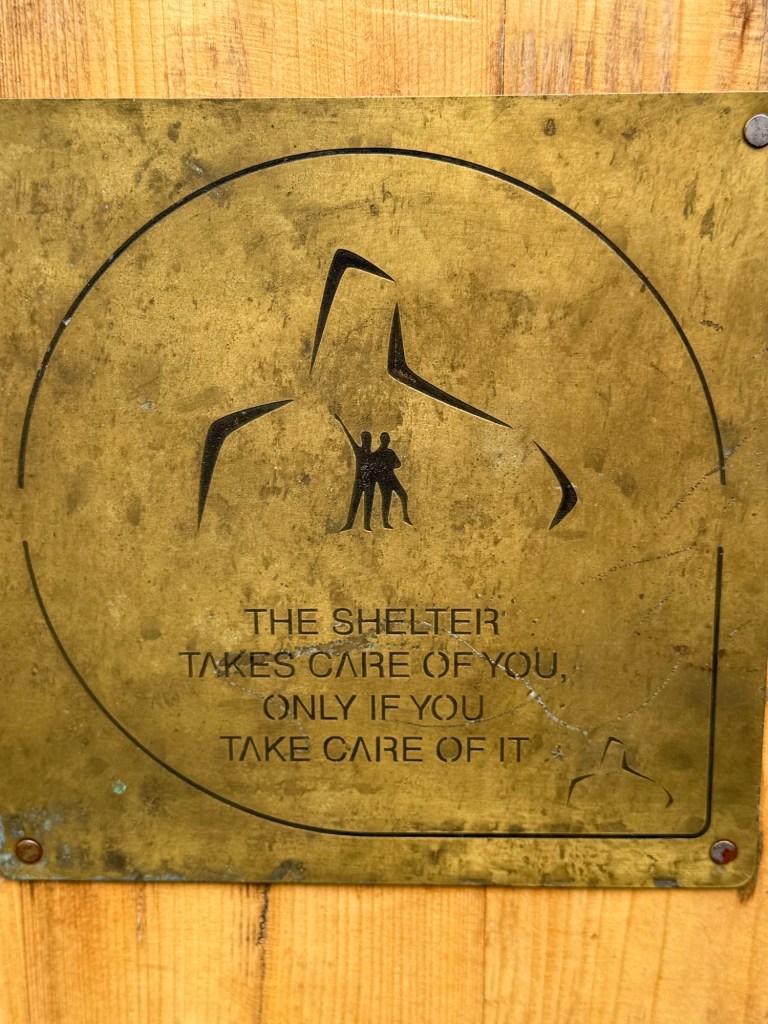
Yet, the structure had an unlocked door and offered a place to rest after an eventful hike in Transylvania.

























































 The Blue Vet Diary